Introduction
Enlightenment sculpture presents its argument through the human face. Where Baroque sculptors captured the body at the twisting, transforming, ecstatic instant of overwhelming physical and spiritual crisis, Enlightenment sculptors focus on the face as the site of character, reason, and social identity. The portrait bust becomes the period’s defining sculptural form: a head and shoulders, rendered with unflinching specificity, asserting that this particular person’s mind matters.
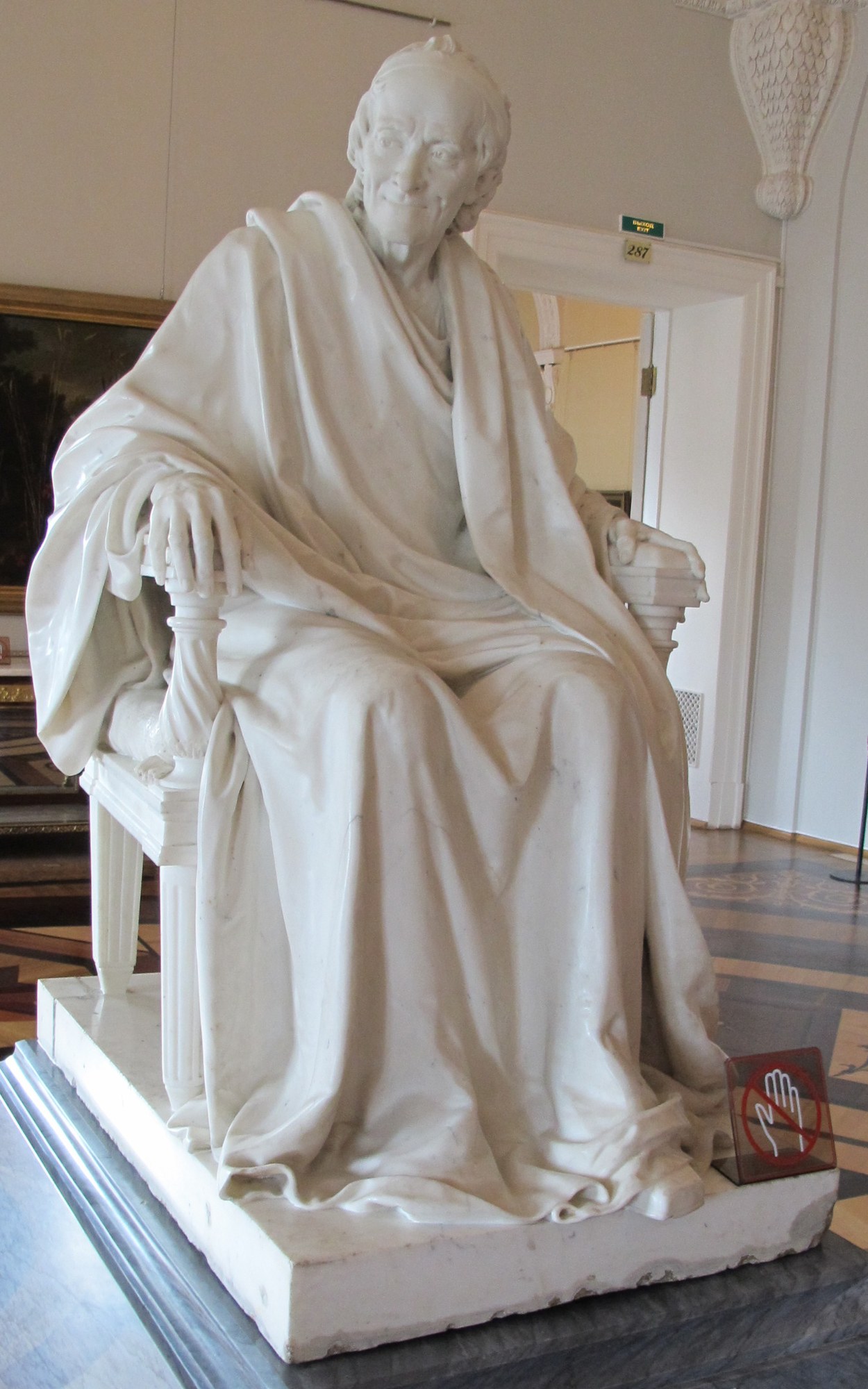
The presiding genius of this development is , whose portrait busts of Voltaire, Franklin, Jefferson, Washington, and Rousseau constitute a kind of sculptural encyclopedia of Enlightenment thought. Houdon did not merely reproduce likenesses; he produced character studies — faces in which one can read the quality of the mind within. His Voltaire is the period’s supreme achievement: an old man’s body in a Roman toga, alert eyes beneath an ironic brow, the whole figure radiating the sardonic intelligence that had discomfited kings and bishops for six decades.
Pride and Prejudice is a novel about exactly this kind of legibility — about whether a face, a manner, a first impression reliably reveals the person behind it.
Body & Volume
How does the sculpture render the human body in three dimensions — idealized, naturalistic, fragmented, abstracted?
The Enlightenment body in sculpture is disciplined and controlled — neither the medieval figure’s subordination to theological program nor the Baroque figure’s explosion into physical crisis, but something more measured and socially legible. Houdon’s portrait subjects are rendered with remarkable specificity: the loose skin at Voltaire’s throat, the sharp alertness of his eyes, the slight forward inclination of the body that suggests a mind perpetually engaged. This is naturalism in the service of character revelation. Accuracy is conveyed not as an end in itself but as a way of making the inner life visible on the outer surface.
’s approach is the counterpoint. His Psyche Revived by Cupid’s Kiss achieves a surface so refined, so smoothly idealized, that it seems to transcend individual bodies altogether. These are not particular people but perfected forms, the classical ideal recovered and polished to an impossible smoothness. Where Houdon insists on the individual, Canova insists on the type. Both are Enlightenment gestures: one says that the particular rational individual deserves to be seen clearly; the other says that beauty, like reason, tends toward the universal and the ideal.
Connection to Pride and Prejudice
’s novel is organized around the problem of reading faces — whether surface manner reliably reveals inner character. Wickham’s is the face that performs perfectly: handsome, open, agreeable, he produces exactly the impression he intends. Darcy’s face is unreadable in a different way. His expression, which Elizabeth reads as proud contempt, turns out to conceal a complex emotional life. The novel’s great question is whether the Enlightenment premise that careful, rational observation of surfaces yields reliable knowledge of what lies beneath holds up in the social world. Houdon’s portrait busts argue that a social observer can study the face long enough, with enough honest attention, and character will reveal itself.
Material & Making
What does the choice of material say about the work’s ambitions and its culture?
The Enlightenment sculptor’s turn to classical antiquity as a model is not mere nostalgia. The German art historian , whose Thoughts on the Imitation of Greek Works (1755) became the theoretical foundation of neoclassicism, argued that ancient Greek sculpture represented the highest achievement of human art precisely because it was the product of a rational, free society; modernity can recover that achievement only by recovering those social conditions. The implication was radical: great art is not a matter of divine inspiration or individual genius alone. It is best regarded as the product of an entire culture that values freedom and reason.
Canova absorbed this argument completely. His marbles are worked to a finish that makes Bernini’s illusionistic virtuosity look almost rough by comparison — surfaces so smooth they seem lit from within, forms so idealized they suggest that the sculptor’s task is but to reveal an ideal already present in the stone. The material ambition is neoclassical perfection: not marble pretending to be flesh (the Baroque approach), but marble achieving a beauty that transcends the distinction between stone and skin.
Connection to Pride and Prejudice
Winckelmann’s argument — that artistic achievement is the product of rational, free social conditions — has a counterpart in ’s portrait of Regency society. The novel insists that genuine virtue, like great art, cannot be produced by systems of mere constraint and performance. Lady Catherine’s world, in which rank substitutes for character and social position does the work of moral authority, produces Mr. Collins — a man so thoroughly formed by deference that he has no self left with which to exercise judgment. What Austen’s characters who grow and change share with Winckelmann’s Greeks is the capacity for free, rational self-examination.
Space & Setting
Where does the sculpture live, and how does placement shape meaning?
Houdon’s busts went everywhere that Enlightenment thought traveled. Voltaire’s likeness presided over the Comédie-Française; a terra cotta version circulated among salons and libraries across Europe. Jefferson commissioned a life-size standing figure for the Virginia State Capitol — the first such civic monument in the new republic, deliberately modeled on a Roman senator to argue that the American experiment was the heir to classical republican virtue. Franklin and Rousseau were similarly multiplied and distributed; to own a Houdon bust was to announce your intellectual commitments, to align yourself publicly with the values of reason and rational governance.
This is sculpture functioning as argument in domestic and civic space. The cathedral’s total theological environment (which located the viewer within the cosmos whether they consented or not) is replaced by a voluntary, personal statement. The drawing room or library where a Houdon bust sat was a space of rational sociability — conversation, correspondence, debate — and the sculpture was a participant in that conversation, a reminder of the values that the room’s inhabitants were trying to embody.
Connection to Pride and Prejudice
’s world is saturated with this kind of spatial argument. Pemberley’s portrait gallery — where Elizabeth encounters Darcy’s likeness and begins to revise her judgment of him — operates on exactly the principle of Houdon’s portrait busts: a face rendered with honest specificity, encountered in a domestic setting, producing a reassessment of character. The portrait “had a striking resemblance to him, with such a smile over the face as she had sometimes seen when he looked at her.” Situated in his own estate, the painting humanizes Darcy in a way that the social performance of the Netherfield Ball could not.
Looking Back
Baroque sculpture conceived the body as a site of crisis — twisting, ecstatic, overwhelmed. Enlightenment sculpture disciplines the body back into legibility: a face that reveals character, a posture that announces civic identity, a surface that repays patient rational attention. The shift from Bernini to Houdon is the shift from a world of figures caught up in forces larger than themselves to a world in which the individual, examined carefully and honestly, is the measure of manners and character.
Looking Forward
Romanticism will find the Enlightenment’s rational surface insufficient. Houdon’s faces reveal character through careful observation, but Romantic sculpture will ask about what observation cannot reach: the inner life of feeling, the body under the pressure of passion and grief rather than the pressure of rational self-presentation. Rodin’s figures will abandon the Enlightenment’s legible social surface for something rawer and more interior. The unfinished marble — the figure still half-emerged from the stone, as if the sculptor has caught a private moment of becoming rather than a public moment of being — will replace the polished neoclassical ideal.
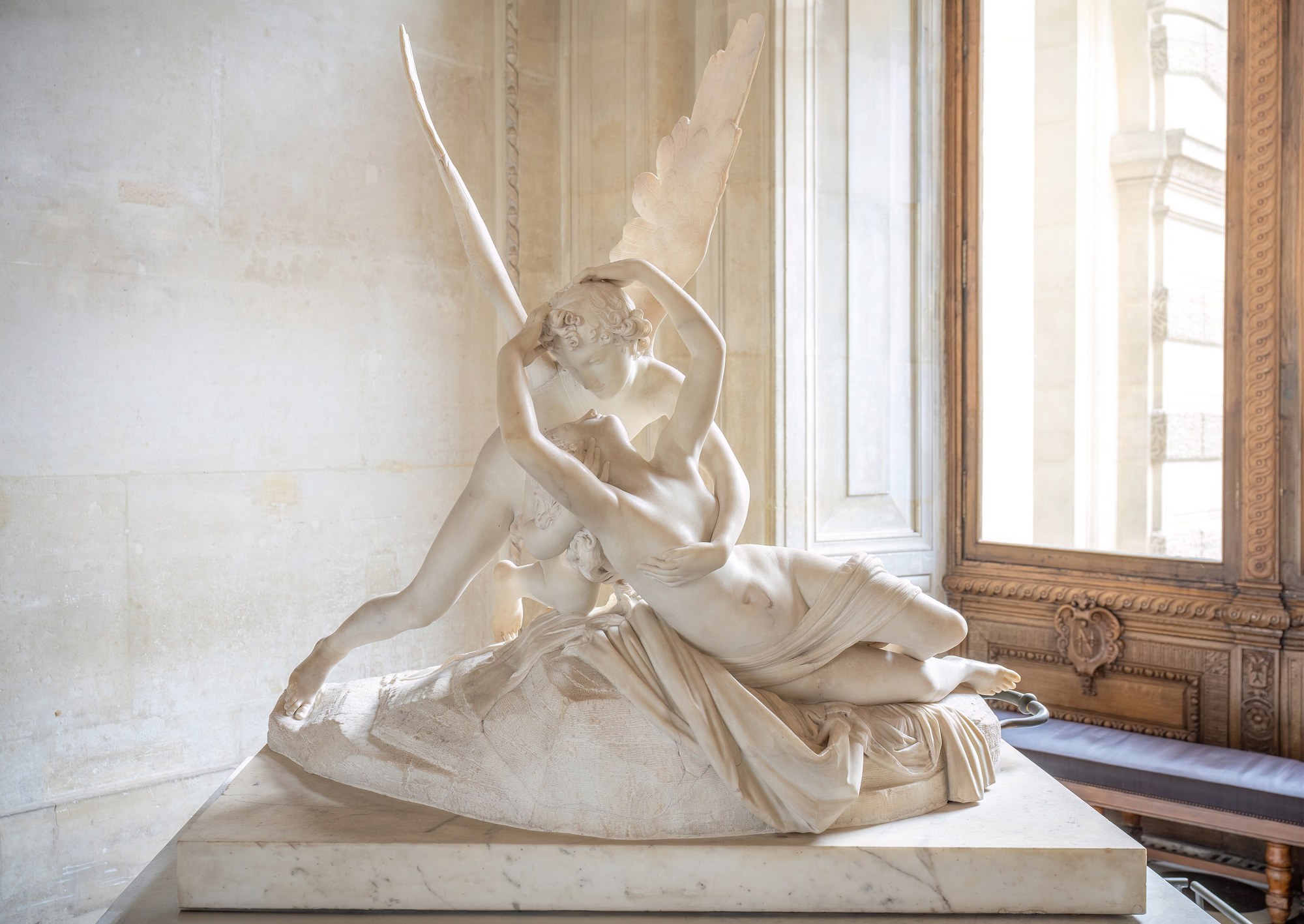
Look at how little the two bodies betray of individual identity — these are not portraits but perfected types, the human form lifted toward an ideal. The composition is built on a gentle diagonal, Cupid's wings and arms forming a frame that draws Psyche's reviving body up into his kiss. The marble is polished until it seems to become skin; the drama of the Baroque has quieted into something restrained, tender, and self-contained. Compared to Bernini's writhing Daphne, this is emotion held under perfect rational control.
Where Houdon fixes a specific mind in time, Canova lifts the body out of time entirely — the universal over the particular.