Introduction
Medieval painting can seem alien to modern eyes, but becomes coherent with an understanding of its assumptions. These painters were simply not interested in realism. Their goal was to make the invisible visible, depicting spiritual truths that transcend the physical world with paint and gold leaf.
Hamlet is set in a world whose visual imagination is still Medieval. The court at Elsinore — hierarchical, rank-ordered, organized around the symbolic weight of the king’s presence — is the world these paintings depict made architectural. “Reading” Medieval painting alongside Shakespeare’s play makes visible the Christian spiritual values that Hamlet can never simply accept without questioning unease.
Figure & Space
How is the human figure placed within the pictorial space?
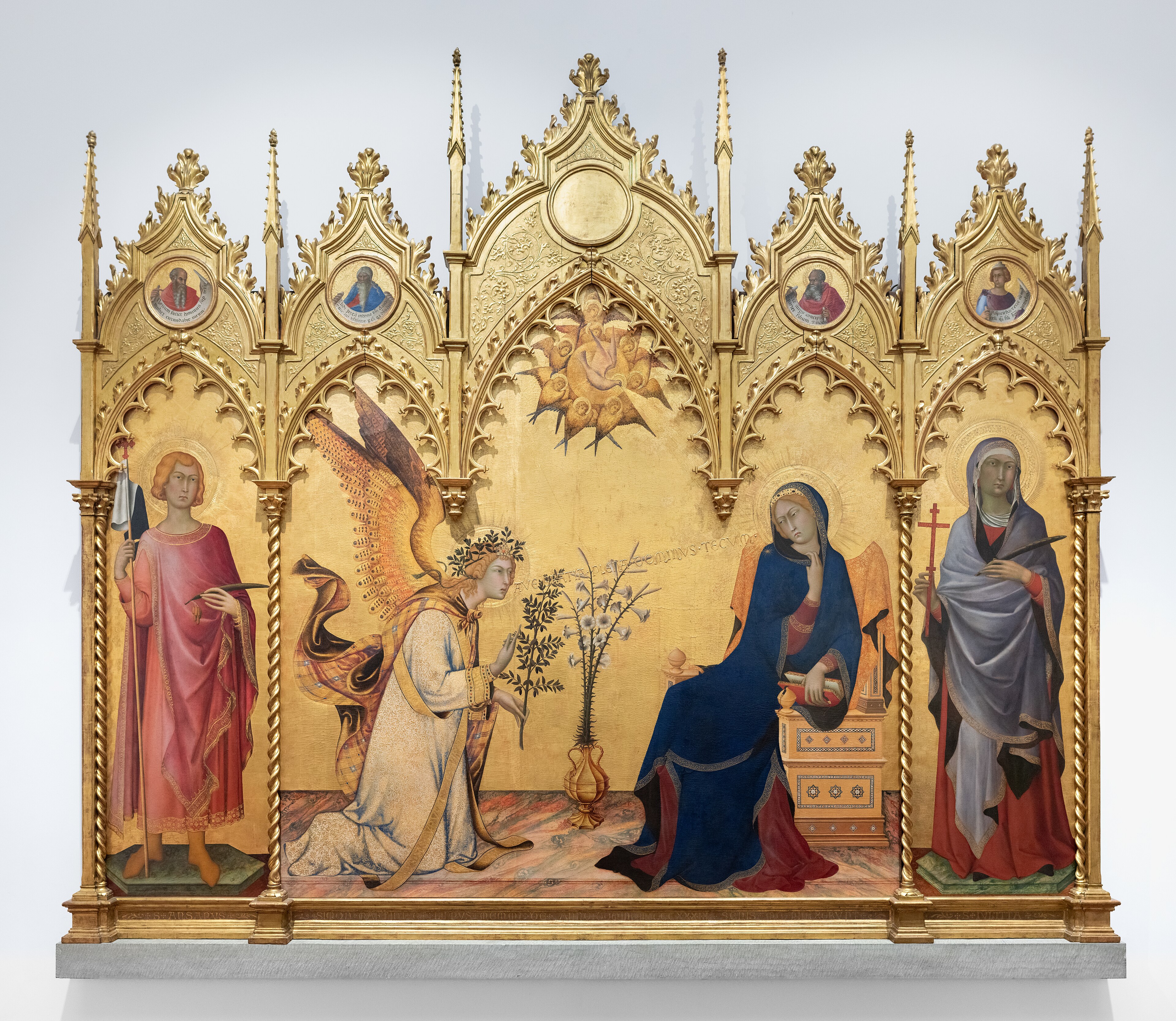
Medieval figures exist against flat backgrounds, often embellished with shimmering gold leaf meant to represent divine light, the radiance of heaven. There is no horizon line, no vanishing point, no attempt to place figures in a measurable physical space. Instead, the hieratic scale of size indicates importance: Christ and the Virgin are larger than saints, who are larger than donors.
The absence of measurable space is not a failure of technique but a theological statement. In a universe governed by divine order, the physical world is secondary to the spiritual one. Placing figures in a realistic, navigable three-dimensional space would imply that physical location matters. Medieval painters rejected that premise. Their paintings are maps of spiritual reality, not windows onto the physical world.
Connection to Hamlet
The court at Elsinore operates on the principle of hieratic scale. The king’s physical presence — his word, his gaze, his command — organizes the space around him the way Christ’s mandorla organizes the tympanum at Autun. Claudius is not merely a man on a throne; he is the center around which the entire court orbits. Polonius, Rosencrantz, and Guildenstern exist in defined positions relative to royal authority, their significance determined by rank rather than individual perspective. The Renaissance painter will give the viewer a specific position from which to see a rationally organized world. The Medieval painter — like the Medieval court — does not acknowledge that the viewer’s position matters at all.
Light & Shadow
How does the painting use light — its source, quality, and emotional effect?
Light in Medieval painting is uniform and symbolic rather than naturalistic. It comes from no particular direction, casts no shadows. Figures exist in a spiritual realm where darkness has no purchase. The gold ground itself effectively is light — not reflected light from a window, but the intrinsic radiance of the sacred.
This flatness of illumination mirrors the theological certainty of the Medieval worldview; there are no shadows because there is no ambiguity. The world is ordered, its meaning clear, and the task of the painter is to make that clarity visible. Compare this especially to what Baroque painters will do with light in the seventeenth century — selectively illuminating, plunging vast areas into darkness, using shadow to create mystery and doubt — to feel the immense intellectual distance between the two eras.
Connection to Hamlet
The ghost appears at midnight, in darkness, on the battlements, a seemingly Baroque figure of ruined radiance emerging from shadow. But the ghost’s message is Medieval, carrying the certainty of divine revelation, the unambiguous moral clarity of a world where right and wrong are legible. The play’s anguish lies in the gap between the ghost’s Medieval certainty and Hamlet’s Renaissance inability to act on certainty alone. Medieval painting has no shadows because Medieval theology has no moral ambiguity. Hamlet is a play drowning in shadowed uncertainty, a darkness that no gold ground can dispel.
Brushwork & Surface
What is the physical character of the paint itself?
Individual brushwork is suppressed in favor of precise, anonymous craftsmanship. Tempera paint (pigment mixed with egg yolk) was applied in thin, careful layers. The artist’s personality was not the point; fidelity to a received tradition was. The act of painting was closer to devotional labor than personal expression. The smooth, icon-like surfaces reflect a world in which the individual artist’s hand mattered far less than the sacred truth being transmitted.
In every subsequent period we study, the question of whether the artist’s individual hand should be visible becomes increasingly important until, by the time we reach Modernism, the artist’s gesture is the subject. The Medieval starting point, where maker disappears into the making, is the opposite extreme.
Connection to Hamlet
The anonymous craftsman — identity absorbed into institutional role — is essentially what Polonius, Rosencrantz, and Guildenstern represent in the play. These are figures who exist to serve a function. Rosencrantz and Guildenstern are so thoroughly instruments of the court’s program that they are effectively interchangeable, just as the Medieval painter disappears into the devotional program.
Looking Forward
The Renaissance will shatter nearly every assumption of the Medieval worldview. Where Medieval painters suppressed the individual in favor of the sacred, Renaissance painters will place the individual human being at the center of a rationally organized, physically measurable world. Where Medieval brushwork effaced the maker, Renaissance technique will celebrate the artist’s rational skill. The revolution is total, and in Hamlet one can feel it happening in real time, in a character who has made the Renaissance journey in his mind but cannot yet complete it with his actions.
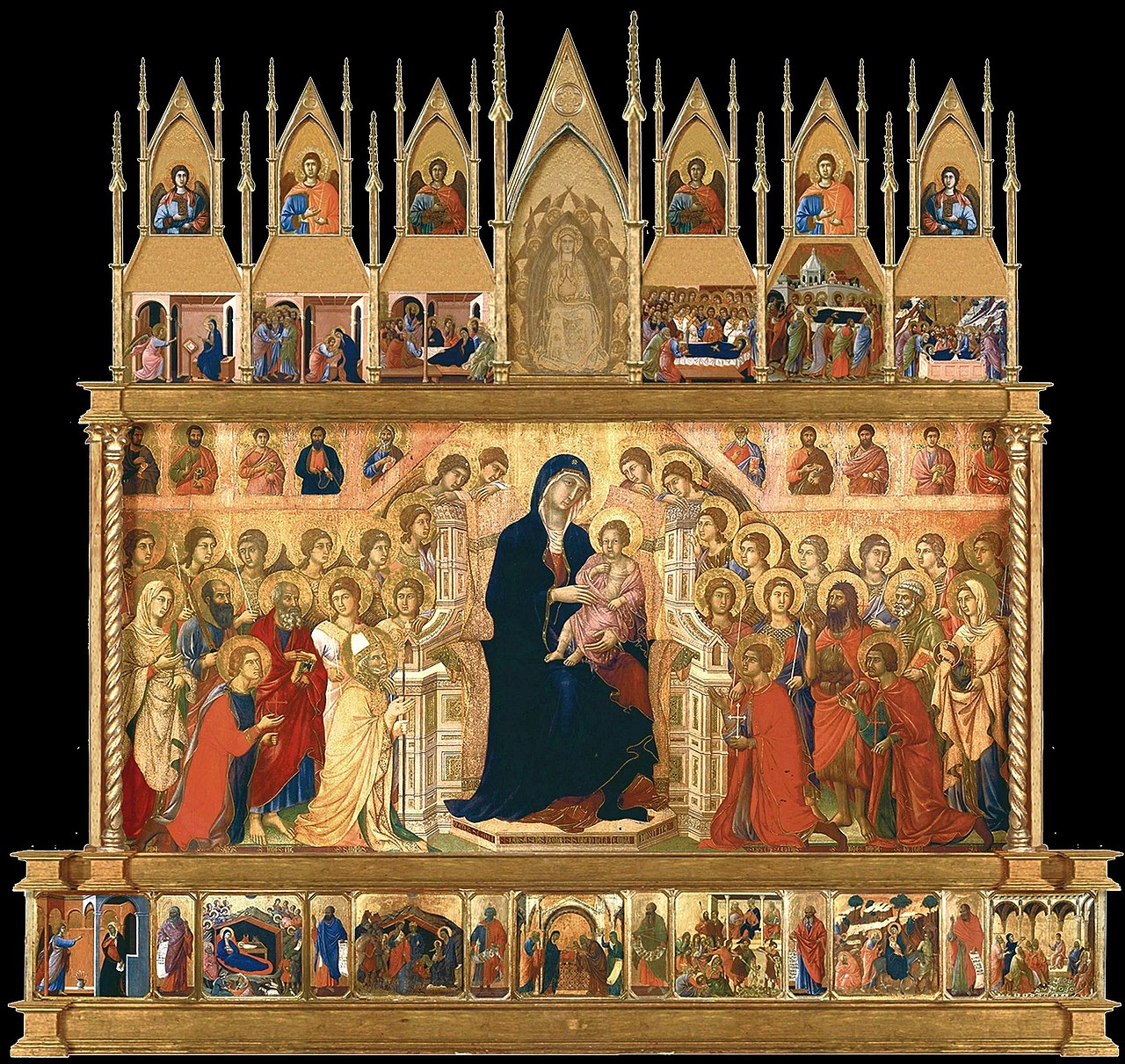
Duccio stacks the heavenly court in tiers rather than in depth. The enthroned Virgin is rendered far larger than the saints and angels ranked around her — her scale announces her rank, not her nearness to us. There is no floor receding to a horizon; the gold ground refuses physical space altogether, so the eye reads position as spiritual hierarchy.
Notice how the rows stack *upward* instead of shrinking into the distance.
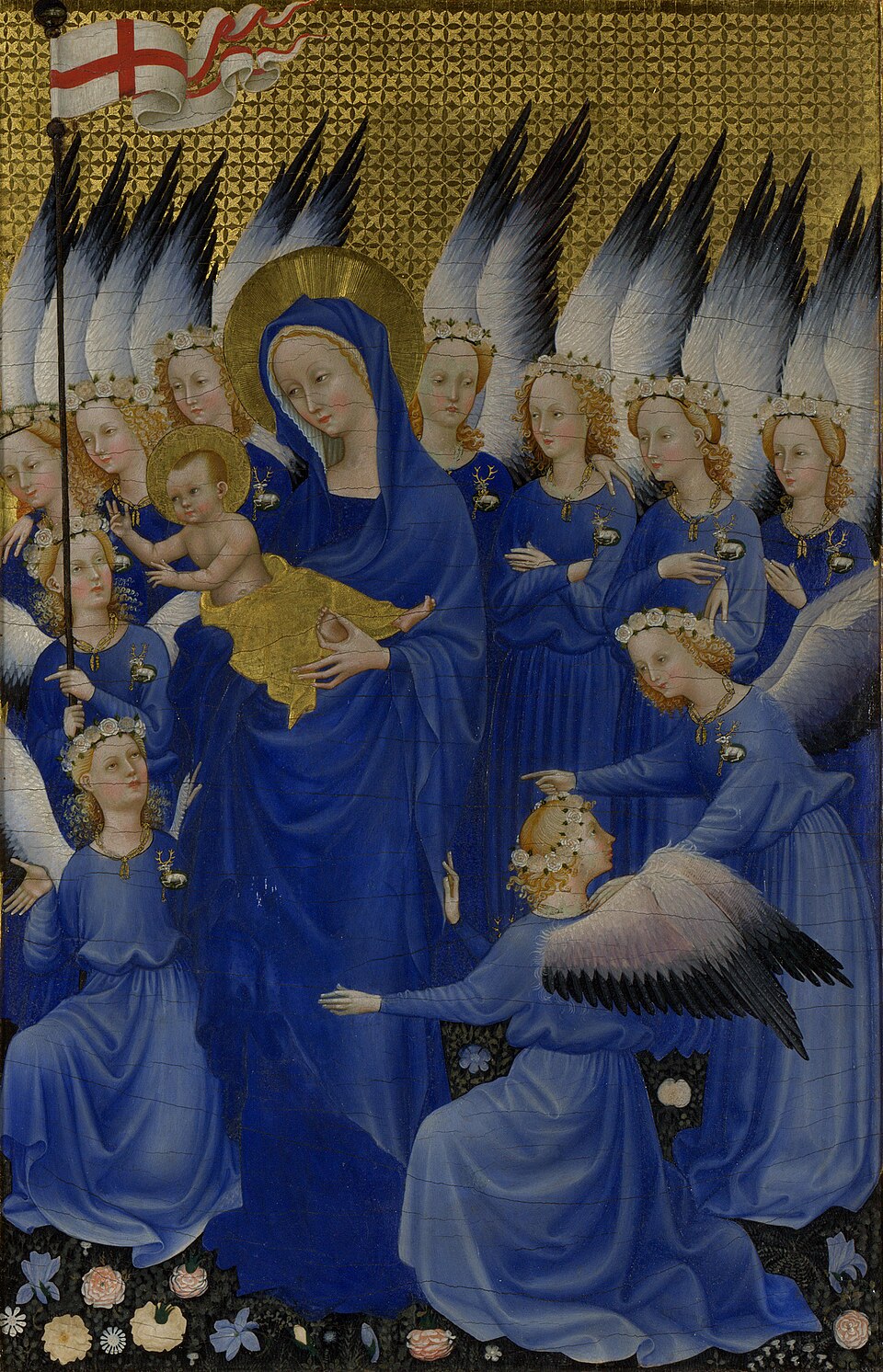
The Virgin and Child stand among eleven angels on a ground of burnished gold. The light has no source and throws no shadow — every face is lit with the same even radiance. What glows here is not sunlight but the sacred itself; the ultramarine blue and gold leaf do the work that modeled light and shade will do in later centuries.
Look for a single light source. You won't find one — the gold *is* the light.
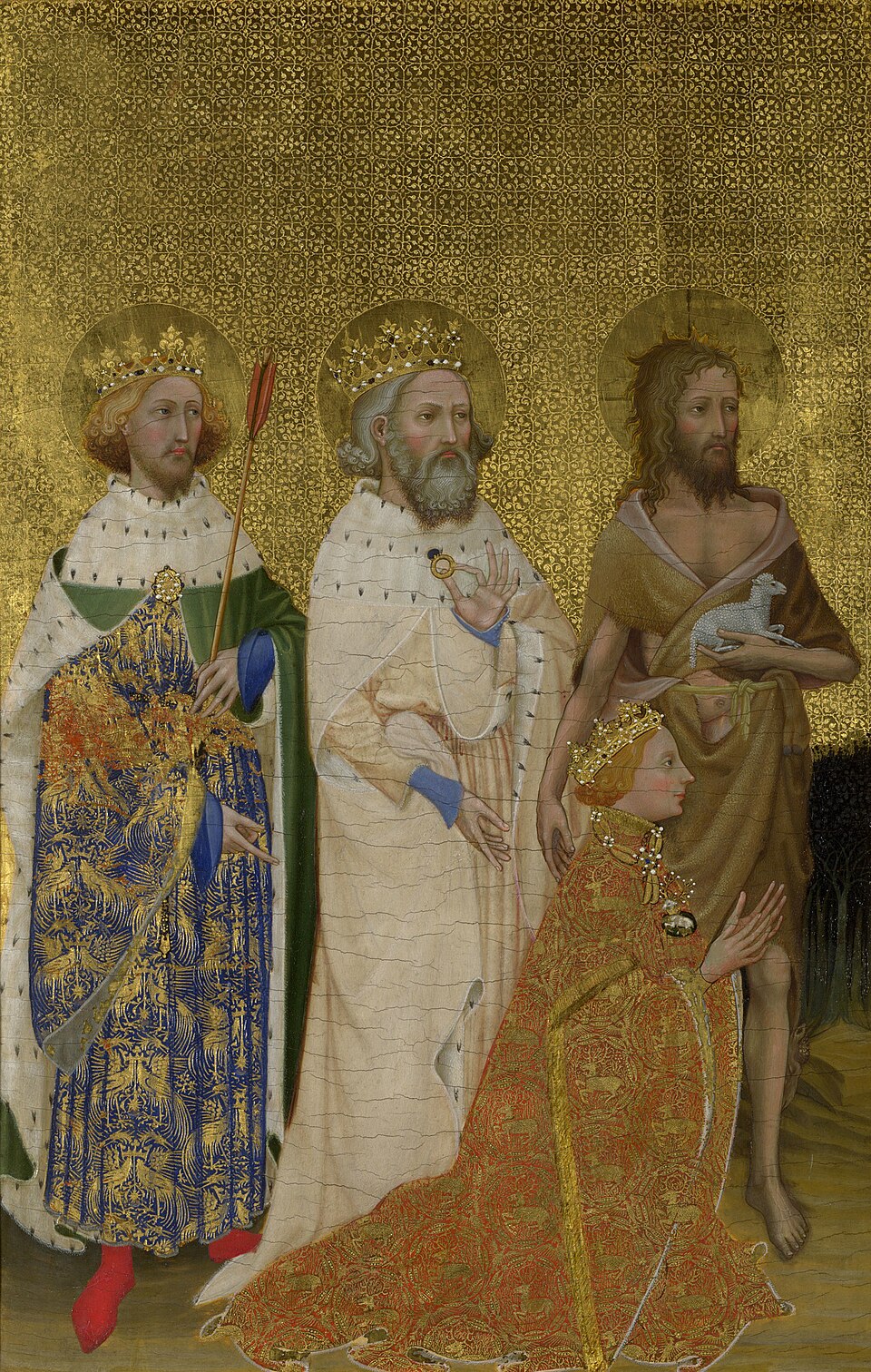
Richard II kneels, presented by three saints. The surface is smooth as enamel and the brushwork is invisible; the panel reads as a jewel rather than as a record of the hand that made it. The painter's individuality is deliberately effaced in favor of a flawless devotional finish — craft in service of the sacred, not of the maker's fame.
Try to find a single visible brushstroke.