Introduction
Medieval sculpture serves a total theological program. It exists inside, on, and as part of the cathedral, which is itself a model of the cosmos, an image of the heavenly Jerusalem made in stone. The figures on a portal are not portraits or celebrations of individual human beings; they are presences arranged according to spiritual rank, teaching doctrine through their placement, scale, and gesture. The individual sculptor disappears into this program the way a single note disappears into plainchant.
The stylized, hierarchical figures on medieval portals and tympanums are not failures of realism but achievements of a different kind. Hamlet is a play set in a world that still operates on medieval assumptions — a world of ghosts, divine judgment, hierarchical duty, and the weight of the afterlife pressing down on every decision. Understanding medieval sculpture means understanding the visual and material culture that shaped Elsinore’s values, even as Shakespeare’s protagonist begins to think his way out of them.
Body & Volume
How does the sculpture render the human body in three dimensions — idealized, naturalistic, fragmented, abstracted?
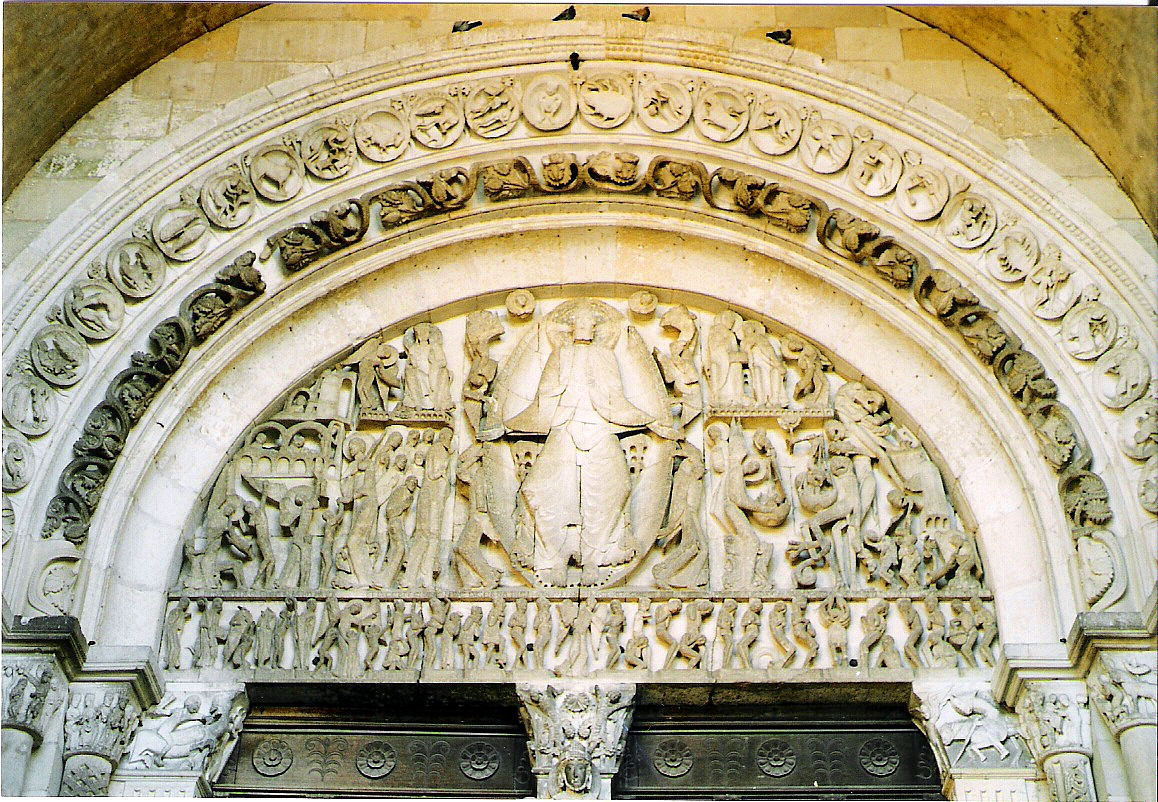
The bodies on the Autun tympanum are not anatomically accurate, and they are not meant to be. Figures are elongated, flattened, their proportions adjusted to fit the architectural field they occupy. The damned writhe in exaggerated contortion; the saved process in rigid, calm rows. The demons are monstrous. Christ in the central mandorla is enormous — not because he is physically large but because he is spiritually supreme. Hieratic scale — size indicating spiritual rank rather than physical reality — organizes every figure in the composition.
This is the body understood as a vehicle for spiritual meaning rather than as an end in itself. A twisted body signals damnation; a calm, upright body signals grace. The physical form is legible, like a text, because every gesture and proportion carries a fixed meaning within the theological program. The Chartres portal figures take this further still: the column figures are so elongated, so absorbed into the architectural shafts they decorate, that they seem to be becoming stone — the human body yielding itself to a structure larger than any individual.
Connection to Hamlet
The medieval body is always already mortal, and medieval culture never lets you forget it. The Last Judgment tympanum is a permanent reminder that the body will be weighed, judged, and either saved or damned — that every living body is a body on its way to that reckoning. Hamlet’s graveyard scene is saturated with this awareness. When he holds Yorick’s skull, he is doing what the tympanum does visually: stripping the body back to its spiritual stakes. “To what base uses we may return, Horatio.” The humor and the horror of the scene are both medieval in their logic — the flesh is temporary, the judgment is real, and no amount of courtly performance changes what the body ultimately is.
Material & Making
What does the choice of material say about the work’s ambitions and its culture?
Medieval sculpture is almost always limestone — the same stone as the cathedral itself — and this is not merely a practical choice. Limestone is permanent, impersonal, and communal. It belongs to the building, which belongs to God. The craftsmen who carved it worked in teams, trained in workshops, and passed their techniques through generations of anonymous labor. Their names were not recorded because their names did not matter. What mattered was the work’s fidelity to the theological program and the quality of the devotional attention it would inspire.
is the striking exception. His name is carved directly beneath the feet of the Christ figure at Autun — “Gislebertus hoc fecit,” Gislebertus made this — in a position so prominent that it cannot be missed. But notice what his signature does not claim: it does not assert individual artistic vision or personal expression. It is closer to a craftsman’s mark, a record of accountability to the commission. Compare it to Michelangelo’s signature on the Pietà — carved across the Virgin’s sash, asserting authorship in the heart of Rome — and the cultural distance between the two acts is immediately legible. Gislebertus signs as a maker; Michelangelo signs as a genius.
Connection to Hamlet
The medieval craftsman’s anonymity — identity absorbed into institutional role — maps directly onto several of Hamlet’s most troubling figures. Rosencrantz and Guildenstern have no existence outside their function as instruments of the king; they are courtiers the way a column figure is a column figure, their individuality subordinated to the program they serve. Polonius is more complex but ultimately the same: his identity is his institutional role. When Hamlet kills him — “Thou wretched, rash, intruding fool, farewell” — he kills not a person but a function. The Renaissance question the play keeps asking is whether there is a self beneath the role. The answer provided by the medieval world is that there doesn’t need to be.
Space & Setting
Where does the sculpture live, and how does placement shape meaning?
The tympanum at Autun sits above the west portal of the cathedral — the door through which every worshipper enters. You pass beneath the Last Judgment to enter the church. This placement is not incidental; it is the work’s entire meaning. The carved scene frames the threshold between the secular world and the sacred one, between the present life and the one to come. Every time you enter, you are reminded of what awaits. The architecture and the sculpture are a single theological argument, and you move through it rather than looking at it from outside.
The Chartres Royal Portal operates on the same principle at greater scale. The three doorways of the west facade organize the entire portal program around a theological hierarchy: Christ in Majesty at the center, flanked by scenes of the Incarnation and the Last Judgment. The column figures — kings, queens, patriarchs, prophets — are not portraits of specific individuals but presences arranged to represent salvation history. To approach the cathedral is to walk through time, through prophecy and fulfillment, toward the eternal.
This is total environment in a completely different sense from Bernini’s Cornaro Chapel. Bernini stages an encounter with the divine as theater — immersive, spectacular, emotionally overwhelming. The medieval cathedral stages an encounter with the divine as cosmos — you are not watching something happen; you are being located within a structure that contains everything that has ever happened or will happen.
Connection to Hamlet
Elsinore is a medieval space organized around judgment and hierarchy — a court where one’s place in the order of things is everything, where the king’s word is law, where the ghost of a murdered father demands that his son fulfill a duty assigned from beyond the grave. The ghost’s demand is the Last Judgment tympanum made personal: everyone will be held accountable, the dead have claims on the living, and the proper response is obedience to a structure of authority that transcends individual will. Hamlet’s tragedy is that he has a Renaissance mind trapped in a medieval world. He cannot simply obey — he must verify, question, and understand — but the world he inhabits has no place for that kind of hesitation. The cathedral portal does not ask whether we accept its terms. We pass beneath the judgment whether we believe in it or not.
Looking Forward
The Renaissance will make everything the medieval cathedral suppresses the center of its program: the individual body, the named maker, the freestanding work that belongs to no building and no theological hierarchy. Donatello’s David — nude, slight, self-possessed, standing free in space — is the precise inversion of a Chartres column figure. Where the medieval sculptor gives the body to the building, Donatello gives it back to itself. Where Gislebertus signs as a craftsman under the feet of Christ, Michelangelo signs as a genius across the Virgin’s sash. The revolution is total — and its consequences are still playing out in Hamlet, where a mind formed in the Renaissance finds itself haunted by a world that has not yet made that journey.
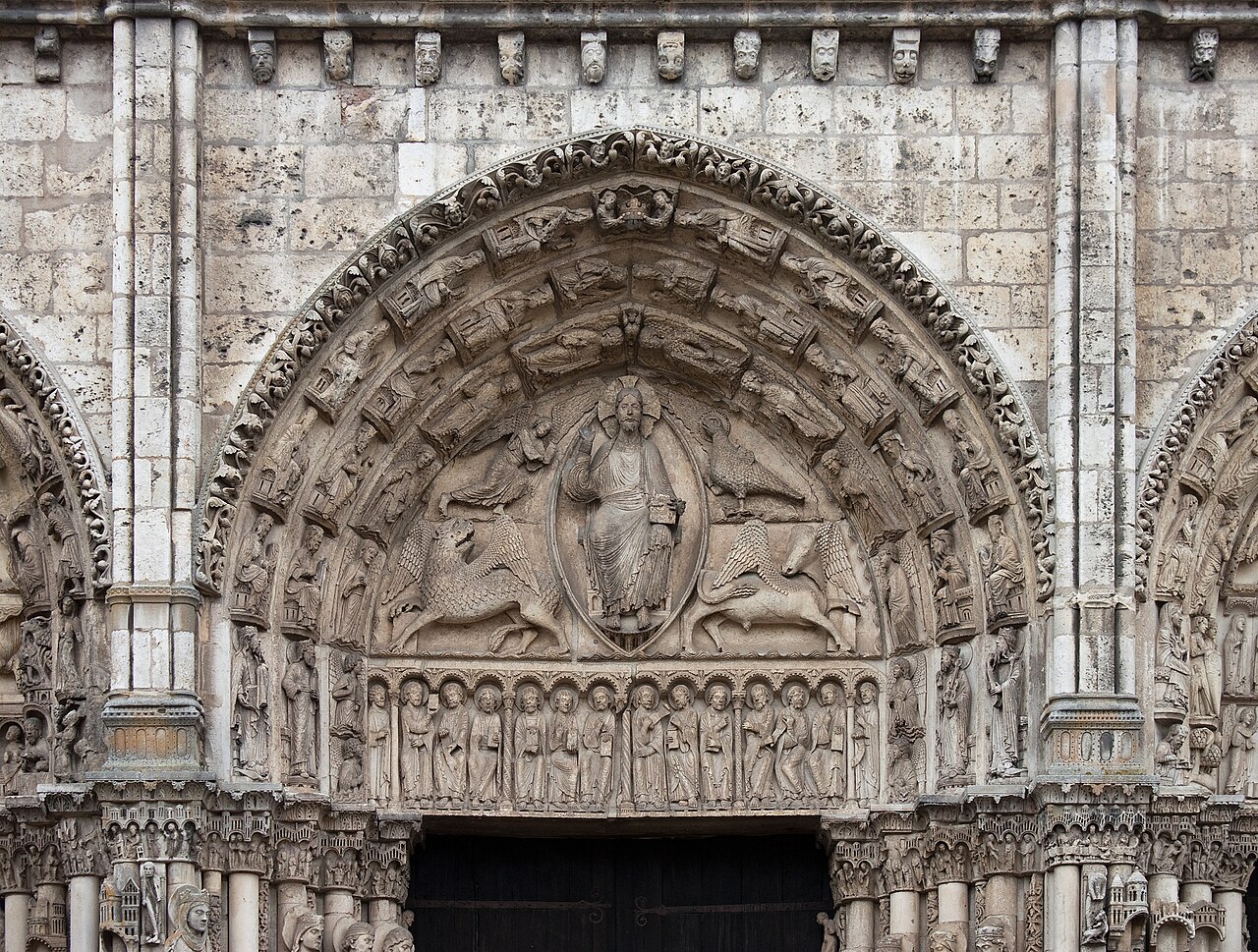
Notice how the column figures are absorbed into the architectural shafts — barely separated from the stone itself, their bodies elongated to match the proportions of the columns. Kings, queens, patriarchs, and prophets stand as presences, not portraits, arranged to represent salvation history. The building is using them as much as they are inhabiting it.
The three west doorways organize the whole facade around a hierarchy — to approach the cathedral is to walk through prophecy toward the eternal.
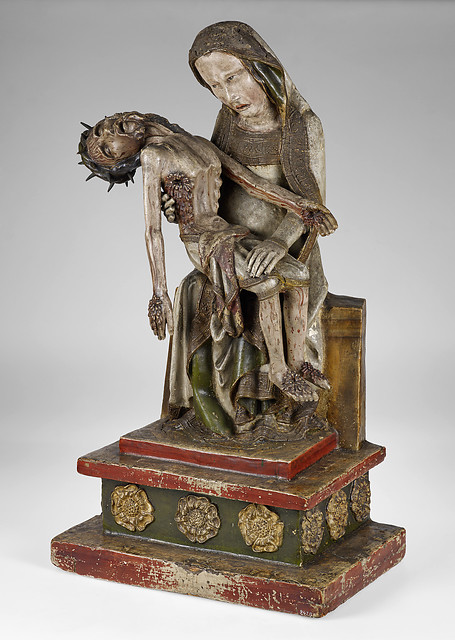
Mary holds the body of her son, and nothing about the encounter is composed. Christ is emaciated to the ribs, the wounds cut open wide, the crown of thorns still driven into his scalp. His body has stiffened and will not settle into her lap. The whole object is painted wood, under three feet tall, made for one person to kneel in front of rather than for a crowd to pass beneath.
Look at Mary's face, then at the Virgin in the Wilton Diptych on the Painting page. This one does not appear to know how the story ends.