Introduction
Baroque sculpture refuses to be looked at from a safe distance. Where Renaissance sculptors crafted figures meant to be contemplated — stable, self-contained, placed on pedestals to be admired — Baroque sculptors created figures that reach into the viewer’s space, demand a response, and refuse to resolve into stillness. The drama is the point, and it is everywhere: in the twist of a body, the texture of marble rendered as cloth or flesh, the theatrical staging of entire chapels designed as unified environments.
The figure most responsible for this transformation is , whose work dominates this unit as completely as Caravaggio and Rembrandt dominate the painting pages. Bernini was also an architect, stage designer, and theatrical impresario; he applied all of those varied skills to his sculpture. His works don’t occupy space; they organize it.
Body & Volume
How does the sculpture render the human body in three dimensions — idealized, naturalistic, fragmented, abstracted?
No single comparison clarifies the Baroque body more quickly than the three Davids. Donatello’s David (c. 1440s) stands in easy contrapposto after the fight is over: relaxed, self-possessed, the severed head already beneath his foot. Michelangelo’s David (1504) is imagined pre-action: the body coiled, the gaze fixed, the moment of decision held in suspension. Bernini’s David (1624) captures the moment of action. The torso twists violently, the face set in fierce concentration, the sling already in motion.
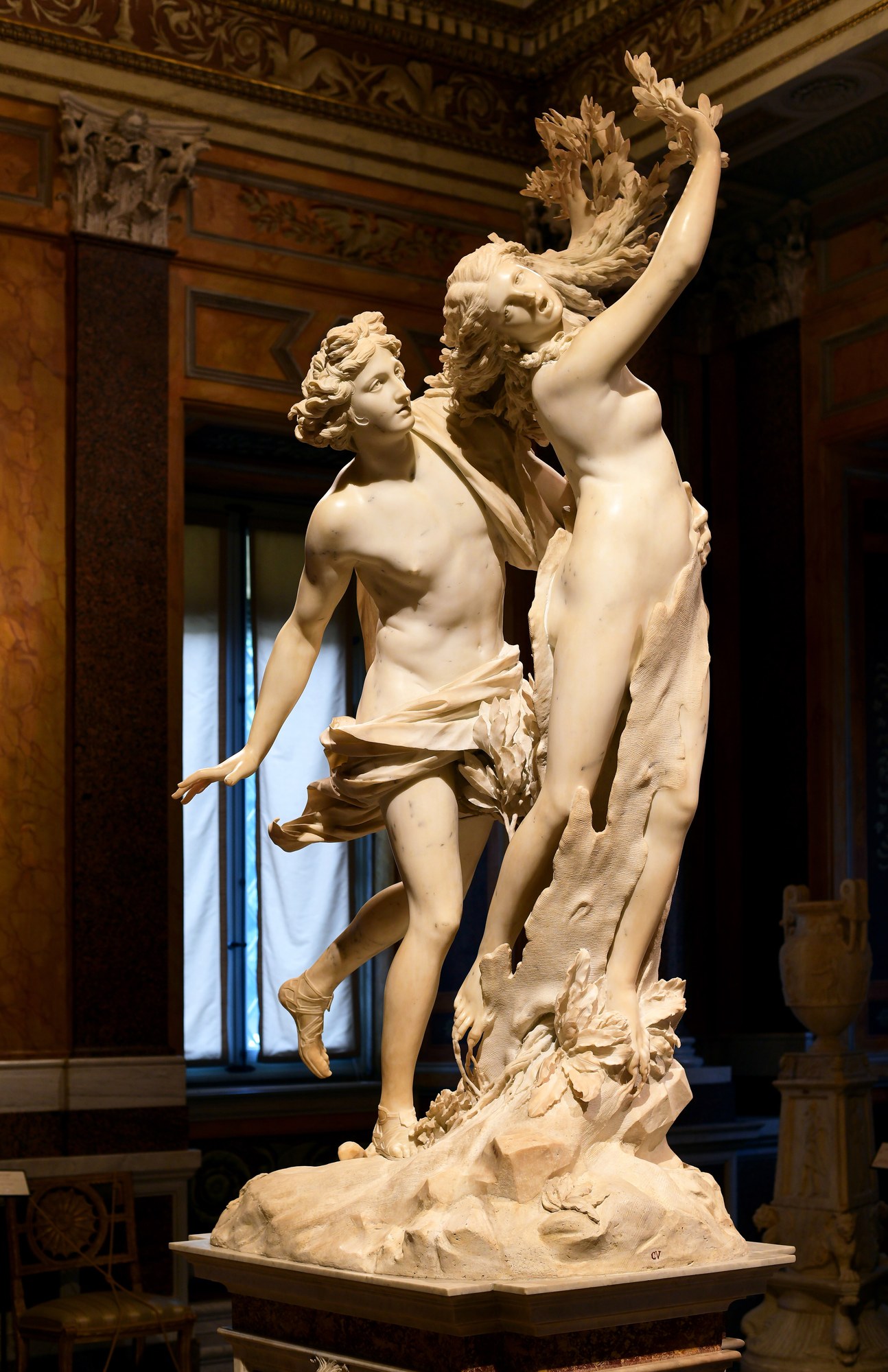
This “action shot” of David in motion is the Baroque’s defining sculptural statement. The body is not a stable form to be admired but a site of dynamic movement. Bernini captures it at maximum tension in his work. The same principle depicts Daphne’s fingers already becoming leaves, her bark rising, her mouth open in a cry that is also the beginning of silence. ’s Milo of Croton pushes this logic to its extreme: the Greek athlete who tried to split an oak with his bare hands and was trapped when the tree closed around him is shown at the moment of maximum muscular effort that is also maximum helplessness. These are bodies overwhelmed — by transformation, by nature’s indifference, by forces they cannot master.
Connection to Paradise Lost
is one of the great poets of the body under pressure. His fallen angels retain their titanic forms even as they are diminished — Satan’s “form had yet not lost / All her original brightness” — and the poem returns obsessively to the gap between what bodies were and what they have become. The Fall is also a transformation. Adam and Eve are irrevocably changed by their choice, their perfected forms giving way to shame, labor, and mortality.
Material & Making
What does the choice of material say about the work’s ambitions and its culture?
The Baroque sculptor’s material is almost always marble — and the Baroque’s central ambition is to make marble deny its own solid nature. Marble’s capacity for a luminous surface finish — impossible in the porous limestone of medieval cathedrals — is what makes this ambition achievable: polished to the right degree, it can be made to suggest warmth, translucency, even the give of flesh. Bernini exploits this to its limit. His ability to render Daphne’s bark-becoming skin, her hair lifting in a wind as it transforms into blown leaves, her terrified flesh still somehow warm beneath the transformation is a claim about what art can do: the sculptor’s intelligence and hand can extract from cold stone something more convincingly alive, matter made to transcend its own nature.
This ambition is inseparable from its cultural context. The Counter-Reformation Church needed art that would move people, overwhelming their senses and producing conviction through strong feeling. Bernini was the Church’s primary visual instrument in Rome, and his willingness to push marble to its illusionistic extreme was a theological as well as an aesthetic commitment. The Ecstasy of Saint Teresa is simultaneously the most technically daring marble carving of the century and a precise instrument of devotional persuasion.
Connection to Paradise Lost
’s language works on the same principle, pushing past the apparent limits of poetic expression. Latinate constructions carried over into English, double syntax that requires multiple re-readings, heavily enjambed stanzas that the poet sometimes imagined as bodies with their own freedom of movement — deploys the English language against its own grain, demanding that it carry a weight it was not built to convey.
Space & Setting
Where does the sculpture live, and how does placement shape meaning?
Bernini understood that a sculpture’s environment is part of its meaning. The Ecstasy of Saint Teresa is not just a carved group but an entire chapel installation: the marble figures of Teresa and the angel are suspended in a gilded light-shaft above an altar, flanked by side walls carved with box seats from which marble portrait figures of the Cornaro family watch the ecstasy as if from theater balconies. Real light enters from a hidden window above and strikes gilded rays behind the figures.
This is a decisive break from Renaissance sculptural practice, where the work was self-contained and the setting secondary. Baroque sculpture colonizes its environment. Fountains erupt in Roman piazzas — Bernini’s Fountain of the Four Rivers makes water itself a sculptural medium. Portal programs give way to freestanding works that organize the space around them rather than filling an assigned slot within it.
Connection to Paradise Lost
constructs his epic as a total environment the reader must move through rather than a series of episodes to be observed from a fixed position. The poem’s scale is spatial as much as narrative, asking the reader to hold Heaven, Hell, Chaos, and the Garden in their mind simultaneously. When Satan crosses Chaos in Book II on his way to discover the “pendent” Earth that hangs below Heaven, the reader feels the vertiginous scale of the Miltonic universe.
Looking Back
The three Davids tell this story in miniature: Donatello’s self-possessed stillness, Michelangelo’s suspended decision, Bernini’s violent mid-action commitment. Each is a different answer to the question of where the human figure stands in relation to the forces acting on it. Bernini’s answer is the Baroque one: fully engaged, fully exposed, past the point of return.
Looking Forward
Enlightenment sculpture will return to calm but a different calm than the Renaissance’s confident humanism — more deliberate, more archaeological, more self-consciously in dialogue with the classical past. Canova’s figures achieve a serenity that looks back to ancient Greece, absorbing the Baroque’s illusionistic ambitions but disciplining them to quieter purpose. The theatrical environment collapses back into the controlled elegance of the self-contained work, shifting from the chapel stage to the gallery plinth.
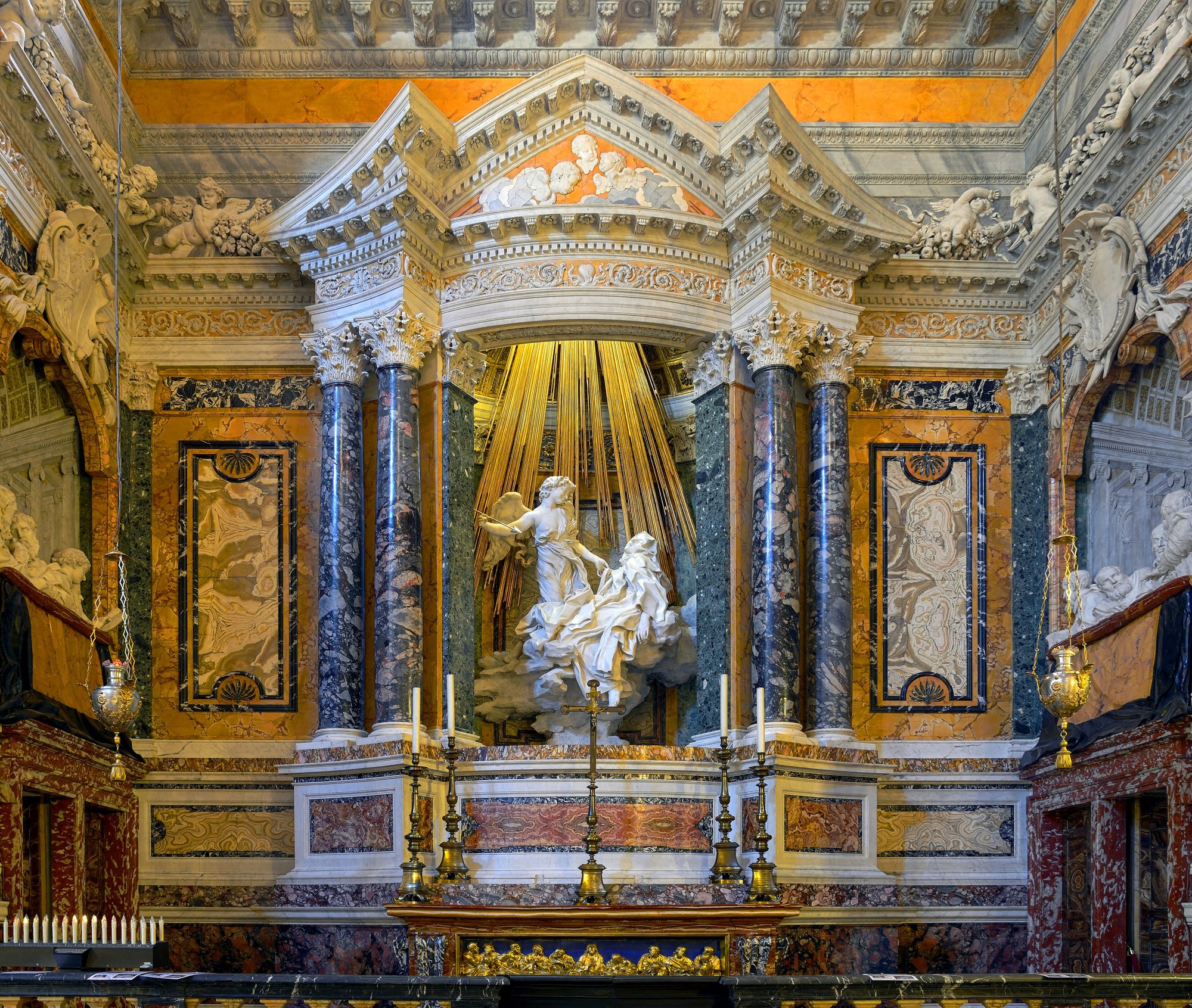
Look for the hidden window above and behind the figures — the source of the real light that falls on the gilded rays. Then look at the Cornaro family portraits in their theater boxes on the side walls: Bernini has made us members of the audience at Teresa's vision. Teresa and the angel float on a cloud of marble, the saint's body slack and her drapery churning, so that the whole chapel — architecture, sculpture, light, spectators — becomes a single unified environment rather than an object on a pedestal.
You are not looking at a statue in a room; you have been seated inside the drama, in the same theater as the carved marble audience.
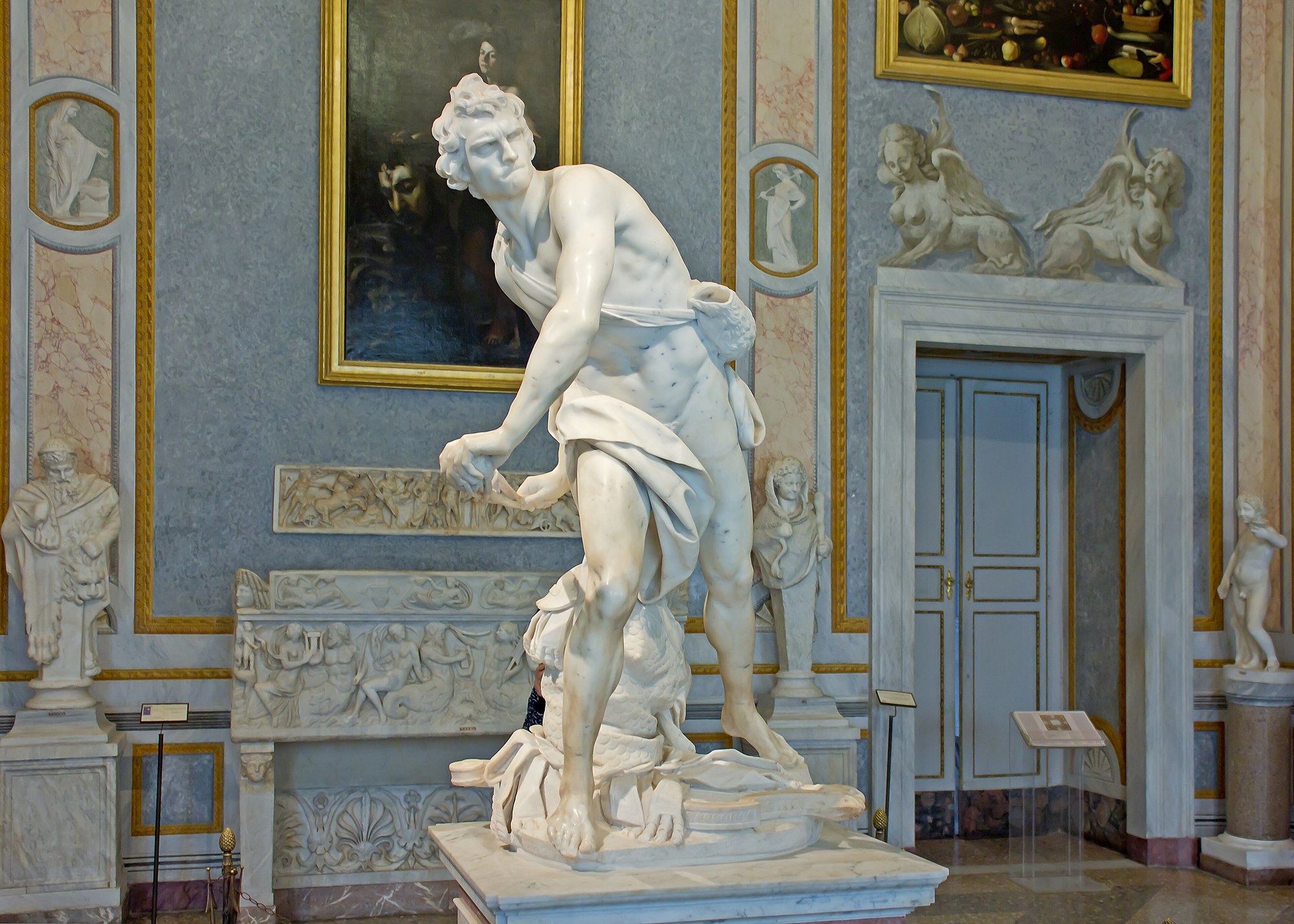
Find the face: it is Bernini's own, according to his biographer, and it conveys something very different from the serene confidence of Michelangelo's version. This David bites his lip, his brow furrowed, his whole body torqued into a spiral committed to an action he cannot retract — the instant before the sling releases. The figure's twist throws his energy out into the viewer's space; you instinctively step back from where the stone he is about to fling would fly.
Donatello sculpts the aftermath, Michelangelo the decision — Bernini sculpts the violent middle of the act itself.
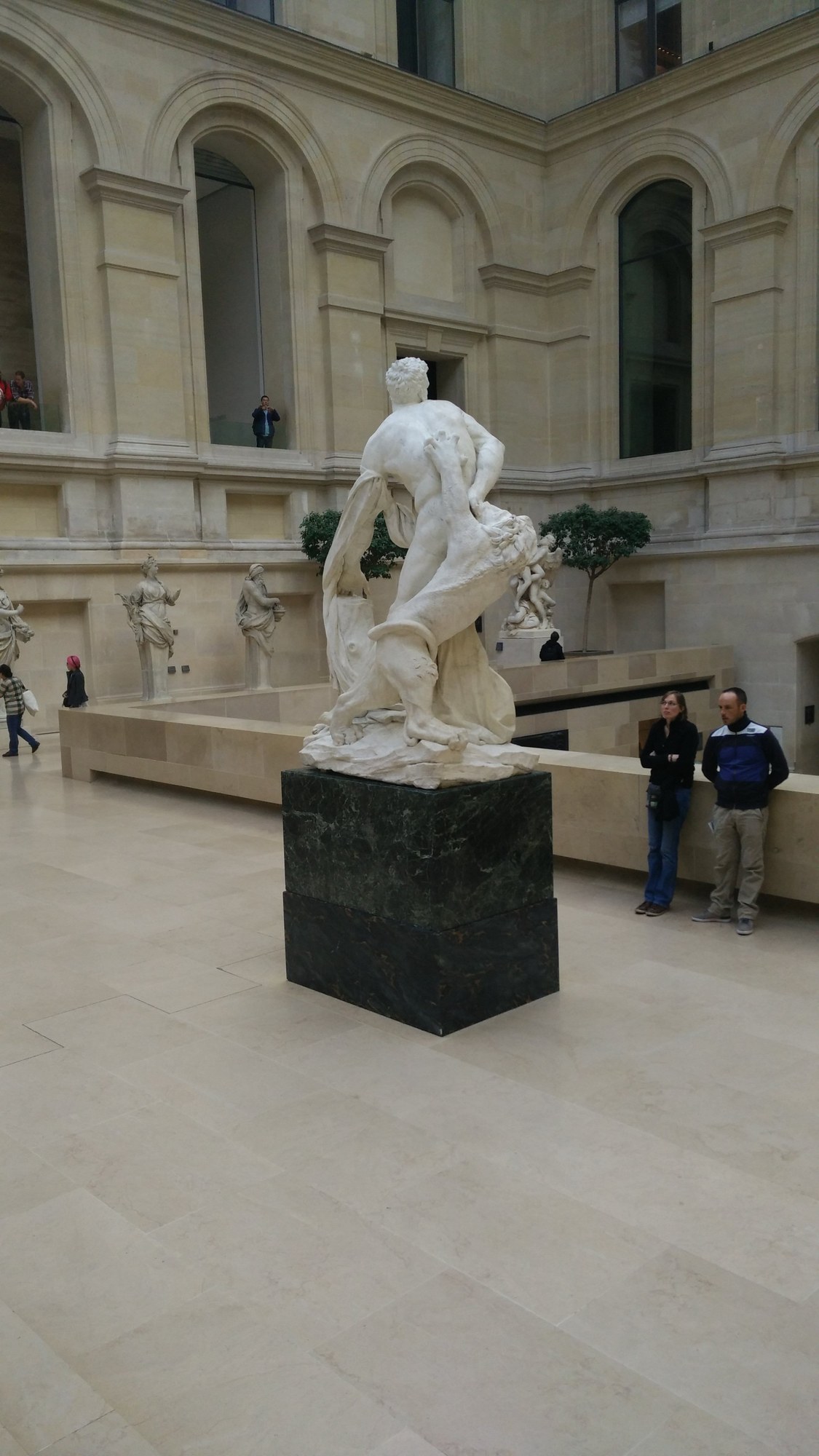
The Greek athlete who tried to split an oak with his bare hands was trapped when the tree closed around his fingers, then devoured by a wolf. Puget shows the instant of maximum muscular effort that is also maximum helplessness. The body is anatomically hyper-specific — every tendon and straining muscle described — and it is precisely that virtuosic marble specificity that makes the helplessness devastating. The polished stone renders both the strength and its total futility.
The same marble mastery that makes Bernini's Daphne miraculous makes Puget's Milo unbearable — technique in the service of overwhelming force.