Introduction
Romanticism explodes the Rococo’s drawing room. Where the eighteenth century valued reason, social order, and elegant restraint, the Romantics pursued the raw, the wild, and the overwhelming. They were drawn to what the philosopher Edmund Burke called the sublime — the experience of something so vast, powerful, or terrifying that it exceeds the mind’s ability to comprehend it. The visual art of Romanticism and the fiction of share a common obsession: the encounter between a solitary human consciousness and forces — natural, metaphysical, existential — that refuse to be mastered, measured, or fully understood.
Figure & Space
How is the human figure placed within the pictorial space?
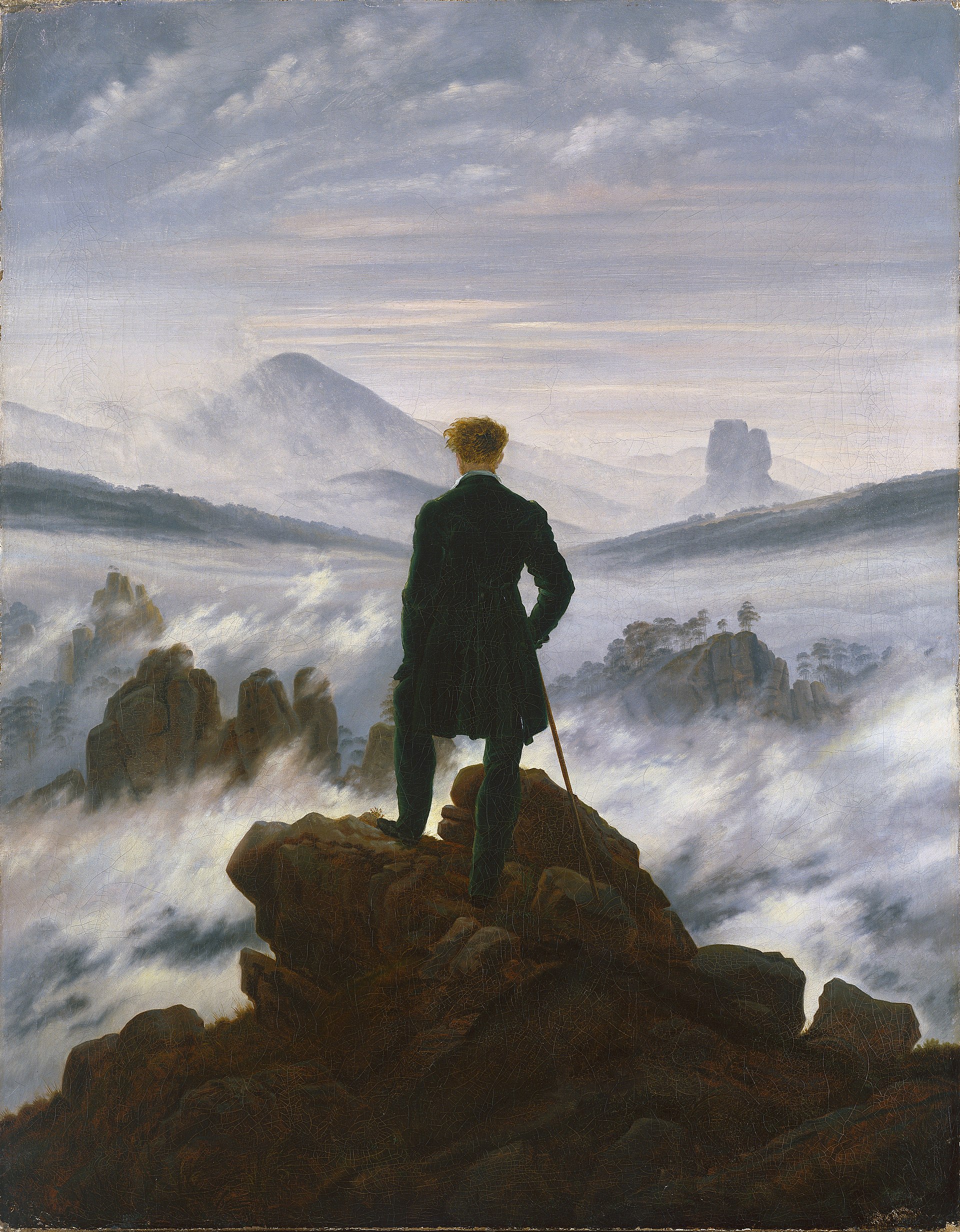
The relationship between figure and space reverses. In ’s Wanderer above the Sea of Fog, a solitary figure stands with his back to us, gazing out over a vast, mist-shrouded landscape. The human being is tiny against an immensity that dwarfs and swallows. Nature is no longer a backdrop or a garden; it is the subject, and it is ungovernable. Compositions open up into panoramic skies, churning seas, and mountain ranges that push the human figure to the edge — or eliminate it entirely.
Connection to Moby-Dick
Ishmael clinging to Queequeg’s coffin in an indifferent ocean captures the Romantic reversal of scale that runs through the entire novel. Whether Ishmael at the masthead, Ahab on the quarterdeck, or Pip lost in the open sea, the human figure is perpetually dwarfed by a natural world that exceeds comprehension. The ocean functions exactly as landscape does in or : not a setting but a force, not a background but the primary reality against which human meaning is tested. In “Bartleby,” the overwhelming space inverts — it becomes the dead wall Bartleby stares at, the claustrophobic office that shrinks the human figure rather than dwarfing it against nature. In Benito Cereno, the becalmed ship on an opaque sea is itself a Romantic composition: a human scene set against a natural world that conceals its meaning.
Light & Shadow
How does the painting use light — its source, quality, and emotional effect?
Romantic light is atmospheric, emotional, and often turbulent. ’s paintings dissolve solid objects into storms of golden, fiery, or stormy light. Sunsets blaze, storms darken, and the distinction between sky and sea, solid and void, can become almost impossible to discern. Light is no longer rational (Renaissance) or dramatic (Baroque) but elemental — an expression of natural forces that exceed human control. Where Baroque chiaroscuro created a theater of divine drama, Romantic light creates an arena of natural power.
Connection to Moby-Dick
’s prose handles light the way handles paint. In “The Whiteness of the Whale,” the color white — the presence of all light — becomes a source of metaphysical terror rather than illumination. Descriptions of the sea at different times of day dissolve water and sky into a single luminous or threatening field. , like , erases the boundaries between solid objects and the elemental forces that surround them. The whale itself appears and disappears in conditions of light and obscurity that make it seem more like a natural phenomenon — a storm, a wave, a shaft of light through water — than a creature.
Brushwork & Surface
What is the physical character of the paint itself?
For many Romantic painters, brushwork becomes visibly energetic. , in his later work, dissolves the painted surface into swirling, almost abstract fields of color that anticipate Impressionism and even abstraction. used bold, rapid strokes that convey urgency and passion. The smooth, controlled surface of neoclassical painting gives way to visible physical energy. The paint does not merely depict a storm; it behaves like one. This expressiveness of surface — the idea that paint can embody emotion, not just illustrate it — is a Romantic innovation with enormous consequences for the future of art.
The paint does not merely depict a storm; it behaves like one.
Connection to Moby-Dick
’s prose style is the literary equivalent of ’s late brushwork. His sentences do not politely describe the ocean; they enact it — surging, accumulating, crashing across the page in long, rhythmically complex periods that seem to move with the energy of the phenomena they describe. The famous cetology chapters, the rhetorical set pieces, the passages of visionary intensity all insist on a prose surface with its own energy and physicality. ’s language is not transparent; it is a force. This is precisely the Romantic principle that the medium is part of the meaning.
Looking Back
Place ’s Wanderer next to ’s The Swing and the eighteenth-century world vanishes. The intimate garden, the flirtatious social scene, the pastel palette, the decorative charm — all swept away by fog, rock, and an immensity that makes the solitary human figure look fragile and exposed. The drawing room has become the mountaintop; ’s precisely calibrated social comedy has given way to ’s oceanic confrontation with the sublime.
Looking Forward
Modernism will take the Romantic dissolution of form — visible in ’s late work — and push it to its conclusion. Where dissolved objects into light and atmosphere while still holding onto recognizable subject matter, the Modernists will abandon representation altogether. The Romantic painter stood in awe before nature; the Modernist turns inward, making the canvas itself the subject. The solitary figure gazing at an incomprehensible world becomes the fragmented figure who is that incomprehensibility — the shift from to , and from ’s whale to ’s invisibility.
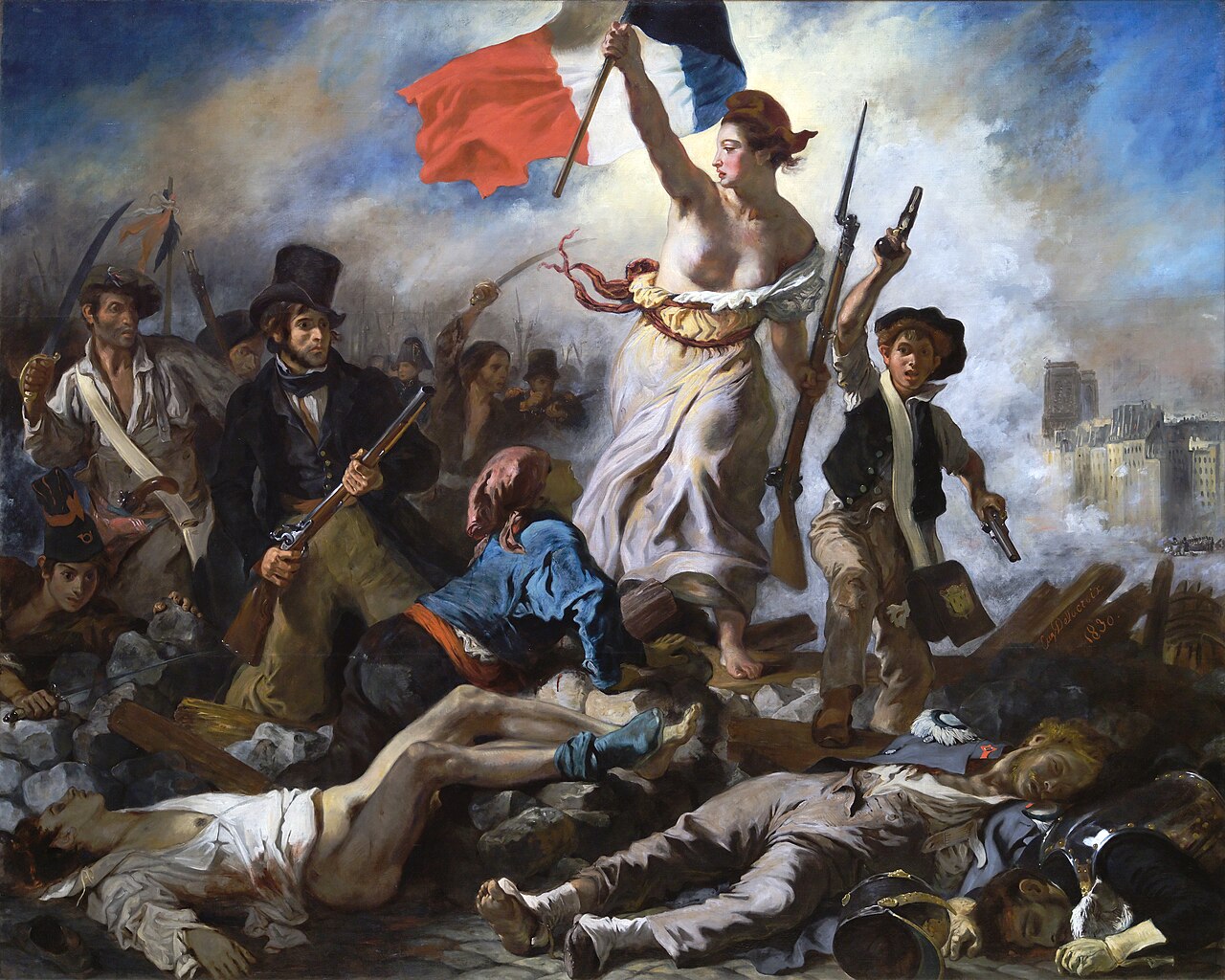
Look at the brushwork in the smoke, the flag, and the tumbled bodies at the base of the composition — bold, rapid, and visibly energetic, conveying the chaos and passion of revolution rather than describing it neatly. Delacroix applies Romantic surface energy to a political subject: the allegorical figure of Liberty surges forward over the barricade, and the paint surges with her. The handling itself carries the urgency.
The brushwork doesn't describe the revolution from a safe distance — it enacts its turbulence. Surface energy *is* the meaning.
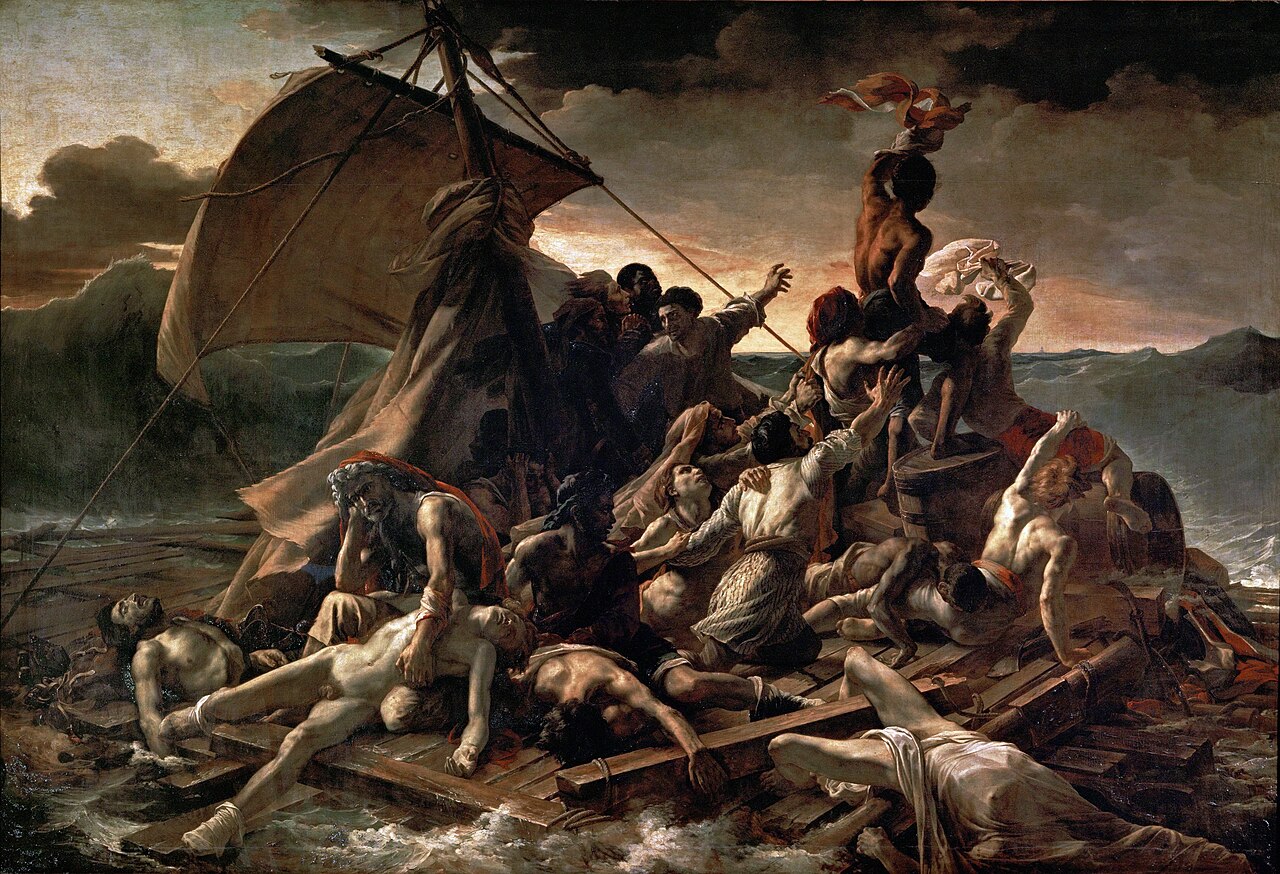
Read the composition as two surging diagonals: a pyramid of straining bodies climbs from the dead and dying in the foreground toward a single figure waving a scrap of cloth at a barely-visible ship on the horizon. The survivors are piled, reaching, and collapsing on a makeshift raft against an indifferent ocean that dwarfs them. Hope and despair are built into the geometry itself — the desperate upward push against the vast, uncaring sea.
Follow the pyramid of bodies up to the waving figure — then find the tiny ship on the horizon. The sea holds all the power.
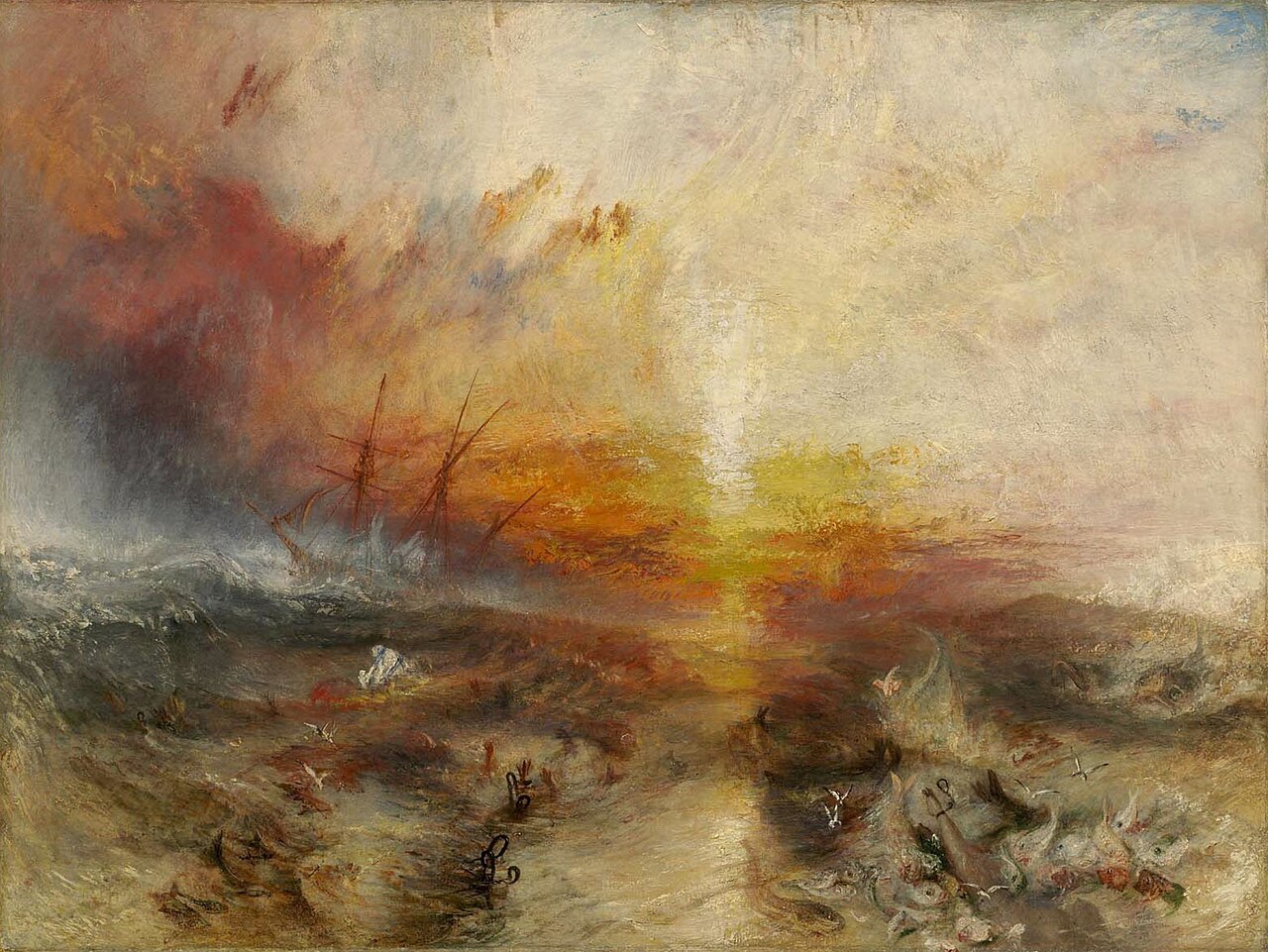
A blazing, blood-red sunset consumes most of the canvas, and solid forms dissolve into swirling color until the boundary between sea and sky nearly vanishes. The ship tilts in a churning storm while the horrific human cargo — the drowning enslaved people thrown overboard — is rendered almost illegibly amid the turbulence, half-swallowed by the elemental fury. Turner makes light and paint themselves carry a moral catastrophe that exceeds what any single legible figure could convey.
Try to find the horizon line. It has dissolved — sea, sky, and atrocity have become a single field of turbulent light.