Introduction
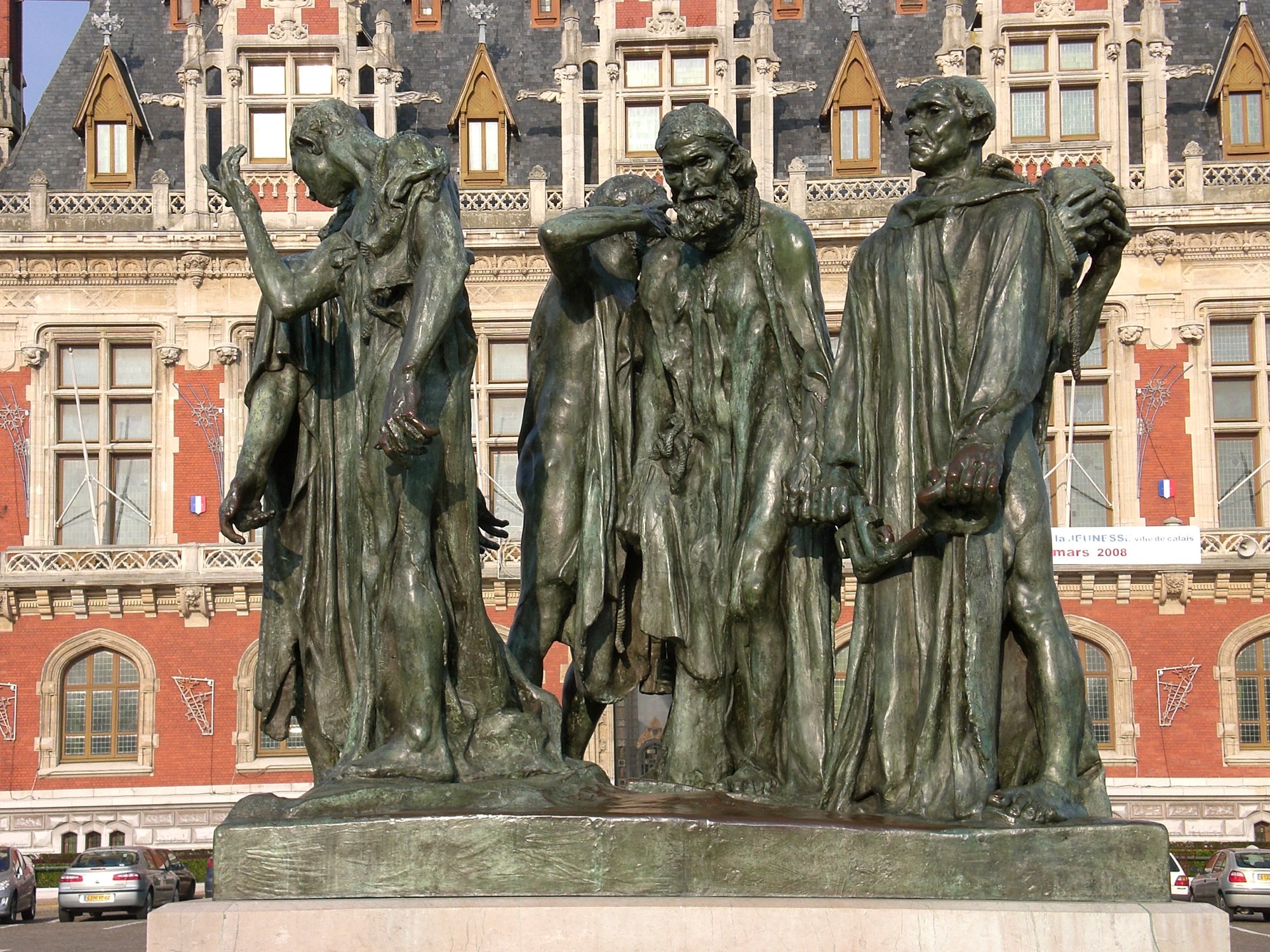
breaks the pedestal of Western sculpture, literally and figuratively. His Burghers of Calais was designed to stand at ground level among ordinary people, not elevated on a traditional plinth. The decision is a manifesto: Romantic sculpture insists that the body in its full psychological and physical reality belongs in the world, not above it. Where Enlightenment sculptors disciplined the body into legible, rational surfaces that could be read like texts, Rodin makes the body the site of interior struggle, collective grief, and individual will pressing against its own limits.
’s Moby-Dick is similarly obsessed with bodies under pressure and makers pursuing their work past the point of rational control. Rodin and Melville share a Romantic conviction that the most important truths are found not in polished surfaces but in the probing encounter with the ineffable sublime.
Body & Volume
How does the sculpture render the human body in three dimensions — idealized, naturalistic, fragmented, abstracted?
The six figures of the Burghers of Calais commemorate the men who offered their lives to Edward III of England to spare their city during the Hundred Years’ War. Rodin does not give them heroic bodies. They are heavy, tentative, burdened — each figure isolated within the group, each facing the decision alone even as they face it together. Hands hang, heads bow, feet drag. One figure throws his arms wide in what might be despair or surrender. The bodies express what no classical or neoclassical sculptor would have shown: courage and grief can occupy the same body at the same moment, and the heroic act can look, from the inside, like devastation.
’s La Marseillaise offers the counterpoint — bodies not weighted by grief but ignited by passion. The central winged figure of Liberty surges forward and upward, mouth open in a battle cry, her body at the full extension of forward motion. The warriors below her are equally charged, their forms expressing the explosive energy of collective revolutionary action. This is the Romantic body in its exhilarated rather than anguished mode, not burdened by decision but propelled by conviction.
Connection to Moby-Dick
The Burghers maps onto the Pequod’s crew with uncomfortable precision. These are men yoked to a collective enterprise they did not fully choose, each carrying the weight of what is coming in their own body, isolated within a group. Pip, the cabin boy, carries that isolation to its extreme — lost in the open ocean, his mind broken by the vastness of what he encounters. Ahab’s body is itself a Romantic subject: the scarred, peg-legged figure driving himself and his crew toward an encounter that his body has already recorded as catastrophe.
Material & Making
What does the choice of material say about the work’s ambitions and its culture?
Rodin’s most radical formal innovation is the unfinished surface. In works like The Gates of Hell — the monumental bronze door commission he worked on for nearly four decades without completing — figures emerge from rough, unworked stone or dissolve back into it. The boundary between the finished form and the raw material is deliberately refused. The struggle between form and formlessness, between the sculptor’s will and the stone’s resistance, is itself the subject.
The Gates of Hell began as a commission for a decorative arts museum and became an obsession — a lifetime’s accumulation of figures, all drawn from Dante’s Inferno, reworked and repositioned over decades. The Thinker originated here, as did The Kiss and dozens of other figures. Rodin recycled forms across works, combined figures from different projects, and never declared the piece finished. The gates are, finally, a monument to the act of making rather than to any completed statement — a work that mirrors its subject (souls in perpetual torment) in its own perpetual incompletion.
Connection to Moby-Dick
’s novel can be read as a book about a man who cannot stop working. The cetology chapters — the obsessive cataloguing of whale anatomy, behavior, and history — are Ishmael’s version of Rodin’s unfinished surface: an accumulation of material that circles around its subject without ever capturing it. The whale resists every system of classification the way raw stone resists the sculptor’s chisel. Ahab’s pursuit is the purest expression of the Romantic maker’s obsession: he will remake the world or destroy himself in the attempt. Rodin working on the Gates of Hell for thirty-seven years without finishing is a figure of obsessive toil comparable to mad Ahab, driving the Pequod across every ocean in pursuit of a creature that may well be beyond human reach.
Space & Setting
Where does the sculpture live, and how does placement shape meaning?
Rodin’s original design for the Burghers placed the six figures directly on the ground, at the same level as viewers, without a pedestal. The city of Calais rejected this — pedestals were expected, hierarchy was the convention — and the work was eventually installed on a low base. But Rodin’s intention was clear: the figures should be among us, not above us. Their grief is not monumental but human, and its power depends on proximity. When the work is finally installed as Rodin intended, as it is in several locations today, the effect is immediate — you walk among figures who seem poised to leave the space, each alone with their decision.
Rude’s La Marseillaise occupies the opposite end of the spatial spectrum. Carved in high relief on the Arc de Triomphe in Paris, it is public sculpture at its most monumental — high above street level, readable from a distance, designed to be part of the city’s symbolic architecture. The Arc was Napoleon’s commission; the relief celebrates the revolutionary army that preceded him. The sculpture is inseparable from its setting: to see it is to see it on the Arc, in the city, at the axis of the great Parisian boulevards. Its meaning is civic, nationalist, and collective.
Connection to Moby-Dick
The contrast between Rodin’s ground-level grief and Rude’s elevated civic energy maps onto a tension at the heart of Moby-Dick: between the collective enterprise and the individual experience of it. The Pequod is a public vessel with a manifest civic and commercial purpose; a whaling ship was a floating factory and a profit-making enterprise. But what happens aboard after Ahab turns the Pequod into an instrument of revenge is profoundly private: each man on board suffers his own encounter with fear, with the sublime, with his own limits. Ishmael’s narrative shifts between the ship’s collective life and the interior life of the individual consciousness observing it. Rodin places his figures in the civic square but strips away the civic elevation; places his narrator on a commercial vessel but strips away the economic purpose. Both artists insist that the private, interior life of the body persists beneath its public role.
Looking Back
Enlightenment sculpture disciplined the body into social legibility — a face that revealed character, a posture that announced civic identity, a surface smooth enough to repay rational attention. Rodin refuses all three. His surfaces are rough or deliberately incomplete; his figures’ faces express states that exceed social legibility; their postures do not announce civic identity but register interior devastation. The shift from Houdon’s Voltaire to Rodin’s Burghers is the shift from a world in which the rational individual is the measure of things to a world in which the individual is overwhelmed — by grief, by obsession, by forces that no amount of rational self-examination can master.
Looking Forward
Modernism will take Rodin’s dissolution of the finished surface and push it past representation entirely. Where Rodin’s figures emerge from rough stone but remain recognizably human, Brancusi will reduce the human form to pure abstract volume — an egg, a column, a bird’s wing. Where Rodin’s Gates of Hell accumulates figures in a restless, unresolved composition, Duchamp will provocatively question the boundaries of fine art by presenting a mass-produced urinal as sculpture. The Romantic conviction that the struggle of making is itself the subject survives into Modernism, but the forms it produces become unrecognizable as the human body that Rodin never entirely abandoned.
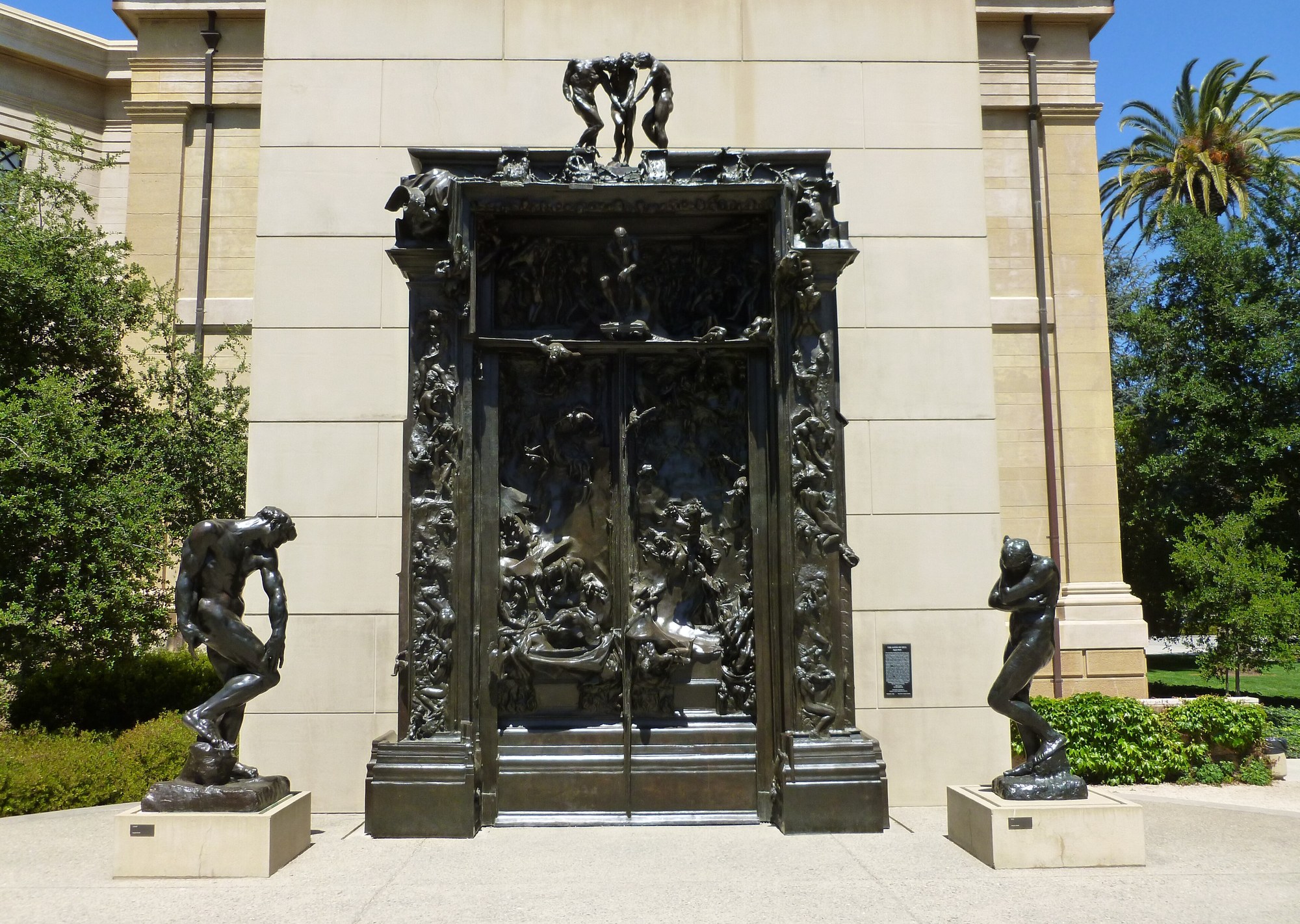
Find the *Thinker* at the top — Rodin's original figure is not pondering philosophically but physically straining, every muscle engaged, as if thought itself were an act of violent effort. Then look to the edges of the doors, where figures begin to dissolve into the bronze ground, bodies losing their definition as they return to the undifferentiated material from which they emerged. Worked and reworked for thirty-seven years and never finished, the gates make their own incompletion the point — the boundary between form and raw material deliberately refused.
The finished form and the raw material bleed into each other — the struggle of making is left visible as the subject.
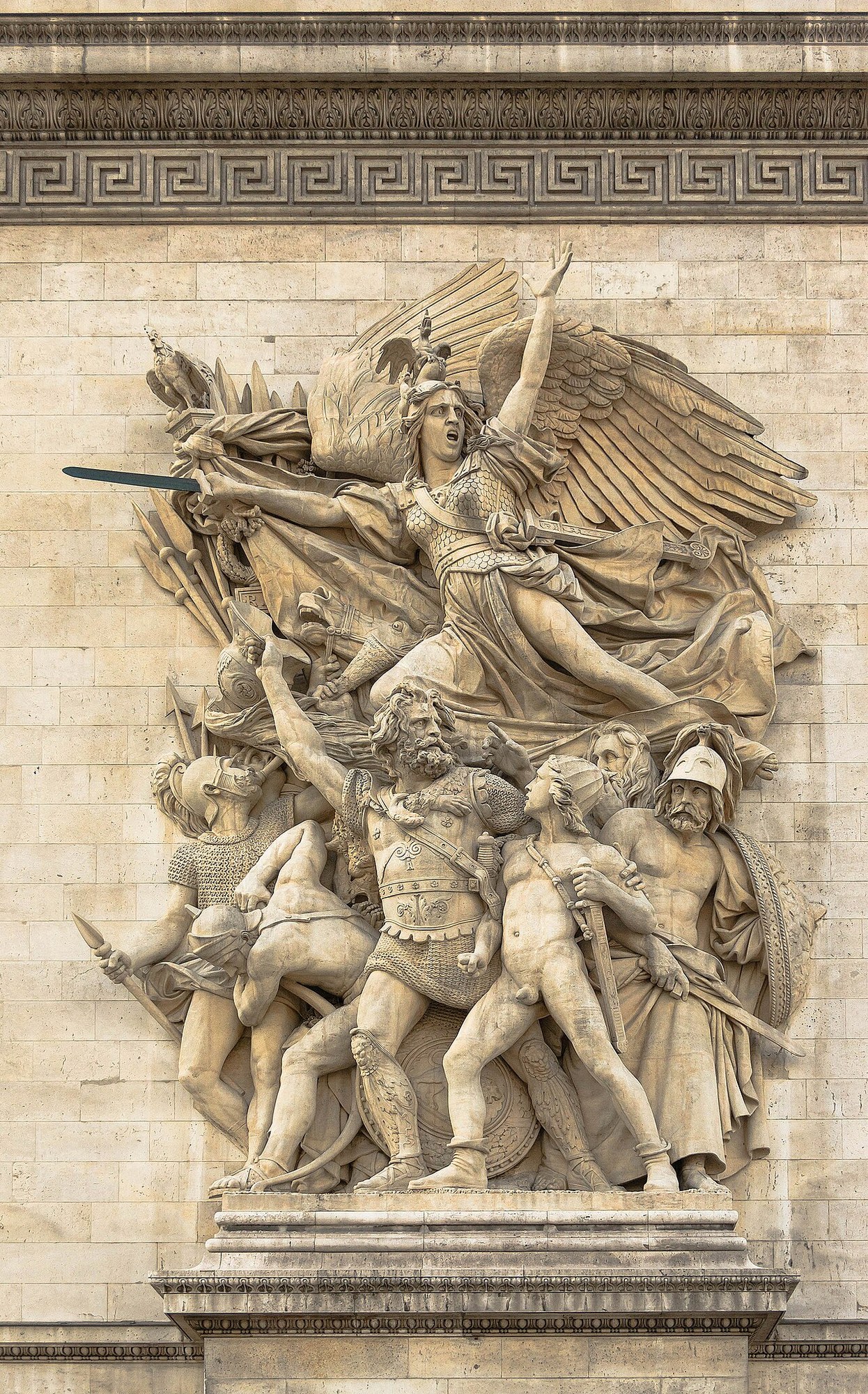
Find the contrast between the figures at the bottom of the relief — warriors preparing for battle, their bodies in active, purposeful motion — and the central winged figure of Liberty above them, whose open mouth and forward surge communicate something beyond purpose: pure passionate force. Carved in high relief on the Arc de Triomphe, high above the street, this is public sculpture at its most monumental, inseparable from the civic architecture it crowns. Its meaning is collective and nationalist, the Romantic body in its exhilarated rather than anguished mode.
Where Rodin drops his figures to ground level, Rude lifts revolutionary energy high onto the city's symbolic architecture.