Introduction
Modernism is really a convenient blanket term for a collection of modernisms, a series of radical breaks with the conventions that had governed European painting since the Renaissance. The coherent picture plane, the illusion of depth, the unified point of view, the smooth narrative surface: all of these are dismantled, questioned, or abandoned between roughly 1860 and 1960. This is the visual equivalent of ’s experiments with the form of the novel: fragmenting perspective, defamiliarizing the reader’s understanding of American society, insisting that the old ways of seeing are inadequate to the complexity of modern experience.
The arc of this course finally arrives here: from the medieval certainty that the world is divinely ordered and fully legible, through the Renaissance confidence that the individual mind can comprehend reality, the Baroque drama of cosmic conflict, the Enlightenment’s social intelligence, and Romanticism’s encounter with the sublime — to a moment when all inherited frameworks for making sense of the world are called into question at once.
Figure & Space
How is the human figure placed within the pictorial space?
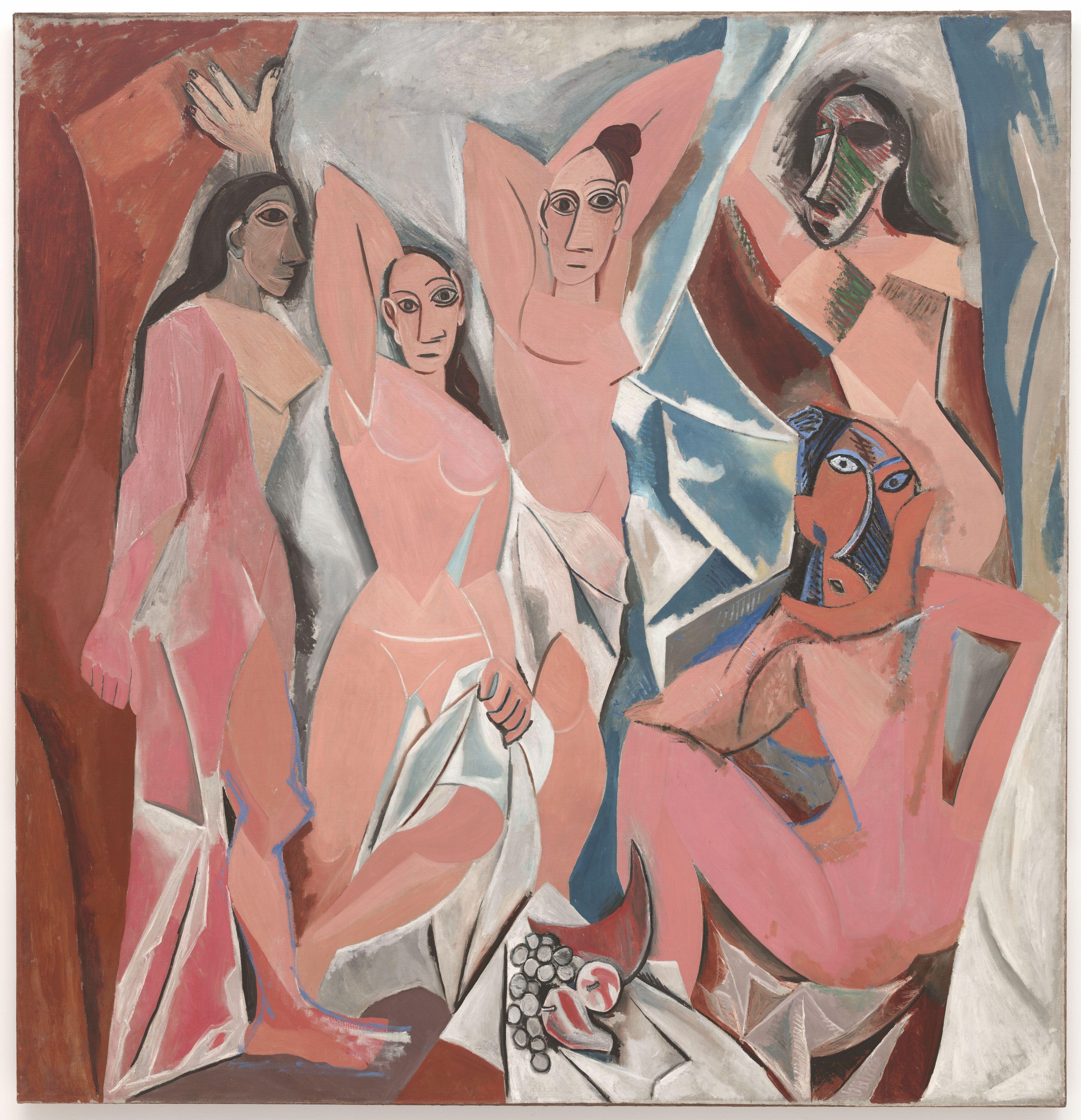
The unified, rational space of the Renaissance is progressively shattered by the development of Modern painting. flattened his figures, eliminating the smooth tonal modeling that gave bodies their three-dimensional illusion. Cézanne fractured objects into geometric planes seen from slightly different angles simultaneously. Cubism completed the revolution: and Braque broke figures and objects into shards, showing multiple viewpoints at once on a single flat surface. The figure is no longer whole, no longer occupying a coherent space. It is fragmented, reassembled, sometimes unrecognizable.
Connection to Invisible Man
’s narrator cannot be seen whole by the society around him. This is not merely a social observation but a formal principle: the novel itself fragments its protagonist across multiple identities, roles, and perspectives — college student, factory worker, Brotherhood orator, underground man — none of which adds up to a complete, coherent self visible from a single vantage point. This is Cubism applied to character. Just as ’s figures are seen from everywhere and nowhere simultaneously, ’s narrator is defined by the multiple, contradictory ways others see him (or refuse to see him). The “invisibility” of the title is not merely a metaphor for racism but a formal condition, the condition of a self that cannot be unified because the social space it inhabits is itself fractured and incoherent.
Cubism’s refusal to privilege a single viewpoint is also a refusal of authority, the authority of the Renaissance tradition that said there was one correct way to see. In ’s novel, no single ideology (the college’s accommodationism, the Brotherhood’s Marxism, Ras the Exhorter’s nationalism) is presented as the correct viable frame of meaning and authority. The narrator’s journey is precisely the discovery that every frame is partial, and that the only honest position is the one that acknowledges its own partiality.
Light & Shadow
How does the painting use light — its source, quality, and emotional effect?
Modernism dismantles the old systems of illumination. The Impressionists broke light into its component colors, applying pure pigments in small strokes that blend at a distance into luminous color. Light is no longer a steady, unified force but a shimmering, unstable phenomenon that changes moment to moment. Later modernists abandon representational light entirely: in Mondrian’s grids or Rothko’s color fields, light is not depicted but produced by the interaction of colors on the canvas. The painting does not display the lighting conditions of a presumed three-dimensional world; paint as medium generates its own luminosity.
Connection to Invisible Man
’s novel opens and closes in a basement illuminated by 1,369 light bulbs wired into the power grid of Monopolated Light & Power — stolen light, repurposed light, light that is simultaneously a defiant assertion of visibility and a confession of marginality. This image condenses the entire Modernist problem of illumination: the old sources of light do not illuminate the narrator, so he must create his own. The Impressionist insight that light is not a stable, objective phenomenon but something that shifts and fragments depending on conditions becomes, in ’s hands, a political and existential insight: who gets illuminated, by what sources, and at whose expense are not neutral questions.
The novel’s movement between visibility and invisibility, between moments of searing clarity and passages of surreal obscurity (the Liberty Paints factory, the hospital machine, the Harlem riot), recapitulates the Modernist dismantling of unified, rational illumination. Light in Invisible Man is partial, contested, and unreliable — exactly as it is in Modernist painting.
Brushwork & Surface
What is the physical character of the paint itself?
The surface of the painting becomes the subject. What hinted at and forced into the open, Modernism makes explicit: a painting is a flat surface covered with paint, and pretending otherwise is a kind of willful self-deception. Abstract Expressionists like Pollock dripped and flung paint, making the physical act of painting visible as the work’s primary content. The artist’s gesture — the record of a body moving through time — replaces the depicted scene. This is the ultimate reversal of medieval anonymity: the individual artist’s hand is now everything.
A painting is a flat surface covered with paint, and the artist’s gesture is now everything.
Connection to Invisible Man
’s novel is relentlessly self-conscious about its own surface — its language, its shifting registers, its visible artifice. The narrator’s language moves between the rhetoric of sermons, jazz riffs, political oratory, naturalistic description, and surrealist hallucination; the shifts themselves are never disguised. There is always an awareness that someone is telling this story, performing it, and that the performance is part of the meaning. This is the literary equivalent of the Modernist insistence that the canvas is a canvas, the paint is paint, and the act of making is not something to be hidden behind a transparent surface. , like the Abstract Expressionists, makes the act of artistic creation — the energy, the improvisation, the risk — visible as content.
Looking Back
The full arc of the course is visible here. The medieval gold ground — flat, symbolic, anonymous — was shattered by Renaissance perspective, which created a rational, measurable world anchored by a single viewpoint. The Baroque complicated that rationality with dramatic extremes of light and shadow, then Enlightenment domesticated the drama into social observation. Romanticism overwhelmed the social world with natural sublimity. Modernism breaks all of it apart — the unified space, the stable viewpoint, the coherent figure, the transparent surface — revealing that every previous way of seeing was itself a constructed artifice. This is both a loss (the comfortable illusions are gone) and a liberation (new ways of seeing become possible). ’s narrator, emerging from his underground room to affirm that “even an invisible man has a socially responsible role to play,” is reaching for something beyond the fragmentation, not a return to old certainties, but a new kind of wholeness that can acknowledge its own complexity.
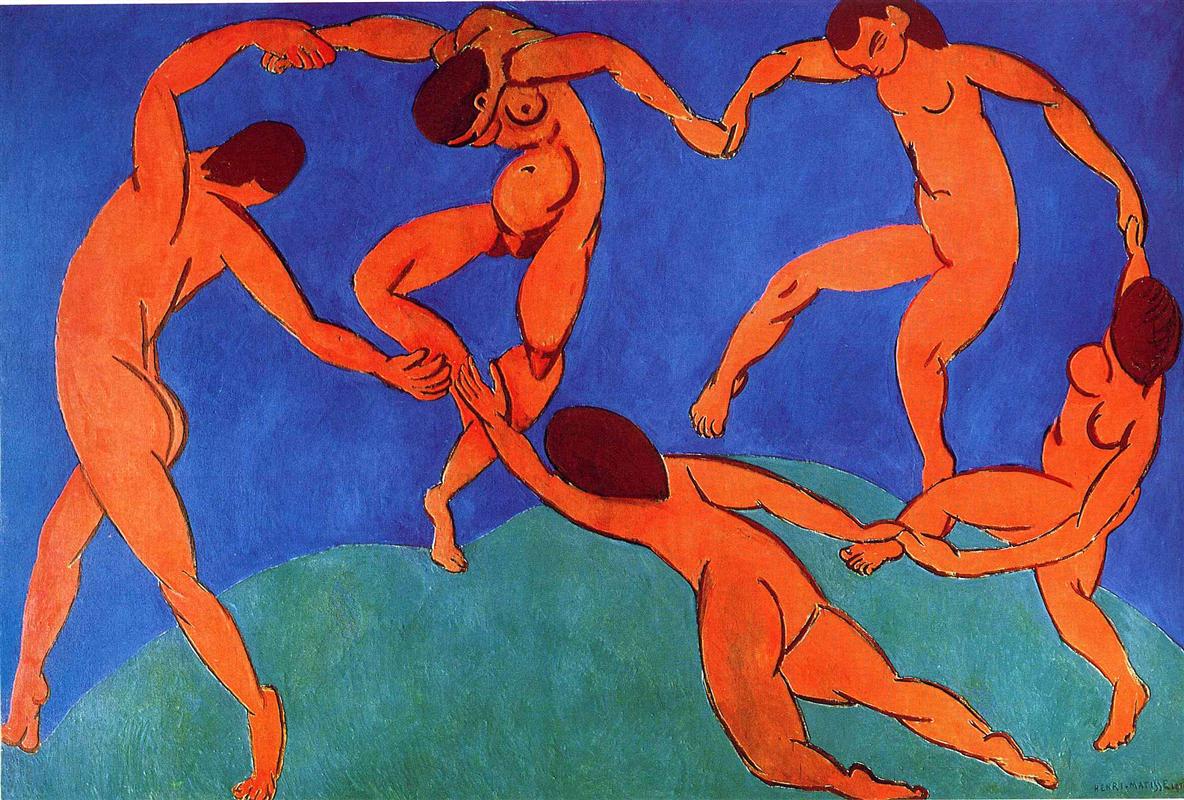
Five figures circle in a ring against nothing but a band of blue and a band of green — the human body reduced to its most elemental: flat, outlined, rhythmic. There is no modeling, no measurable space, no anatomical detail beyond what the movement requires. Pattern and rhythm matter more than accuracy, and the flat planes of pure color announce the canvas as a surface rather than a window. The painting is about the pulse of the dance, carried entirely by shape and color.
No floor, no depth, no shading — only flat color and the rhythm of the ring. The surface has become the subject.
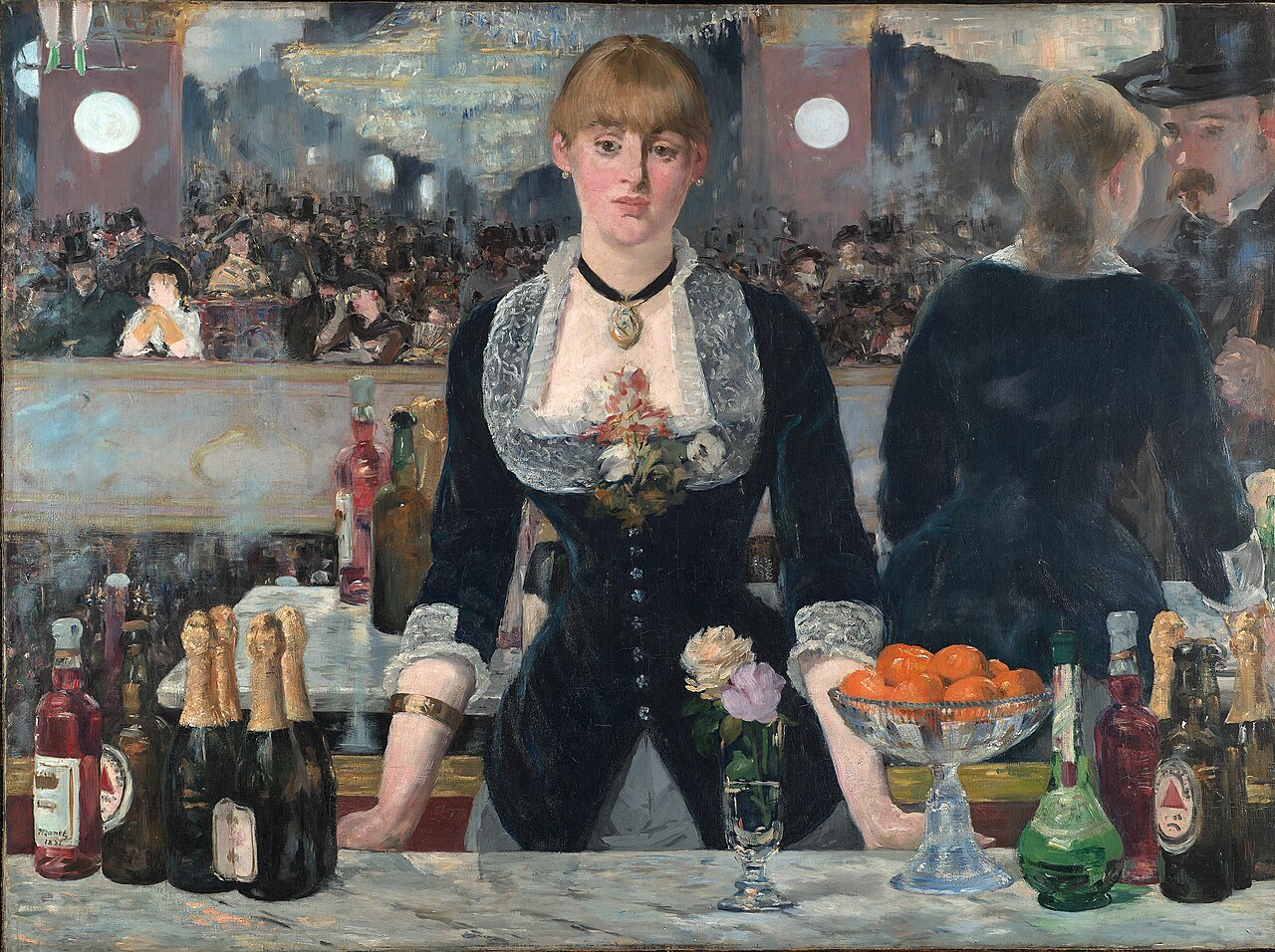
Start with the barmaid facing us, then look at her reflection in the mirror behind her — and notice it doesn't line up. The reflected back of her figure is shifted far to the right, where a top-hatted customer faces her, though no such customer stands before us. Manet flattens the modeling and lets the spatial logic contradict itself, so the coherent, single-viewpoint space of the Renaissance quietly comes apart. The picture refuses to resolve into one consistent world.
Line up the barmaid with her reflection. You can't — and that impossibility is the painting's real subject.
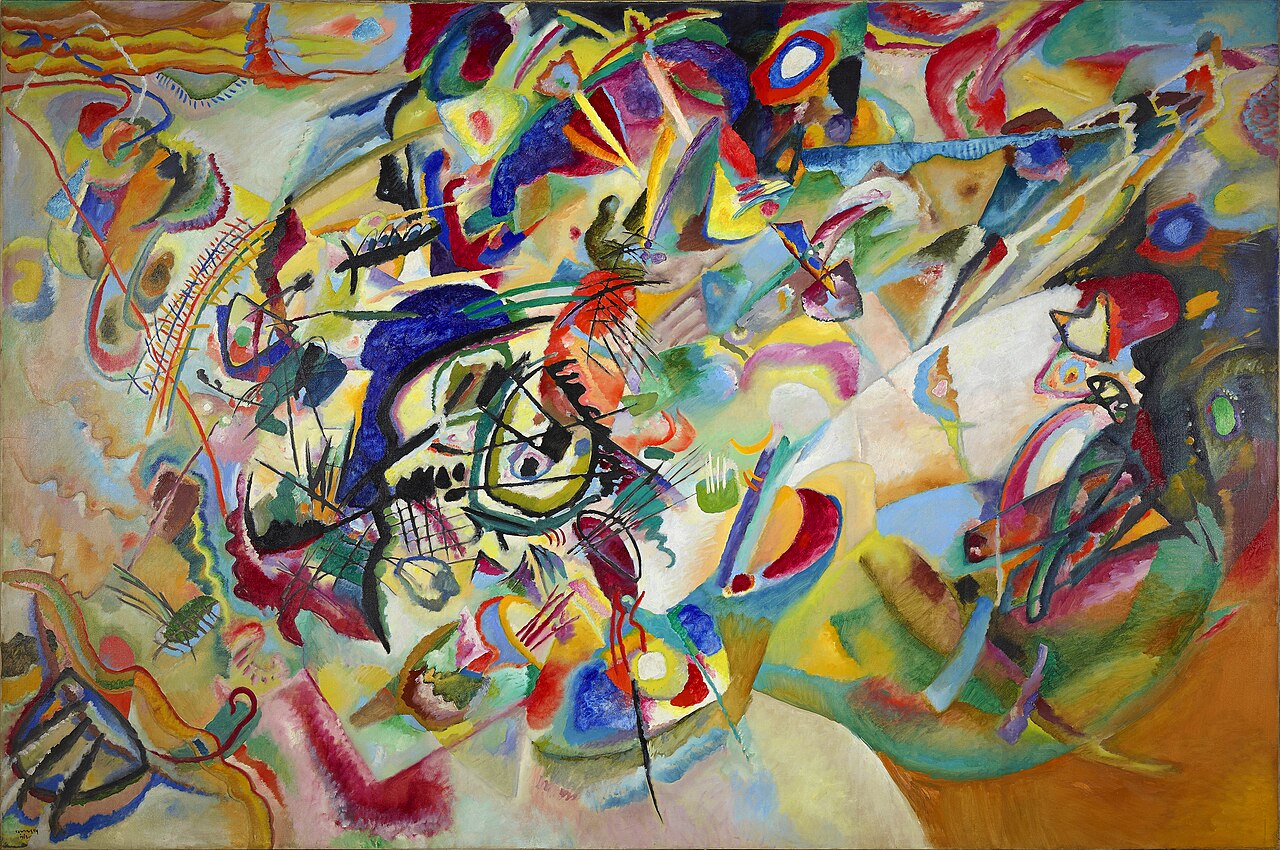
There is no recognizable subject here at all — what you see is color, line, and energy operating without reference to the visible world. Luminosity is not borrowed from any depicted sun or window; it is produced directly by the collision of hues on the canvas. Kandinsky treats color the way a composer treats sound, so the 'light' of the painting is generated by the paint itself rather than illustrating the lighting of a three-dimensional scene.
Stop hunting for objects. The glow here is made by color against color — light with no world behind it.