Introduction
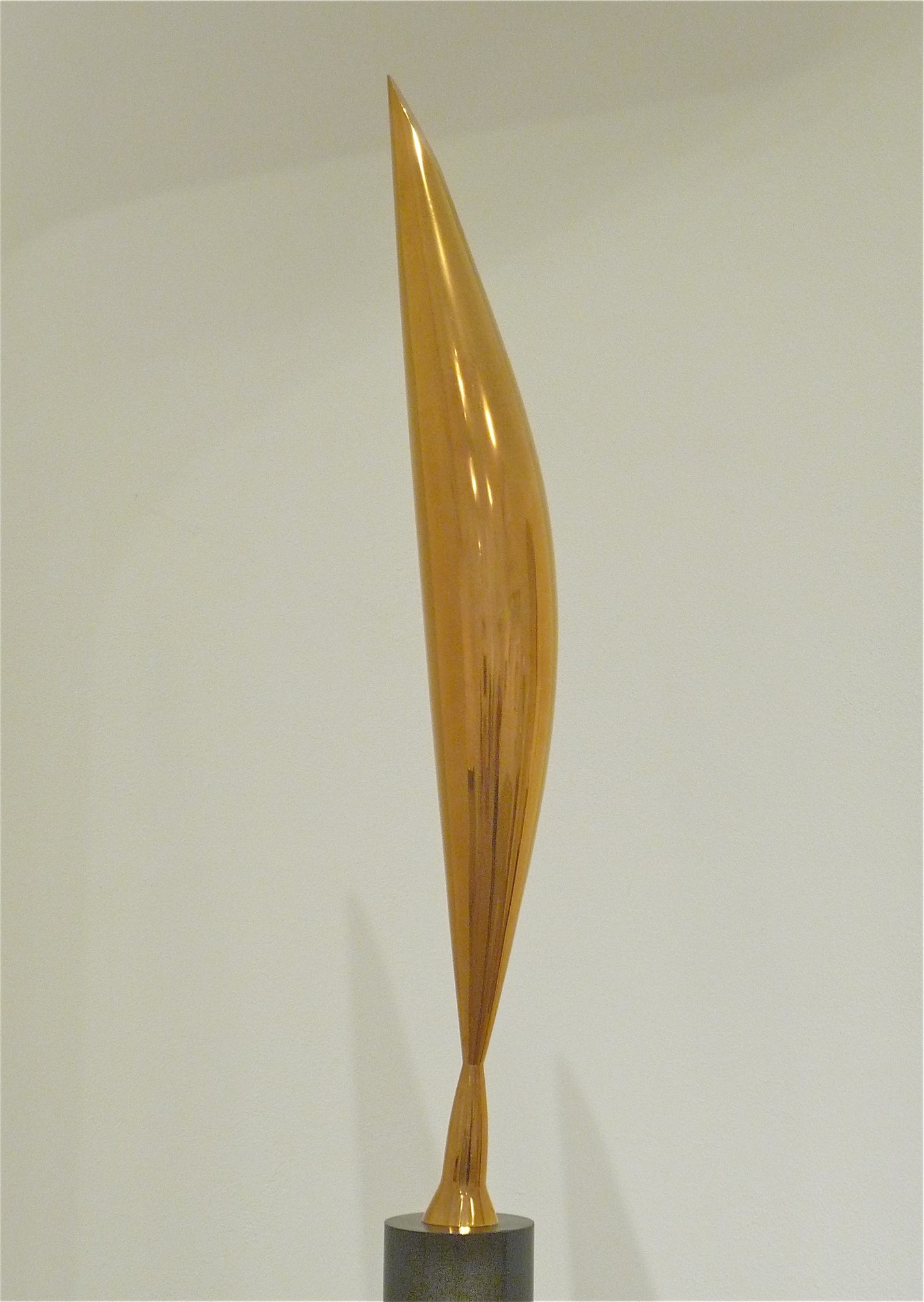
In 1926, a US Customs official in New York refused to classify ’s Bird in Space as a work of art. It looked, to the official’s eye, like a piece of industrial metal — a shaft of polished bronze with no recognizable subject, no depicted figure, no apparent craft. The customs service taxed it accordingly. Brancusi sued, and the case went to trial. A federal court was forced to decide, officially and on the record, what counts as sculpture.
Modernist sculpture does not merely change how figures are depicted; it dismantles the assumptions that made depiction the point. The human body, the single material worked by a single hand, the pedestal that elevates the work above the everyday world, the finished surface — all of these are questioned, abandoned, or turned into subjects in themselves.
Invisible Man operates under the same pressure. The novel’s central question is about classification: what counts, what is seen, whose existence is legible to the systems that govern recognition. Brancusi’s bird and ’s narrator face parallel existential problems: they cannot be seen for what they are by institutions designed to exclude by narrow definitions of what to look for and where to look.
Body & Volume
How does the sculpture render the human body in three dimensions — idealized, naturalistic, fragmented, abstracted?
’s Bird in Space is not a bird. It is an idea of flight — a single upward-tapering form, its surface polished to a mirror finish, that captures the sensation of motion through air without depicting any creature moving through it. Brancusi arrived at this form through years of progressive reduction, stripping away every feature (wings, feathers, beak, recognizable avian anatomy) until only the essential gesture remained. The human body undergoes the same treatment in his other works: The Kiss reduces two embracing figures to a single rectangular block with barely differentiated surfaces; Sleeping Muse reduces a head to an egg. The question Brancusi asks — what is left when you remove everything that is not essential? — is one of Modernism’s defining questions.
moves in the opposite direction. His figures in City Square are elongated to the point of near-dissolution, diminished to the verge of disappearing, present but barely acknowledged. Brancusi discovers the irreducible core; Giacometti reveals the attenuated remainder.
Connection to Invisible Man
Brancusi’s concentration and Giacometti’s deterioration are two versions of the same Modernist question about the human figure: what is actually there beneath the layers of social role, institutional identity, and projected meaning? The narrator of Invisible Man asserts this question through the frame of a narration of life experience. Stripped of each identity the world assigns him — college student, factory worker, Brotherhood orator — what remains? Giacometti’s figures in City Square suggest an answer: something minimal, isolated, present but barely acknowledged, moving through shared space without connecting. This is the narrator’s experience of New York — a city in which he moves among thousands of people who register his physical presence without seeing anything they recognize as a self.
Material & Making
What does the choice of material say about the work’s ambitions and its culture?
welded steel. He had worked in an automobile plant and a locomotive factory before becoming a sculptor, and he brought those industrial skills directly into his art — cutting, grinding, and welding metal the way a factory worker assembles parts. Hudson River Landscape was made by welding together gestural lines of steel drawn from sketches Smith made on a train journey along the Hudson; the finished work is simultaneously a drawing, a landscape, and a sculptural object, occupying a category of its own creation.
’s Large Glass — The Bride Stripped Bare by Her Bachelors, Even (1915–1923) — pushes the question of material further still. Made on two large panes of glass with oil paint, varnish, lead wire, and dust, it is simultaneously painting, sculpture, and architectural element: by design, one looks at it and through it, the space behind the glass becoming part of the experience of the work. When it cracked during transport in 1926, Duchamp declared the crack an improvement, an accidental contribution that no amount of intentional craft could have produced. The found object (Fountain, his earlier urinal submitted as sculpture) had already asked whether the artist’s hand was necessary; the Large Glass asks whether intention itself is the limiting factor of meaning. Duchamp’s more extreme provocations notwithstanding, Smith’s welded steel and Duchamp’s glass share a common premise: the sculptor is not obligated to work in traditional materials, and the choice of material is itself a statement about what a culture values and what it throws away.
’s Guitar (1912) precedes both Smith and Duchamp and makes their work possible. Constructed from cut and folded sheet metal and wire rather than carved or cast, it was the first major Western sculpture built rather than carved or poured — a three-dimensional Cubist object assembled from flat planes the way a Cubist painting assembles multiple viewpoints. The choice of materials is not incidental: sheet metal is cheap, industrial, anonymous — the antithesis of marble. The construction method makes the process visible; we can see exactly how the guitar is put together, which is precisely the information that a carved or cast surface suppresses.
Connection to Invisible Man
The Liberty Paints factory sequence is Invisible Man’s most concentrated meditation on material and making. The narrator works underground, mixing a black substance into white paint to produce “Optic White” — the purest white, the standard of American whiteness, produced by invisible Black labor. The scene is an industrial allegory: the material product (white paint) depends on the hidden ingredient (the darkness that makes whiteness possible) and on the invisible worker who adds it. Smith’s welded steel makes visible the industrial labor that traditional high culture preferred to keep in the factory and out of the gallery. makes visible the labor that American culture preferred to keep underground. Both insist that the materials of civilization — steel, paint, language — carry the history of the people who made them and the conditions under which they were made.
Space & Setting
Where does the sculpture live, and how does placement shape meaning?
Giacometti’s City Square was designed to be placed on the floor, without a pedestal, at human scale — five figures on a flat bronze base that could be the pavement of any city. This is Rodin’s ground-level gesture pushed to its limits: the street itself made into sculpture. The work does not represent urban isolation; it produces it. Looking down at the figures, the viewer becomes another figure moving through the same space, equally isolated, equally unnoticed.
David Smith placed his large outdoor sculptures — the Cubi series, the Voltri works — directly in fields and landscapes, where they entered into dialogue with horizon lines, light, and weather. Louise Nevelson, working in assemblage, covered entire gallery walls with found wooden objects painted a uniform black — turning the gallery itself into a new kind of total environment, a secular reliquary in which discarded things were consecrated by arrangement and attention.
Connection to Invisible Man
The narrator of Invisible Man begins underground — in a basement he has lined with 1,369 light bulbs, wired into the power grid of Monopolated Light & Power. The space is invisible to the city above it; it exists outside the systems of recognition that organize public life. This is not mere metaphor: the underground room is a specific spatial argument, a counter-setting to the civic and institutional spaces that have repeatedly failed to see him. Giacometti’s City Square places isolated figures in shared space and makes their isolation a formal condition of the work. ’s underground room inverts this: the narrator removes himself from the social world entirely and makes the removal a precondition of thought. Both works ask what it takes to be physically present in a world organized around limiting systems of visibility that determine whose presence registers as existing, valid, worthy of attention.
Looking Back
Rodin’s unfinished surfaces — figures half-emerging from rough stone — were already a statement about the struggle between form and formlessness. Modernist sculpture takes that struggle to its conclusion: the form that barely emerges, or the form that asks whether emergence is the right goal at all. Where Rodin kept the human figure at the center of his obsession, Brancusi and Giacometti ask what the figure becomes when stripped to its essence or its minimum. Where Rodin’s Gates of Hell accumulated figures in restless, unresolved profusion, Smith’s welded lines and Duchamp’s glass panes suggest that the accumulation itself — the obsessive making — may be what sculpture is, rather than any figure it produces.
Looking Forward
Modernist sculpture has no single Looking Forward — it ends the course’s arc rather than passing its questions to another period. What it leaves is a set of open provocations: if anything can be sculpture, what is sculpture? If the figure is not necessary, what is the human body’s place in art? If the pedestal is gone and the gallery wall is a surface for assemblage, where does sculpture end and the world begin? These questions do not resolve; they persist. ’s narrator, at the novel’s end, prepares to emerge from his underground room into a world that has not changed. He does not have answers. He has, instead, the refusal to remain invisible — the insistence on existing as a particular, irreducible self in a world that would prefer he be something else. That refusal expressed through spatial rearrangement is a sharp analogue to the impulse that drives much Modernist sculpture.
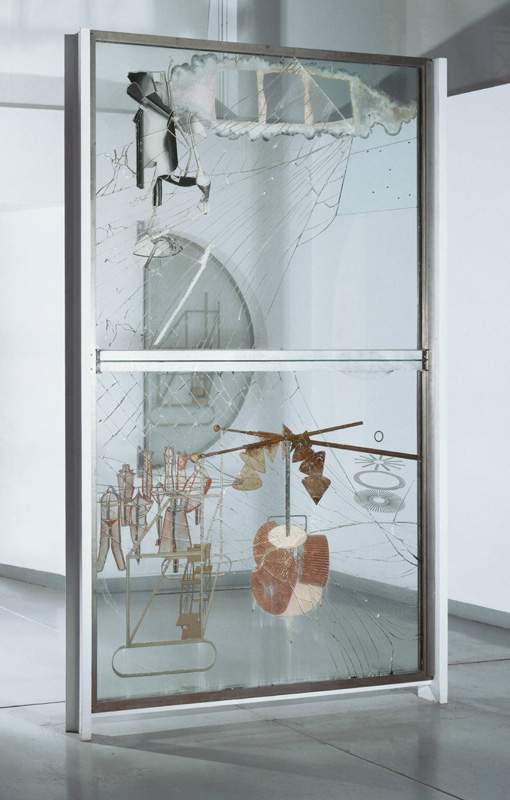
Look *through* the work as well as at it — it was designed so that whatever appears behind the glass becomes part of the composition. Made on two panes with paint, varnish, lead wire, and dust, it is at once painting, sculpture, and architectural element. Then find the cracks: the glass shattered in transport in 1926, and Duchamp declared the damage an improvement, an accidental contribution no intentional craft could produce. Where his earlier *Fountain* asked whether the artist's hand was necessary, the *Large Glass* asks whether intention itself is the limit of meaning.
Chance — a crack in transit — is accepted as a collaborator. Intention is no longer the boundary of the work.
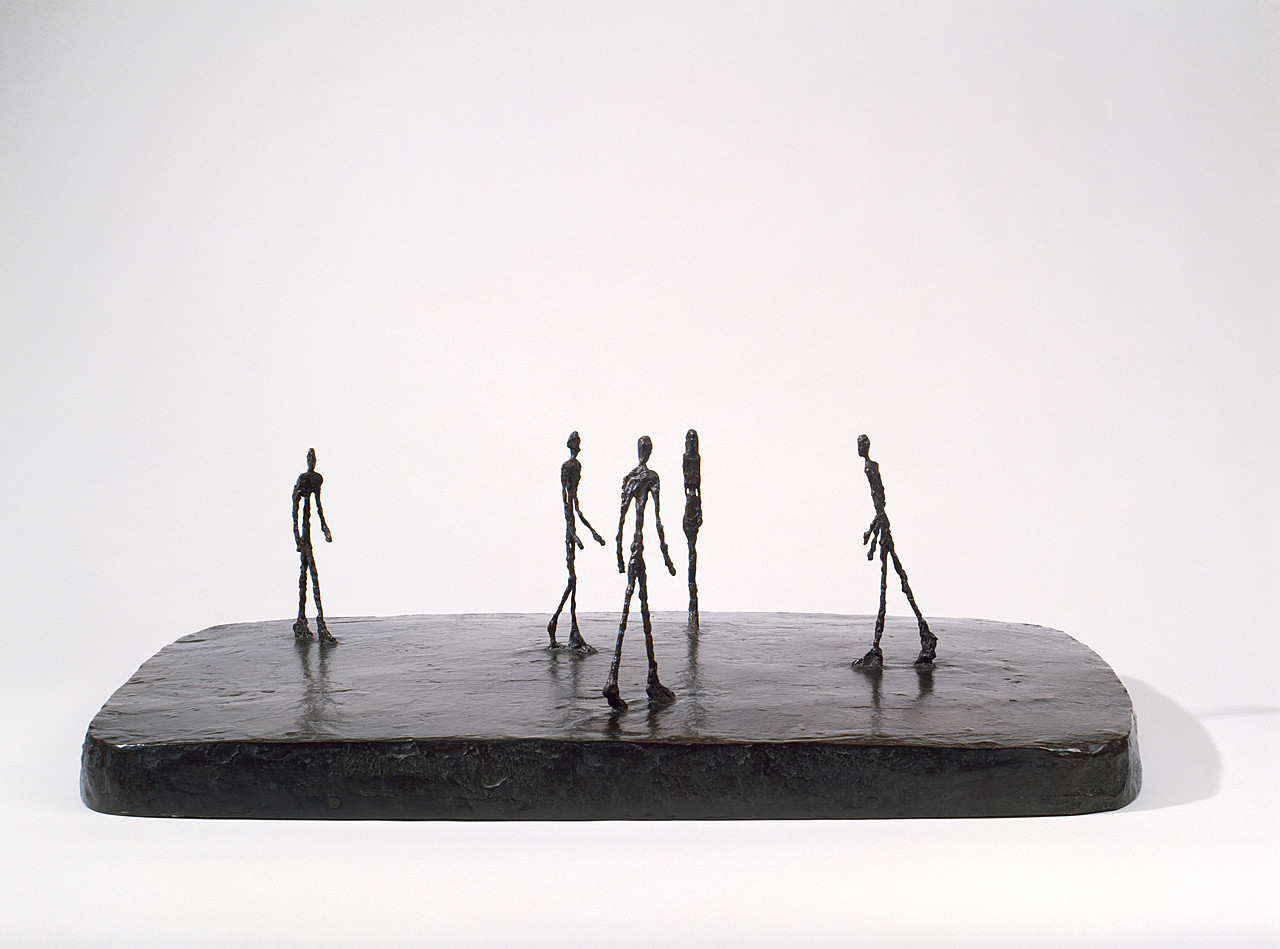
Notice the scale: the figures are small enough to observe from above, which immediately makes you a kind of god or surveillance camera looking down on a city scene. Their elongation is most visible from the side — thinner than any human body could be, as if the sculptor has subtracted from them until only the gesture of being upright and moving remains. Five figures cross a flat bronze base that could be the pavement of any city, near one another yet connecting with none. The work does not represent urban isolation; it produces it.
This is Rodin's ground-level gesture pushed to its limit — the street itself made into sculpture, and you another figure moving through it, equally unnoticed.
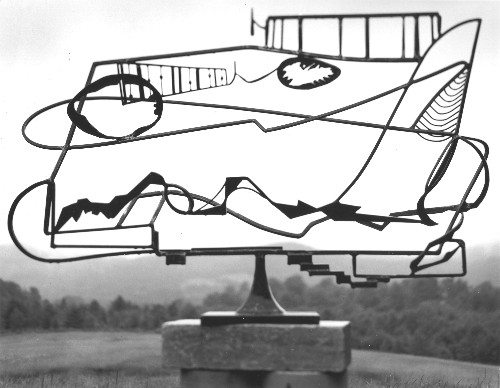
Find the gestural lines of welded steel that trace the horizon and the riverbank — this is drawing in three dimensions, a landscape you can walk around. Smith made it by welding together lines drawn from sketches he took on a train journey along the Hudson, so the finished work is simultaneously a drawing, a landscape, and a sculptural object, occupying a category of its own creation. A factory worker's skills — cutting, grinding, welding — are brought directly into art, the industrial labor high culture preferred to keep out of the gallery made fully visible.
Neither quite drawing nor quite sculpture nor quite landscape — a work that invents the category it belongs to.
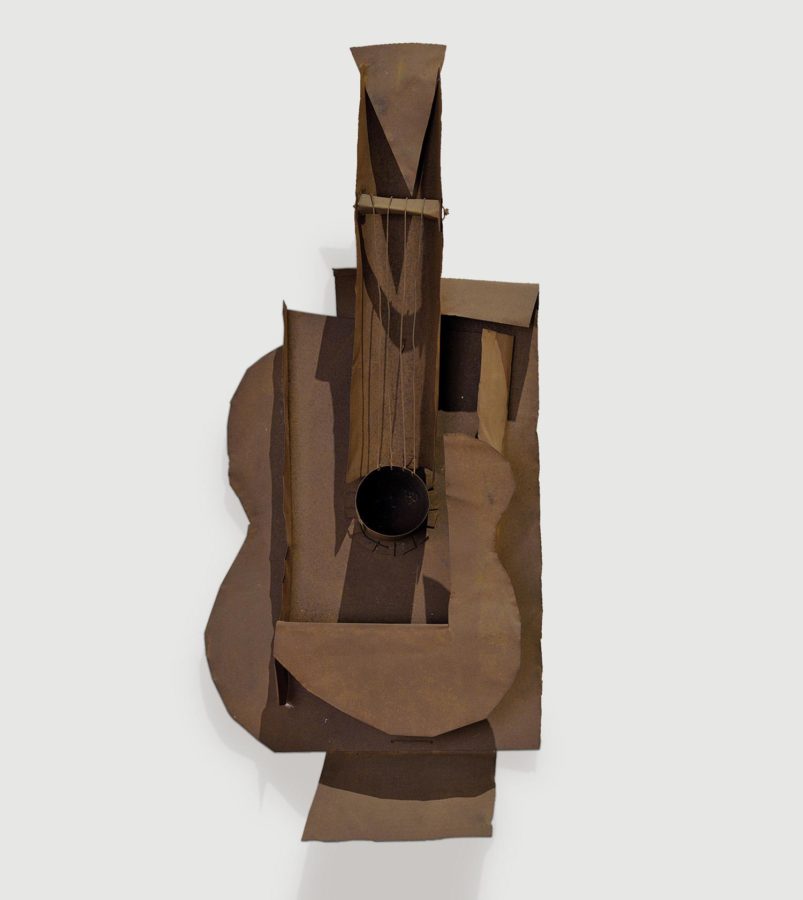
Resist looking at it as a guitar. Instead, notice the construction: flat planes of sheet metal bent and joined at angles, the wire strings, the visible seams and edges. Nothing is hidden or finished smooth. The sound-hole, which on a real guitar is a void, projects *outward* as a cylinder — the negative made positive. This is the first major Western sculpture built rather than carved or cast, a three-dimensional Cubist object that shows exactly how it is put together. It is a guitar the way a Cubist portrait is a face.
The cheap industrial material and visible seams are the point — everything a marble surface was designed to suppress.