Society
A republic without a king, a meritocracy of titles, and a cosmos that runs from a distant creator down to the spirit assigned at a person's birth — the internal logic that makes Umuofia make sense.
The Republic Without a King
The single most important fact about pre-colonial Igbo political life is that the Igbo had no kings. Scholars call the system acephalous — literally, "without a head." Each village was a sovereign unit. Above the family stood no higher individual; above the village council, no higher institution but the ancestral spirits and the Oracle.
Led by the Okpara, the eldest male of the senior lineage.
Direct democracy: any adult male may speak, and decisions require consensus.
Bonds that cut across lineage — collective labor, policing, defense.
The basic unit of political and social life, led by the Okpara — the eldest male of the senior lineage. Within the Umunna, mutual support was not optional; it was the structural foundation everything else rested on.
The highest human authority — direct democracy in which any adult male could speak and decisions required consensus. No speaker, no president, no individual with final authority. The community itself held it.
Cutting across family and lineage, age grades performed collective labor, civic maintenance, policing, and defense — overlapping bonds of peer solidarity that supplemented loyalty to kin and gave the community multiple structures of mutual obligation.
Ọfọ
a ritual object of ancestral authority, held by the eldest male of a lineage — the material presence of the lineage's accumulated dead
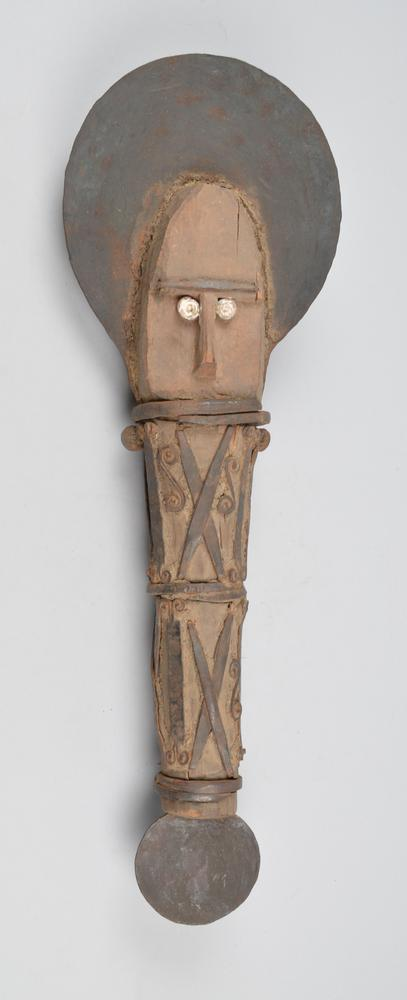
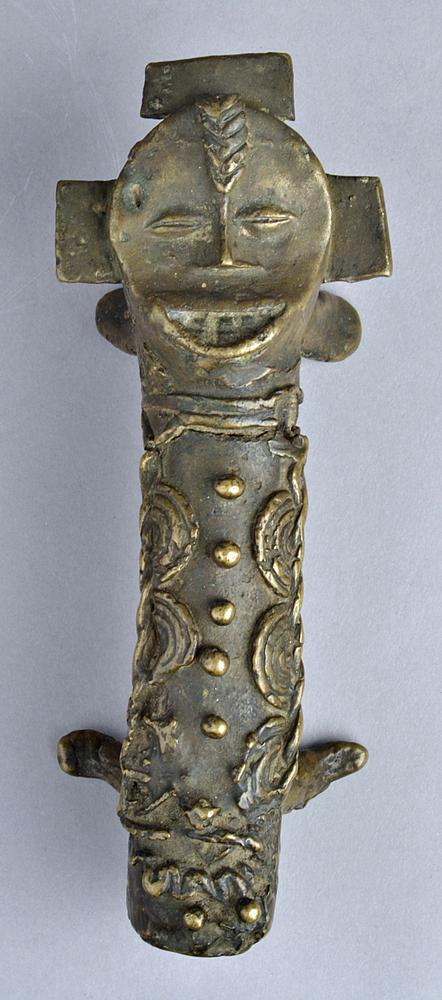
Neither object is a symbol of power so much as a manifestation of it. The Ọfọ is not decorative; when the Okpara speaks with it in his hand, he speaks with the voice of the lineage's dead. A man who holds the Ọfọ and speaks falsely brings the ancestors' wrath upon himself. In a republic with no king, legitimacy is never inherited or enthroned. It is carried, carved, and conferred by the community and its ancestors.
The Title System
The highest honors in Igbo society were never inherited — they were earned and taken. A man climbed a ladder of titles, each bought with accumulated wealth and a feast given back to the whole community, each conferring greater standing and heavier obligation. At the summit stood the Ọzọ title, reached by only a few men in any generation.
Open to any man who could afford it. A title was bought not with money alone but with a public feast that redistributed his wealth back to the community.
The higher a man climbed, the greater his standing — and the heavier his obligations. Title-holders hosted feasts and supported the poor, proving wealth through generosity, not accumulation alone.
The Ọzọ title-holder presided over councils, adjudicated disputes, and spoke with recognized authority. It could not be inherited — every man began at the bottom and climbed on his own.
Because titles were earned and never inherited, a man's starting point counted for nothing. Okonkwo's father Unoka took no titles, grew no yams, and died in debt. In a hereditary system, Okonkwo would have inherited that diminished status. In Igbo society he began from nothing and made himself great — which is exactly what drives his consuming ambition and his consuming terror of failure. The title system that rewards him also produces his pathology: a man who cannot allow himself to look like his father, in any circumstance, at any cost.
Age was respected among his people, but achievement was revered. As the elders said, if a child washed his hands he could eat with kings.
This meritocratic drive is the direct answer to a literature that imagined Africa without achievement or aspiration. Okonkwo's ambition — raw, consuming, recognizable — is the title system in action, and Achebe places a man of such recognizable human drives at the novel's center to make the point impossible to miss.
An Ọzọ title-holder's stool
a titled man's customized seat — the standing he climbed to, made to sit beneath him at every council and public gathering
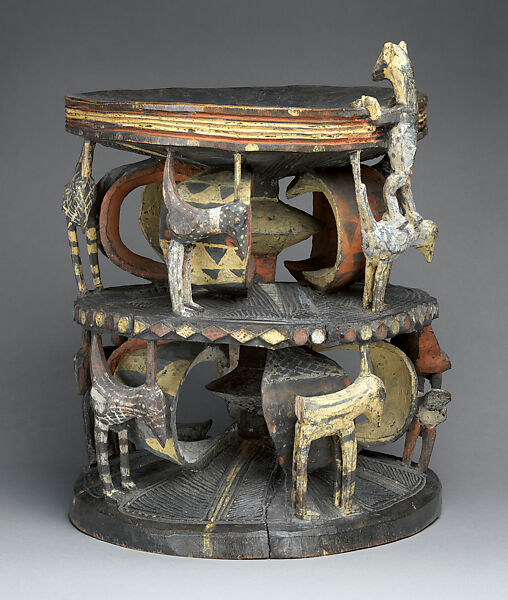
To "take ọzọ" once required far more than a payment. A man underwent a yearlong passage of symbolic death, purification, and rebirth, punctuated by lavish communal feasting at his own expense. The reward was a seat like this one — a customized stool that referenced his status whenever he sat in council. In a republic with no king, authority is never enthroned; it is climbed toward, conferred by the community, and carried in a man's body, his ichi marks, and the seat he has earned the right to own.
The Cosmological World
Igbo religion is not a set of beliefs held separately from political and social life. It is the operating system of those lives — the framework within which governance, justice, agriculture, family, and individual identity all function. To understand why Okonkwo is exiled, why the Week of Peace matters, why the egwugwu's authority is absolute, you have to understand the cosmological structure that makes those things make sense.
The descent begins at the top — with the supreme source from which everything else derives, distant and abstract.
From the cosmic to the immediate: the earth, and the moral force that governs what the community may and may not do.
Down to the level of the single person — the spirit assigned at birth that walks with them through life.
And the institutions that bridge the human and the divine: the ancestral court, and the Oracle whose word is final.
Distant and supreme — not directly petitioned or personally accessible. Interactions with the divine world happen primarily through lesser spirits and deities. The concept has partial analogy to monotheistic traditions, but Igbo theology does not imply a direct personal relationship with Chukwu. He is the ground of being, not a God who intervenes in daily life. Chukwu was not typically represented in figural art — the deity's distance and abstraction made material representation unsuitable. Visual and material religious life in Igboland centered on the alusi (lesser deities) and personal shrine figures, not on Chukwu directly.
Ala governs the land, fertility, and morality. She defines what constitutes an alu — an abomination, a taboo violation. Crimes against Ala are the most serious offenses possible, because they violate the sacred ground on which the entire community depends for its survival. When Okonkwo accidentally kills a clansman's son and is immediately sent into exile, the punishment is not social censure — it is the community's necessary response to protect itself from Ala's wrath. The crime is against the earth itself.
The chi is neither a deity nor an impersonal force like fate, but something between the two: the personification of what a person is capable of becoming. "When a man says yes, his chi says yes also" — personal determination and chi work in alignment. But the chi also sets limits. When Okonkwo reflects that his chi has turned against him, he is confronting how much any person can will their own fate, and how much is determined by forces beyond their choice. Achebe deliberately leaves chi untranslated throughout the novel — scholars have compared it to the Hindu concept of karma, the Greek daimon, and the Christian soul, but none of these comparisons fully capture it. By refusing to translate it, Achebe refuses to let the idea be absorbed into a simpler framework.
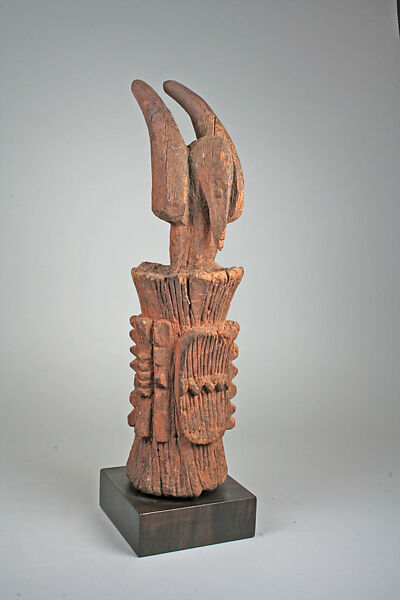
Fig 02Shrine Figure (Ikenga), Igbo artist, Cross River region, 19th–20th c. Wood, camwood. Associated with male achievement and ambition; its ram's horns signify stubborn perseverance, the machete the aggression with which challenges are met. The figure makes visible the same drive that animates Okonkwo — that a man's chi and his own determination work together to shape what he becomes. The Metropolitan Museum of Art, CC0. Object ID 314139.
The Oracle at Awka is the supreme judicial and spiritual authority for Umuofia and the surrounding villages. Its priestess, Chielo, speaks in the god's voice; her rulings carry the weight of divine command. No community goes to war without first consulting the Oracle. When the Oracle decrees that Ikemefuna must be killed, the elders act on that decree without question. The word Agbala carries a double meaning: it is the name of the Oracle, and it is also the insult Okonkwo directs at men without titles — without standing, "like a woman." The Oracle is the source of ultimate authority; the insult is the accusation of ultimate failure. Both derive from the single concept of a person without standing.
The Egwugwu
The egwugwu are men of the village who don elaborate masks and costumes to become, for the duration of the ceremony, the ancestral spirits of the dead. The grammar here is precise: they do not represent or perform the ancestors — they become them. When masked, the man inside is gone; only the spirit is present. Women are forbidden from approaching the egwugwu's compound or knowing what lies behind the masks.
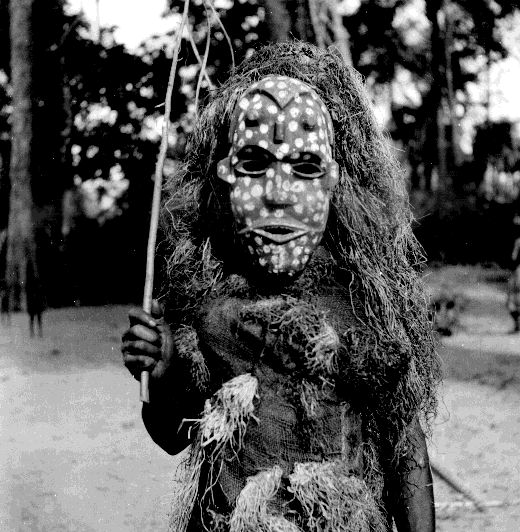
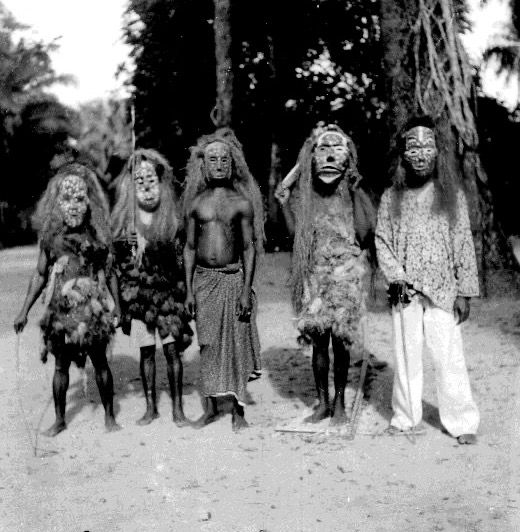
Ekpe masquerade figures photographed by G.I. Jones in southeastern Nigeria, c. 1930–1939 — year-end harvest celebrations honoring ancestors and the earth. In the ceremony, the masked figure is not a man in costume but the ancestral presence itself. © Museum of Archaeology and Anthropology, University of Cambridge.
The egwugwu constitute the highest court in the land. They hear disputes between families and clans that the village council cannot resolve. Their rulings carry the authority of the ancestral dead — the entire accumulated community. When Enoch tears the mask from an egwugwu in the novel's third section, he does not commit an insult or a cultural violation. He kills an ancestor. The egwugwu's response — burning Enoch's compound and the church — follows directly from the logic of what has occurred: a death requires a destructive response in turn.
"Okonkwo's wives, and perhaps other women as well, might have noticed that the second egwugwu had the springy walk of Okonkwo. And they might have noticed that Okonkwo was not among the titled men and elders who sat behind the row of egwugwu. But if they thought these things they kept them within themselves."
The passage above is one of the novel's most carefully managed moments. Achebe allows the reader to see what the women may have noticed — the springy walk, the absence of Okonkwo from his usual place — while also showing that the women keep what they know "within themselves." The egwugwu's power depends on the community's collective maintenance of its necessary fiction. Everyone, at some level, knows what lies behind the masks. The institution functions because everyone agrees to make it function. Colonial disruption of the egwugwu is not simply the tearing away of a costume; it is the destruction of the community's most important shared agreement about how authority works.
Key Practices
Several practices in the novel reward contextual explanation, because each is doing cultural work a first-time reader is likely to miss. The kola nut ceremony, the Week of Peace, and the bride price show the Igbo world's daily forms of hospitality, peace, and kinship. The osu system, the abandonment of twins, and the ogbanje child show that same world at its most difficult — where its cosmological logic produced suffering the novel neither hides nor excuses. Each reflects the Igbo world's internal coherence; the hardest of them also reflect its genuine moral complexity.
ọjị
Presented, broken, and shared before any serious word — to offer kola is to wish life on one another.
Before any serious conversation begins — a visit, a negotiation, a feast, a meeting of kinsmen — kola is presented, blessed, broken, and shared. The host offers it; the guest, by custom, returns it for the host to break, and a brief, courteous contest can follow over who holds the honor. The one who breaks it prays over it, and the lobes are passed and eaten together. "He who brings kola brings life," the novel tells us in its first social scene — and the ceremony means roughly what the proverb says: to share kola is to wish life on one another and to bind the people present into a single fellowship.
The ritual carries the whole Igbo social order in miniature. It enacts hospitality (the host provides), reciprocity and respect for age (the back-and-forth over who breaks it is a courteous negotiation of status, and the lobes are shared beginning with the eldest), and the presence of the ancestors (the breaker prays to them, and a lobe may be thrown to the ground for the dead). The kola is rarely alone: it arrives with alligator pepper, and white chalk belongs to the same welcome — a guest draws lines on the floor with it, a sign of a clean heart and peaceful intent, before the kola is eaten. To break kola together is to be, for that moment, at peace.
This is why a refusal of kola is a rupture, not a discourtesy. When the priest of the earth goddess comes to Okonkwo after he has violated the Week of Peace, Okonkwo offers him kola — and the priest refuses it: he will not eat in the house of a man who has shown disrespect to the gods. To decline the kola is to decline the covenant. The novel never stops to explain the gesture, because in Umuofia no explanation is needed; recognizing its weight is part of reading the book from the inside.
Izu Eke
Before planting, Ala forbids all conflict — the earth must not be shown anger before it is asked to grow.
During the Week of Peace, no one in Umuofia is to speak harshly, let alone raise a hand. The earth must not be shown anger before it is asked to grow. When Okonkwo beats his wife Ojiugo during the Week of Peace, the community's alarm has nothing to do with the violence per se. Okonkwo has offended Ala at the moment she is supposed to be welcoming the new season. The entire community's harvest is at risk. This is one of the novel's early and crucial signals that in Igbo society, individual behavior and communal welfare are inseparable — mediated not through social pressure alone but through the cosmological framework.
Ika-Akalika
Broomsticks exchanged between two families — a bond formed, not a bride bought.
Conducted through a ritual exchange of short broomsticks — avoiding the vulgarity of naming a price for a person's daughter. The bride price is not the purchase of a woman; it is the establishment of a bond between families and the definition of each side's obligations. As rendered in the novel during Obierika's daughter's suitor visit, its negotiation is elaborate, ceremonial, and meaningful — a social form in which the families feel each other out across the broomsticks, and the final arrangement reflects not just economics but the relative standing of the families and the character of the match.
"We shall all live. We pray for life, children, a good harvest and happiness. You will have what is good for you and I will have what is good for me. Let the kite perch and let the eagle perch too. If one says no to the other, let his wing break."
The hardest practices ask the reader to hold two truths at once. The osu system set human beings permanently outside the community; harder still are the two that concern the death of infants. Twins were abandoned at birth; a child who died young and seemed to die again and again was understood as an ogbanje, a spirit-child returning to torment its mother. To a modern reader these are among the most painful pages in the novel. Achebe does not present them so that the reader will approve. He presents them because they were part of the world as it was, and because the novel's deepest subject is the cost, borne first by the most vulnerable, of a cosmology under which a community believed its own survival depended on these acts.
osu
Dedicated to a deity and set permanently outside the community — a status passed down, unchosen.
The osu are people dedicated to a particular deity, or those whose ancestors were so dedicated. Their status is permanent and hereditary; they cannot marry freeborn Igbo, cannot take titles, and are excluded from communal activities.
How a person became osu varied. Some were purchased as slaves and dedicated to a deity — either to atone for a serious crime committed by their community or to seek the deity's assistance in a crisis. When a community member committed a grave offense against Ala, the community could also dedicate that person to the goddess to forestall her wrath. Some people voluntarily sought asylum at a shrine during the transatlantic slave trade era, accepting osu status to avoid being sold. Others were born into it: once a person was osu, their children and all subsequent descendants were osu as well. The original act of dedication — however it occurred, however many generations back — was permanent and hereditary.
When Christianity arrives and Nwoye's fellow converts include osu, the question of whether freeborn Christians and osu Christians can worship together becomes a genuine crisis. The church's willingness to include the osu is one of the real reasons it attracts Igbo people whom the traditional system has marginalized — and one of the reasons Okonkwo and the elders find the church threatening. The osu system is one of the novel's clearest illustrations of Achebe's moral complexity: a society can possess genuine philosophical depth and genuine moral failure simultaneously.
twins
Taken as an offence to the earth and left in the Evil Forest — a practice even a loving father could not justify to himself.
In Umuofia, the birth of twins was an alu — an abomination against the earth goddess. The infants were placed in earthenware pots and left in the Evil Forest, the tract of land outside the village set aside for whatever the community believed Ala had rejected. (This is the same Evil Forest that gives the fearsome lead egwugwu his name: the judge who casts out is named for the ground the cast-out are sent to.) The belief was not casual cruelty. It rested on the conviction that an abomination left unanswered would loose the goddess's wrath not on the offender alone but on the whole clan — "if one finger brought oil it soiled the others."
Achebe renders the practice most powerfully not through the act but through its cost to those who carried it out. Obierika — the novel's most reflective man, Okonkwo's closest friend — sits alone and remembers the twin children his own wife bore and he threw away. What crime had they committed? He finds no answer; he is "merely led into greater complexities." That a thoughtful, loving man performs this and cannot justify it to himself is the point. The novel locates the practice's horror exactly where it belongs: not in the supposed savagery of a people, but in the grief of ordinary parents bound by a cosmology that gave them no other choice they could see.
It is no accident that the abandonment of twins is one of the two things — with the killing of Ikemefuna — that breaks Nwoye and turns him toward the church. When the missionaries take in the rescued twins, they answer "the question of the twins crying in the bush" that haunts him. The practice the clan cannot defend to its own gentlest members becomes one of the openings through which the new religion enters.
ogbanje
A child believed to die and return again and again — the shape a community gave to repeated, unbearable infant loss.
Achebe glosses the word himself: an ogbanje is "a child who repeatedly dies and returns to its mother to be reborn." When a woman lost infant after infant, the deaths were understood as a single malicious spirit-child cycling through birth and death to torment her. The condition could be ended only by finding and destroying the child's iyi-uwa — in Achebe's words, "a special kind of stone which forms the link between an ogbanje and the spirit world." This was the work of the dibia, the diviner-healer who read the spirit world and intervened in it.
The novel gives this belief its fullest and most humane treatment through Ekwefi, Okonkwo's second wife, who buried nine of her ten children. Each loss is understood as the same ogbanje returning. Her surviving daughter, Ezinma, is believed to be one too — and the long episode in which the dibia Okagbue locates and digs up Ezinma's iyi-uwa is, beneath its strangeness, a portrait of a mother's terror and love. Ekwefi believes Ezinma has "come to stay," the text says, "because it was that faith alone that gave her own life any kind of meaning." The ogbanje belief is not presented as a quaint superstition. It is the framework within which a grief-stricken woman makes sense of unbearable, repeated loss — the way a community with no germ theory of infant mortality gave catastrophe a shape, a cause, and the hope of a remedy.
The Igbo society that Achebe renders is not a simple or idealized world. It contains the osu system, the abandonment of twins, the ogbanje child, the killing of Ikemefuna, the subordination of women. Achebe does not sanitize any of this, and he sets it beside the world's real philosophical depth and genuine human achievement, asking the reader to hold both ideas at once. To understand why Obierika threw away his twins, or why Ekwefi submitted to the dibia, is not to endorse it; it is to see these as the acts of fully human people inside a coherent world, rather than as evidence that the world was a darkness awaiting European correction. That double vision is the novel's central demand, and it is nowhere harder to meet than here.