An epic beginning, and the tragic descent it names. What Achebe builds before it breaks, what Okonkwo carries, how the church worked through the culture's own fault lines — and the reasonable paragraph the whole novel was written to answer.
Before you read on
This section discusses major plot events, including the endings of several characters' storylines. If you are still reading the novel, you may want to return to this page after you finish Things Fall Apart.
Spoke Five · Connections to the Novel
The other pages on this site have covered the history and culture that Things Fall Apart inhabits: Igbo political structure and cosmology, the agricultural rhythms of Umuofia, British colonialism and its administrative machinery, the missionaries and the social disruptions they produced. This page builds the connections between that context and the specific cultural claims Achebe makes with his novel.
The Epigraph
Achebe and the Western Canon
Turning and turning in the widening gyre The falcon cannot hear the falconer; Things fall apart; the centre cannot hold; Mere anarchy is loosed upon the world.
— W. B. Yeats, "The Second Coming" (1919)Turning and turning · the widening gyre
Yeats's figure for history — a spiral that widens with every turn until the centre it spun from can no longer hold it. Achebe sets the same gyre spinning over Umuofia.
Achebe opens his novel with four lines from Yeats's "The Second Coming," written in the immediate aftermath of World War I. Yeats's poem is a vision of civilizational collapse — order dissolving, the falcon losing contact with the falconer, the center failing to hold. By choosing this epigraph, Achebe is making a claim before his novel has even begun.
In Yeats, the center that cannot hold is European civilization; the collapse is the crisis of Western modernity. Achebe borrows the image and recontextualizes it entirely. In Things Fall Apart, the center that cannot hold is Umuofia — an African civilization, fully realized on its own terms, destroyed not by internal failure but by external force. The widening gyre is colonial encroachment. The falcon that cannot hear the falconer is Okonkwo, increasingly unable to orient himself within a world that no longer operates by its own rules.
The choice of a Yeats epigraph is itself an argument about literary authority. It is the same gesture made by the novel's epic opening, now at the scale of a single allusion. Invoking the form of the epic genre and borrowing Yeats's lines are two versions of one claim — that Things Fall Apart belongs in the conversation of the Western canon, on equal footing, while telling a story that canon had erased. Achebe is claiming the same weight of tragedy and civilizational stakes for Igbo civilization's collapse that Yeats assigned to the collapse of the European order. There is also a quiet irony in the choice: Yeats could not have imagined his poem about European crisis being repurposed as the frame for an African novel written in deliberate opposition to the assumptions of that same tradition. That act of appropriation is itself a form of the novel's argument — the tools of the colonial literary tradition can be used to tell the story of what that tradition erased.
The Epic Frame
An Epic Beginning
The Epic Invocation
angermēnis — the rage of Achilles
Rage—Goddess, sing the rage of Peleus' son Achilles,
murderous, doomed, that cost the Achaeans countless losses,
hurling down to the House of Death so many sturdy souls,
great fighters' souls, but made their bodies carrion,
feasts for the dogs and birds,
and the will of Zeus was moving toward its end.
A story about superhuman anger and its consequencesTrans. Robert Fagles
manandra — Odysseus as the man
Sing in me, Muse, and through me tell the story
of that man skilled in all ways of contending,
the wanderer, harried for years on end,
after he plundered the stronghold
on the proud height of Troy.
A story about a great man — what it means to be a man?Trans. Robert Fitzgerald
In the ancient Greek tradition initiated by Homer, each poem announces its subject in its opening breath. The Iliad begins with the word "anger" — mēnis, a word normally associated with the anger of the gods that describes the famous rage of Achilles. The Odyssey begins with the word "man" — andra, a word that signifies something like a "man's man," used to describe Odysseus as the man "skilled in all ways of contending." That first word is a promise about the subject of the entire story. The hero who carries the burden of that word represents the values of an entire civilization, written larger than life. The Homeric epics celebrate Greek culture, but they also expose the cost, contradictions, and limitations of Greek cultural values.
"It was this man that Okonkwo threw in a fight which the old men agreed was one of the fiercest since the founder of their town engaged a spirit of the wild for seven days and seven nights."
— Things Fall Apart, Chinua Achebe (opening pages)
Achebe opens Things Fall Apart with a similar focus on the defining characteristics of one man. Okonkwo's wrestling victory is measured not against other men but against a founding myth — "the founder of their town engaged a spirit of the wild for seven days and seven nights." His fame has "grown like a bush-fire in the harmattan." He is "tall and huge"; he "seem[s] to walk on springs, as if he [is] going to pounce on somebody." This is a hero introduced the way epic introduces heroes: as the outsized embodiment of his community's ideals.
If Achebe seems to present his main character as a culture-defining epic hero, he also echoes the Homeric tradition of cultural critique. On the first page, the word Achebe associates with his hero is fame — the public reputation that Okonkwo has gained through achievement and feats of strength. But there is another even more potent word that comes to define the experience of Okonkwo.
"Perhaps down in his heart Okonkwo was not a cruel man. But his whole life was dominated by fear, the fear of failure and of weakness. It was deeper and more intimate than the fear of evil and capricious gods and of magic, the fear of the forest, and of the forces of nature, malevolent, red in tooth and claw. Okonkwo's fear was greater than these. It was not external but lay deep within himself. It was the fear of himself, lest he should be found to resemble his father."
— Things Fall Apart, Chinua Achebe (Chapter 2)
Just as the plot of the Iliad is entirely defined by the anger of Achilles and its horrifying consequences, the fear of Okonkwo is the driving force of the story of Things Fall Apart. Fear of failure and weakness, fear of comparison to his embarrassing father, fear of insufficient manhood, all combine to produce a paralyzing anxiety in Okonkwo that expresses itself in self-defeating acts of cruelty and violence.
Nagy · Herakles · kleos
The Unseasonal Hero
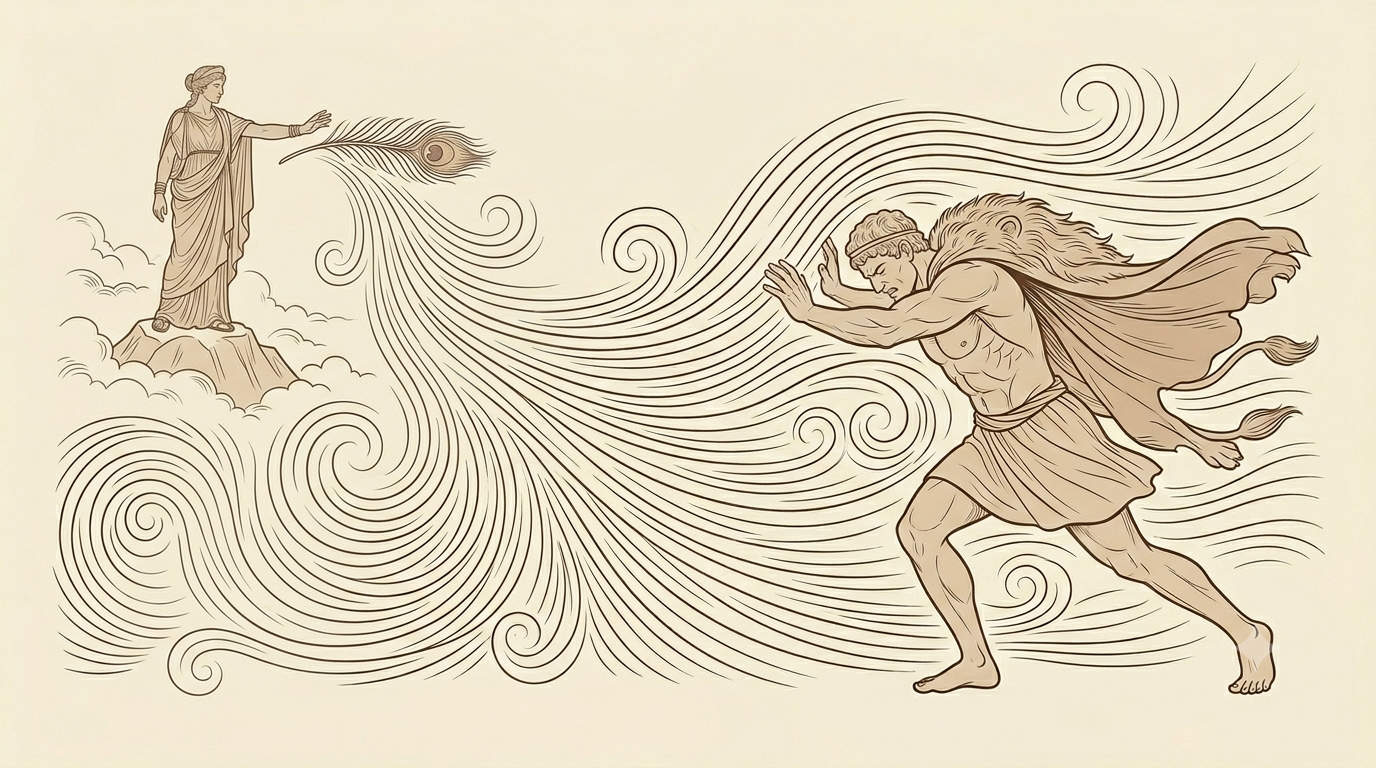
Hera and Herakles. In the reading of classicist Gregory Nagy, the hero's name means "the glory (kleos) of Hera" — the goddess who persecutes him is also the source of his greatness. Original illustration created for this site.
The classicist Gregory Nagy famously defines the ancient Greek conception of the hero as a person who is fundamentally unseasonal — "out of season," born at the wrong time, temporally displaced. The story of Herakles is the defining case that shows that this temporal displacement is the ironic engine of the Greek hero's greatness. The goddess Hera delays his birth so that he is born after, and subordinate to, an inferior cousin, a disadvantage that forces him into the famous Labors that earn his glory. Nagy reads his name itself as the story in compressed form — Hēra + kleos, "the glory that comes from Hera." Kleos is literally the words said about a hero after he is dead, the mortal life that becomes imperishable song. Achilles earns his kleos with an untimely death before the end of the Trojan war; Odysseus is displaced in time and space by the wanderings that keep him away from home for twenty years. According to Nagy, it is exactly the friction created by alienation, displacement, being the wrong person or in the wrong place, that pushes these heroes to the great deeds that lead to a memorable life and generate kleos.
In season → displaced → out of season
Okonkwo begins as the embodiment of his world, the roaring flame that is the literal meaning of his name. Exile uproots him to borrowed ground where his fire begins to flicker. Then Christianity and British authority arrive in a dousing wave to quench his cultural authority forever, reducing an epic life to a paragraph in another man's book.
Okonkwo's story sits in uneasy tension with this Greek conception of heroism. When we meet him, he is the ideal man of Umuofia at its height, perfectly in tune with the world that made him. Over the course of the novel, history and contingency transform him into an unseasonal man. The disastrous explosion of Okonkwo's gun at Ogbuefi Ezeudu's funeral displaces him into seven years of exile. His friend Obierika (another man who seemingly occupies a central cultural position in Umuofia) reflects on the justice of this punishment in one of the most complex moments of cultural representation in the entire novel.
"Obierika was a man who thought about things. When the will of the goddess had been done, he sat down in his obi and mourned his friend's calamity. Why should a man suffer so grievously for an offense he had committed inadvertently? But although he thought for a long time he found no answer. He was merely led into greater complexities. He remembered his wife's twin children, whom he had thrown away. What crime had they committed? The Earth had decreed that they were an offense on the land and must be destroyed. And if the clan did not exact punishment for an offense against the great goddess, her wrath was loosed on all the land and not just on the offender. As the elders said, if one finger brought oil it soiled the others."
— Things Fall Apart, Chinua Achebe (final paragraph of Part One)Anguish weighed against imperativeObierika mourns, and cannot answer his own question. His grief is set on the scale of Ala. The offended earth must be appeased, or her wrath falls on everyone.
Obierika's reflection captures the arbitrary nature of his great friend's punishment, but it also presents both Okonkwo's exile and his own abandonment of his twin children as necessary evils that preserve the fabric of society. When Okonkwo returns to Umuofia, he finds that the colonial encounter has transformed his society into a place where his old authority can find no purchase. The definition of the social good has changed so radically that his attempt to start a violent rebellion against British authority leads to "tumult instead of action." The realization that no one will respond to his call for resistance seems to leave Okonkwo with no other choice but to violate the powerful Igbo cultural taboo against suicide. Obierika is forced to pay the British officials to dispose of his friend's body because "they cannot bury him... Only strangers can." Here we see the ultimate inversion of Nagy's heroic formula. Herakles' unseasonality makes him a hero and earns him immortal kleos; Okonkwo's unmakes him and diminishes his story to a paragraph in the book of a British "stranger."
The Structural Argument
Before the Missionaries
"Okonkwo was well known throughout the nine villages and even beyond. His fame rested on solid personal achievements."
— Things Fall Apart, Chinua Achebe (opening pages)
The most important structural decision in Things Fall Apart is not what Achebe shows but when he shows it. He begins with Okonkwo throwing Amalinze the Cat. He gives the reader Umuofia's governance, its cosmology, its agricultural rhythms, its gender dynamics, its internal tensions — before any British presence has appeared. Part I of the novel is an extended act of cultural construction: a world built on the page so that when it is disrupted, the reader has experienced its logic from the inside.
Western Representations of Africa
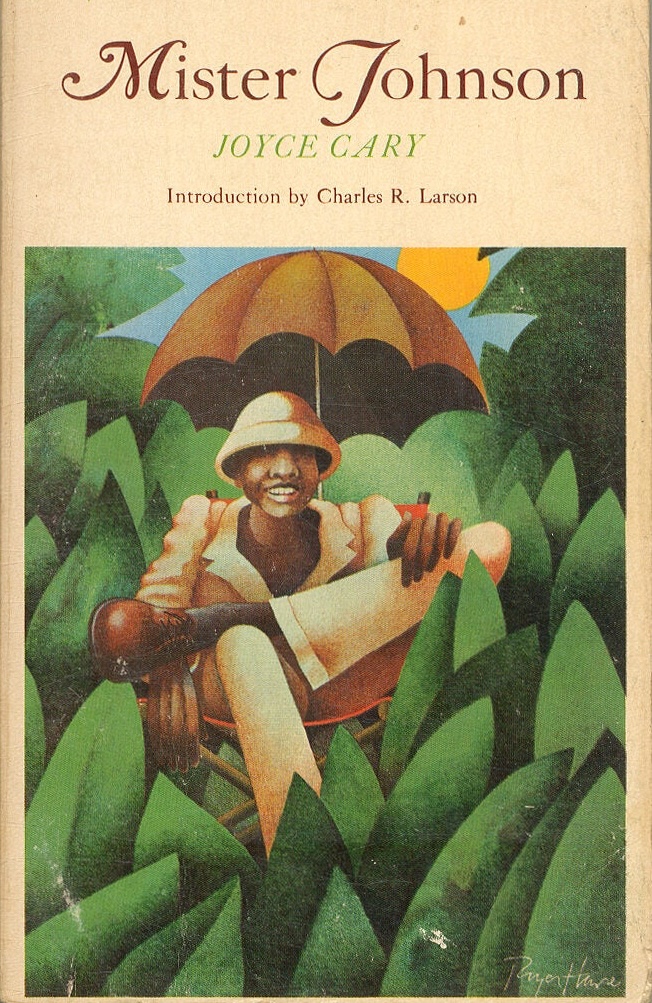
Mister Johnson
Joyce Cary · 1939
A British novel set in colonial Nigeria whose African hero is drawn as a charming, childlike figure with no real inner life. Achebe read it as a student and recognized the distortion — the spark for writing Igbo experience from the inside.
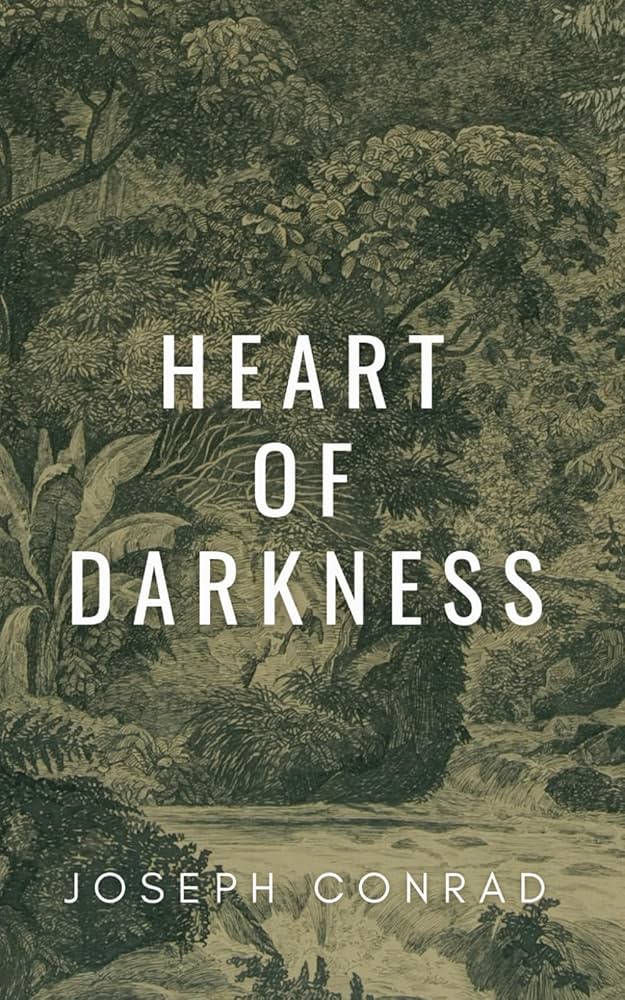
Heart of Darkness
Joseph Conrad · 1899
Conrad's novella renders Africa as a blank, menacing wilderness — a backdrop for European crisis, its people without language or history. Achebe later named its dehumanizing vision directly; Things Fall Apart is the reply.
Achebe's critique of the Western literary tradition — of Conrad's Heart of Darkness, of Joyce Cary's Mister Johnson — was that Africa existed in those books without interiority, without history, without a functioning civilization whose disruption could be experienced as genuine loss. The pre-colonial world was rendered as absence, as darkness, as the condition colonialism was correcting. Achebe renders the pre-colonial world as presence: a functional cultural system, however imperfect, that is being destroyed by hostile encroachment.
The reader who has lived inside Umuofia's justice system — who has watched the egwugwu adjudicate a dispute, understood the Oracle's authority, witnessed the Week of Peace as a genuine communal obligation — experiences the colonial disruption of those institutions as tragic loss rather than civilizing progress. That experience is the structural argument of the novel, built into the sequence of what we are shown and when.
The novel, measured
Most of the reader's experience is the intact world, lived from the inside, before any British presence appears. The disruption — and the administrator's closing paragraph — arrive only at the end. The order is the argument.
The Hero and His Flaw
Okonkwo's Values
"His whole life was dominated by fear, the fear of failure and of weakness… It was not external but lay deep within himself. It was the fear of himself, lest he should be found to resemble his father."
— Things Fall Apart, Chinua Achebe
Okonkwo is a man who has internalized the Igbo achievement ethic completely and amplified it to a pathological extreme. His insistence on masculine strength, his contempt for weakness, his emotional repression, his violence: these are not personal pathologies in a cultural vacuum. They are the Igbo masculine ideal operating at maximum intensity. The title system rewards demonstrated achievement. The community's judgment falls on those, like Unoka, who fail to meet their obligations. Okonkwo has absorbed all of this — and then amplified it, driven by a terror that he will become his father.
The killing of Ikemefuna · a sequenceChinua Achebe · ch. 7–8
The act
The warning
"That boy calls you father. Do not bear a hand in his death." Okonkwo was surprised, and was about to say something when the old man continued: "Yes, Umuofia has decided to kill him. The Oracle of the Hills and the Caves has pronounced it… But I want you to have nothing to do with it. He calls you his father."
The blow
"As the man who had cleared his throat drew up and raised his machete, Okonkwo looked away. He heard the blow. The pot fell and broke in the sand. He heard Ikemefuna cry, 'My father, they have killed me!' as he ran towards him. Dazed with fear, Okonkwo drew his machete and cut him down."
The aftermath
The numbing
"Okonkwo did not taste any food for two days after the death of Ikemefuna. He drank palm wine from morning till night, and his eyes were red and fierce like the eyes of a rat when it was caught by the tail and dashed against the floor. He called his son, Nwoye, to sit with him in his obi. But the boy was afraid of him and slipped out of the hut as soon as he noticed him dozing."
The night
"He did not sleep at night. He tried not to think about Ikemefuna, but the more he tried the more he thought about him. Once he got up from bed and walked about his compound. But he was so weak that his legs could hardly carry him. He felt like a drunken giant walking with the limbs of a mosquito."
The killing of Ikemefuna is the hinge of this strand of the novel's meaning. The Oracle decrees Ikemefuna must die. Ogbuefi Ezeudu tells Okonkwo he has no obligation to participate, but he participates anyway, "because he was afraid of being thought weak." He strikes the killing blow on a boy who called him "father" because his definition of strength has no space for the act of stepping aside.
The night that follows — unable to sleep, thinking of Ezinma as the daughter who "should have been a boy," yet unable to grieve for Ikemefuna — is the novel's earliest and most precise measurement of what the masculine ideal extracts from the men who embody it. His tragedy is simultaneously personal and cultural: the novel suggests that the same values that made Igbo civilization great also produced a structure with built-in vulnerabilities that colonialism could exploit.
Conversion and Tragedy
The Fault Lines of Igbo Culture
"It was not the mad logic of the Trinity that captivated him. It was the poetry of the new religion, something felt in the marrow."
— Things Fall Apart, Chinua Achebe
The arrival of the missionaries in Umuofia is often read as straightforwardly destructive, but Achebe's rendering of their insinuation into Umuofian society is more uncomfortable than that. The church does dismantle Igbo governance and cosmology systematically, but it begins with personal conversions, and those conversions are not irrational.
The clan · the margins · the church
The clan closes around its titled centre and pushes others to its edge. The church is the open ring — marked by the cross — that receives exactly those the circle excluded: Nwoye, the osu, the mothers of twins.
Nwoye hears a Christian hymn and feels something yield inside him — the poetry of the new religion. He cannot meet the demands of Igbo masculine achievement; his father's version of what a man is has been a crushing weight since childhood. The church offers him a different set of values and a community that does not judge him by his father's standards. His conversion is as much an escape from Okonkwo as it is an embrace of Christianity. The osu — the outcast class — find in the church the offer of inclusion they have never experienced. So do the mothers of twins, whose children were left to die in the Evil Forest. The church welcomes those the Igbo system has excluded.
Colonialism succeeded in Igboland partly by embracing the people that Igbo culture had already marginalized. The disruption worked through existing fault lines, and some of those fault lines were real moral failures.
"He heard voices asking: 'Why did he do it?'"
— Things Fall Apart, Chinua Achebe (after Okonkwo kills the court messenger)The death of Okonkwo · a sequenceChinua Achebe · ch. 24–25
The act
The confrontation
"What do you want here?" "The white man whose power you know too well has ordered this meeting to stop."
The blow
"In a flash Okonkwo drew his machete. The messenger crouched to avoid the blow. It was useless. Okonkwo's machete descended twice and the man's head lay beside his uniformed body."
The aftermath
He stood alone
"He knew that Umuofia would not go to war. He knew because they had let the other messengers escape. They had broken into tumult instead of action. He heard voices asking: 'Why did he do it?'"
Against the earth
"That man was one of the greatest men in Umuofia. You drove him to kill himself; and now he will be buried like a dog…" He could not say any more. His voice trembled and choked his words.
Okonkwo's tragedy operates on two levels that the novel refuses to separate. At the personal level, he is a man whose values served him in the traditional world of Umuofia but become lethal liabilities in the world colonialism has made. At the cultural level, his death represents the impossibility of resistance on Igbo cultural terms. He kills a court messenger and looks around to find that no one is following him. The world that made those values coherent has already fallen apart before Okonkwo acts. His suicide by hanging is itself an offense against Ala — he dies in a way that denies him proper burial in the earth he spent his life honoring. The Igbo world that Okonkwo once embodied cannot accommodate the manner of his dying.
What falls apart is specific: village autonomy, the egwugwu courts, the Oracle's judicial authority, the binding force of Ala, the communal solidarity between converts and non-converts. What survives — implicitly, through the act of writing — is the history itself.
The Last Page
A Reasonable Paragraph
The Pacification of the Primitive Tribes of the Lower Niger — the title of the District Commissioner's book, as recorded on the final page of Things Fall Apart. The book does not exist. Achebe invented it to show what the colonial archive does to a human life.
The novel's last page is one of the most precisely calibrated endings in twentieth-century fiction. The District Commissioner walks away from Okonkwo's hanging body. He will not cut it down himself — a district commissioner does not attend to such undignified details. He thinks about his book. Every day in Africa brings him material. Okonkwo's story is interesting. One could almost write a whole chapter about him. "Perhaps not a whole chapter but a reasonable paragraph, at any rate."
Achebe has given the reader two hundred pages of Okonkwo's life: his wrestling match at eighteen, his yam barns, his three wives, his love for Ezinma, his killing of Ikemefuna, his exile, his return, his inability to find anyone to fight alongside him, his death. The District Commissioner will give it a paragraph.
The contrast is the argument. This is what the colonial gaze does to human life: reduces it to administrative material, strips it of interiority and history and tragedy, files it under a title that encodes every assumption the novel has spent two hundred pages dismantling. The District Commissioner is not cruel in any obvious personal sense. That is precisely the point. He considers himself a reasonable man doing important work. Achebe wrote the novel to give Okonkwo back his two hundred pages — to restore the kleos, the glory-in-song that an epic hero is owed and that the colonial archive reduces to a paragraph. The book Okonkwo deserves is the one we have just read; the one the District Commissioner will write is the one Achebe wrote against.