Colonialism
How an empire reached a society it could not read — partitioning a continent in a Berlin map room, inventing chiefs for a people who had none, and reducing a whole world to a paragraph in an administrator's book.
Partitioning a Continent
By the 1880s, European powers were competing intensely for African territory — its raw materials, its land, its strategic position, and the commercial routes to which it offered access. To prevent open conflict between European rivals, German Chancellor Otto von Bismarck convened a conference in Berlin beginning November 15, 1884. Fourteen nations attended.
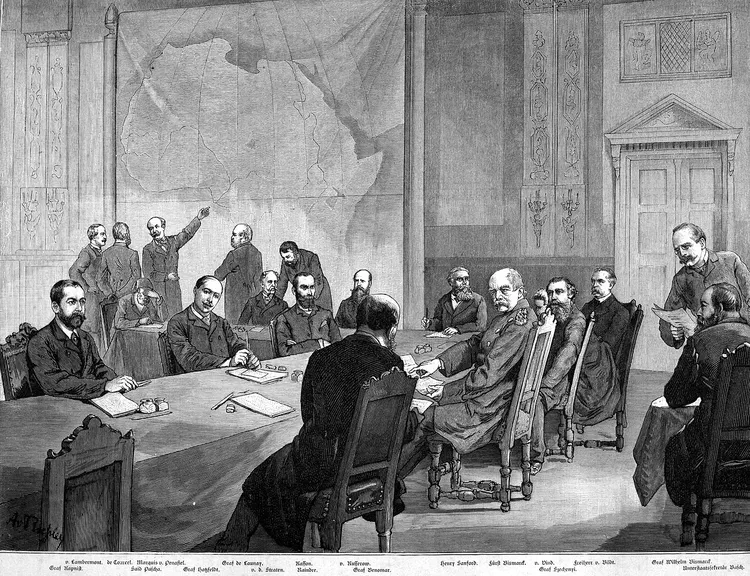
No African representatives were present. No African leaders were consulted.
The conference established the principle of effective occupation: a European power could claim African territory only if it could demonstrate actual administrative control, not merely coastal presence. This principle accelerated what became known as the Scramble for Africa. By 1914, the conference participants and their successors had divided virtually all of Africa among themselves. Only Liberia and Ethiopia remained independent.
Britain's position in the Nigeria region was formalized at Berlin. Through a combination of commercial enterprise — the Royal Niger Company, chartered in 1886 — and military pressure, Britain had been extending its influence along the Niger River for decades. The Berlin Conference ratified this dominance and created the framework within which the Protectorate of Southern Nigeria would be formally established in 1900.
The borders drawn at Berlin and in subsequent negotiations were entirely indifferent to the political, ethnic, and cultural organization of the peoples being divided. The Igbo, Hausa, Yoruba, and hundreds of other peoples with distinct languages, cultures, and governance systems were consolidated into a single colonial entity whose borders reflected European negotiation, not African reality.
Indirect Rule
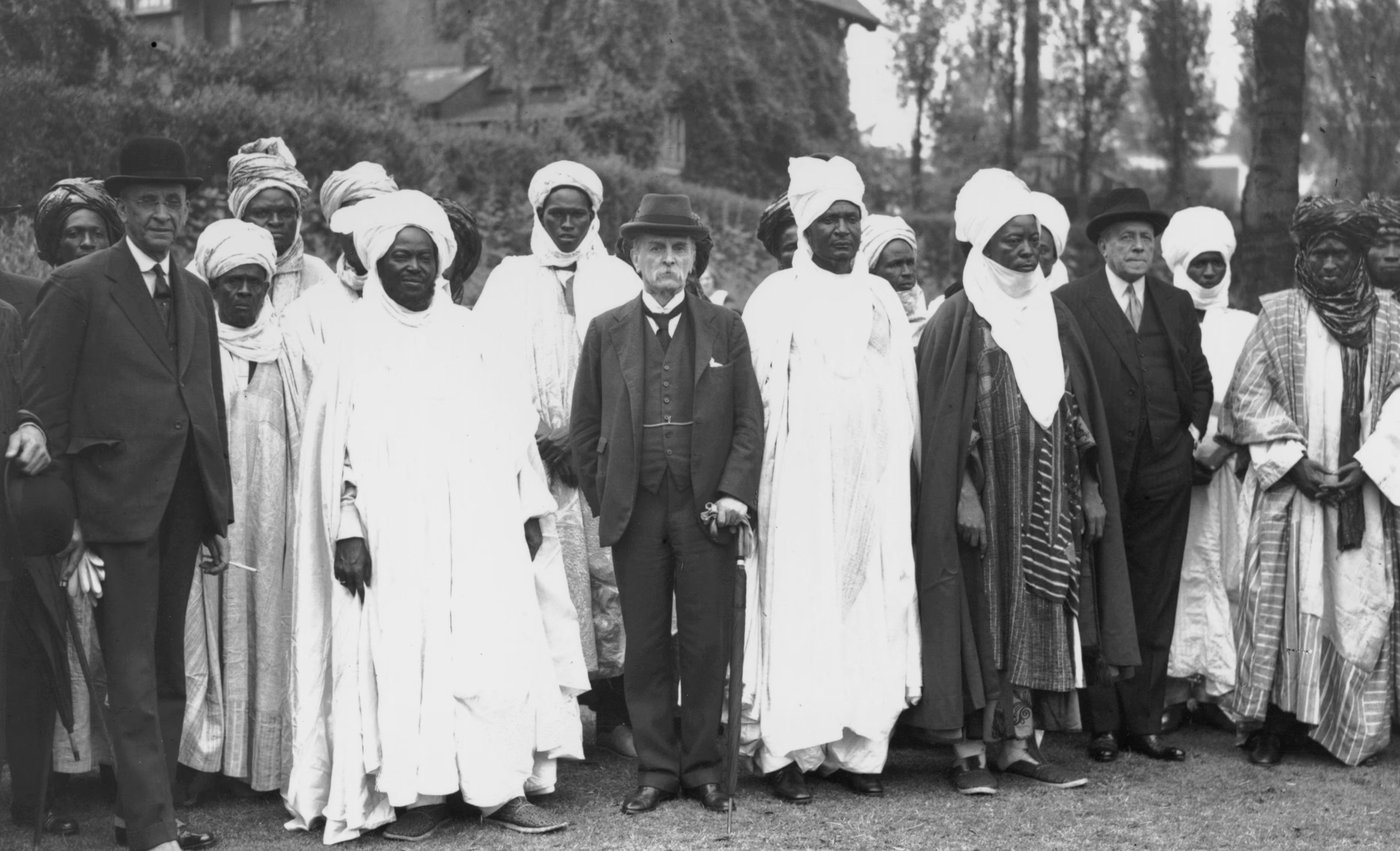
The British colonial strategy in Nigeria was built around the doctrine of indirect rule, developed by Frederick Lugard, who served as High Commissioner of Northern Nigeria from 1900 and as Governor-General of the amalgamated Nigeria from 1914 to 1919. The principle was economical: rather than deploying large numbers of expensive British administrators across a vast territory, rule through existing local authorities — co-opt indigenous leaders, place British officials above them, and use the existing hierarchy to collect taxes, maintain order, and administer colonial law.
In northern Nigeria, indirect rule worked. The Hausa and Fulani of the north had large, hierarchically organized Islamic emirates with established rulers — emirs — who could be absorbed into the colonial administrative framework. In Igboland, it was a catastrophe. The Igbo had no emirs. They had no kings, no paramount chiefs, no permanent rulers with authority over more than a single village. When the British arrived looking for chiefs to co-opt, they found village councils, age grades, and the egwugwu — institutions that did not fit the administrative model they needed.
Their solution was the warrant chief system: the British selected individuals — sometimes arbitrarily, often rewarding those most willing to collaborate — and issued them written warrants granting colonial authority over their communities. These warrant chiefs were frequently men with no traditional standing. Without traditional legitimacy, they depended entirely on British backing to maintain their authority, frequently using that backing to enrich themselves and settle personal scores. The system was corrupt by design.
"The white man is very clever. He came quietly and peaceably with his religion. We were amused at his foolishness and allowed him to stay. Now he has won our brothers, and our clan can no longer act like one."
The women's traditional sanction — gathering at a man's compound to shame him from office, called "sitting on a man" — scaled into mass action against the warrant chiefs.
The most dramatic demonstration of the warrant chief system's failure came in the Women's War (Ogu Umunwanyi) of 1929 — two decades after the novel's setting. Tens of thousands of Igbo and Ibibio women mobilized through traditional women's associations that the colonial administration had entirely failed to account for or understand. They marched to Native Court buildings, demanded the resignation of the warrant chiefs, and were met with force: thirty-two women were killed. In the aftermath, the British conducted a formal inquiry, acknowledged the system's failures, and began studying Igbo governance seriously for the first time. The system was eventually dismantled and replaced with a structure more attentive to actual Igbo political organization.
This event postdates the novel's setting, but it illustrates what the warrant chief system produced — and the kind of organized resistance that Okonkwo, in the novel's final section, fails to inspire.
Disruption Through Respect
The missionaries who arrive in Things Fall Apart are not uniformly brutal or contemptuous. Mr. Brown, the first missionary to establish a lasting church in Umuofia, is patient, genuinely curious, and willing to engage seriously with Igbo theology. He learns the language. He sits with the elder Akunna for long philosophical conversations. He treats Igbo religion with intellectual respect.
He is also the most structurally effective agent of colonial disruption in the novel.
The Church Missionary Society and the Roman Catholic Mission arrived ahead of formal colonial administration in many areas, establishing schools and congregations before district commissioners appeared. Mission schools became the primary pathway to Western literacy and education, which quickly became the primary pathway to employment in the colonial administration. The missionaries were not simply converting souls; they were producing the administrative class that would govern colonial Nigeria.
The church also specifically targeted the margins of Igbo society — the osu (outcasts), the mothers of twins, those who had suffered most under Igbo hierarchical norms. The church offered them dignity, inclusion, and a community outside the system that had excluded them. Nwoye, who cannot meet his father's demands for masculine achievement, finds in the church a different set of values and a different community. His conversion is not simply religious; it is an escape from a structure within which he cannot succeed.
"It was not the mad logic of the Trinity that captivated him. It was the poetry of the new religion, something felt in the marrow."
This is one of Achebe's most uncomfortable arguments: colonialism succeeded partly because the culture it displaced had its own exclusions, and some of the people most desperately seeking escape from those exclusions were willing to accept the alternative the missionaries offered. The church exploited not only Igbo culture's strengths but also its genuine failures.
Cultural Substitution
Colonial administration did not simply add new institutions alongside existing ones. It replaced Igbo institutions, function by function, with colonial equivalents that operated on entirely different principles.
Colonial administration did not merely add new structures to Igboland. It replaced the institutions through which Igbo political, judicial, and social life functioned. What remained was not Igbo governance modified by colonial presence — it was colonial governance occupying the space where Igbo governance had been.
The District Commissioner who appears in the novel's final section considers himself a reasonable man, engaged in a civilizing project. He has spent years bringing order to different parts of Africa, and he plans to write a book about his experience. Its title — The Pacification of the Primitive Tribes of the Lower Niger — is Achebe's summary of the self-image of the entire colonial project. The title encodes every assumption the novel has spent two hundred pages dismantling: that the Igbo were primitive, that what happened to them was pacification, and that the story belongs to the man with the pen.
"The story of this man who had killed a messenger and hanged himself would make interesting reading. One could almost write a whole chapter on him. Perhaps not a whole chapter but a reasonable paragraph, at any rate. There was so much else to include, and one must be firm in cutting out details."