World
Late-nineteenth-century Igboland — autonomous village republics, an economy built on the yam, and a calendar of sacred time. Achebe renders this world whole and working from the inside, before any colonial presence appears to disrupt it.
Igboland
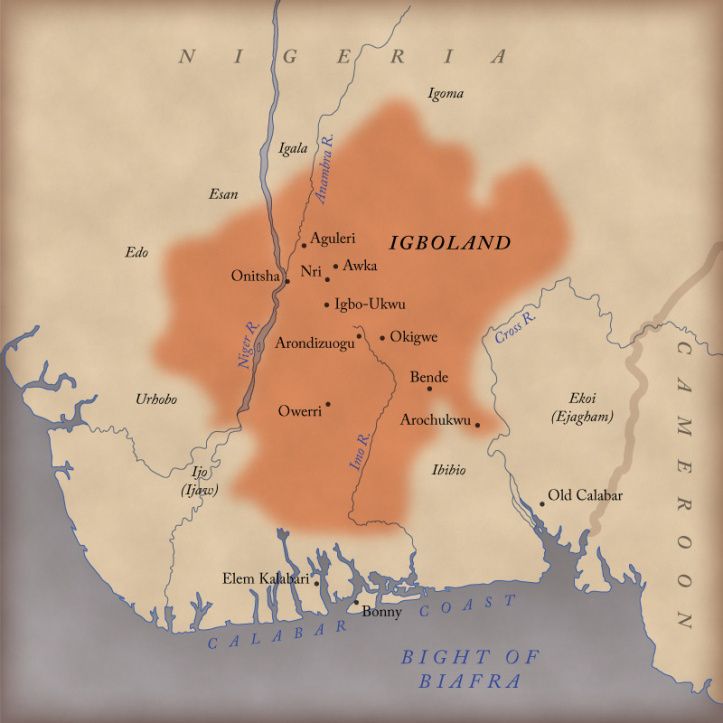
Things Fall Apart is set in the late nineteenth century in Igboland — the southeastern region of present-day Nigeria, in the territory of the lower Niger River. The novel follows Okonkwo, a man of considerable standing in the village of Umuofia, across the final years of his world's existence as an autonomous, self-governing community. By the time the novel ends, that world has been enclosed by British colonial administration.
The Igbo homeland was not a political nation. Before European colonization, the Igbo lived in hundreds of autonomous village communities, connected by shared language, cultural practices, and religious beliefs, but without a single centralized government or ruler. Each village was a sovereign republic, governing itself through councils of elders, age grades, and a meritocratic title system.
Hundreds of self-governing villages, no capital among them. Umuofia — the novel's setting — is one such loosely organized federation: nine villages bound to their neighbours for defense and ritual, representative of the whole.
This political organization was not a failure to develop centralized governance. It was a fully developed alternative to it. The significance of this distinction becomes clear when the British arrive and discover they have no chiefs to co-opt. The story of what happens next — how the British imposed the fiction of chiefs on a society that had none — is one of the historical through-lines traced by this site.
ọfịa forest
Umuofia is renowned for its military strength and for the power of its agadi-nwayi, the spirit of the old woman. It is "never beaten" in war, and its Oracle holds authority over the surrounding region. For the novel's purposes, it is representative: what happens to Umuofia is what happened across Igboland.
Before the Missionaries
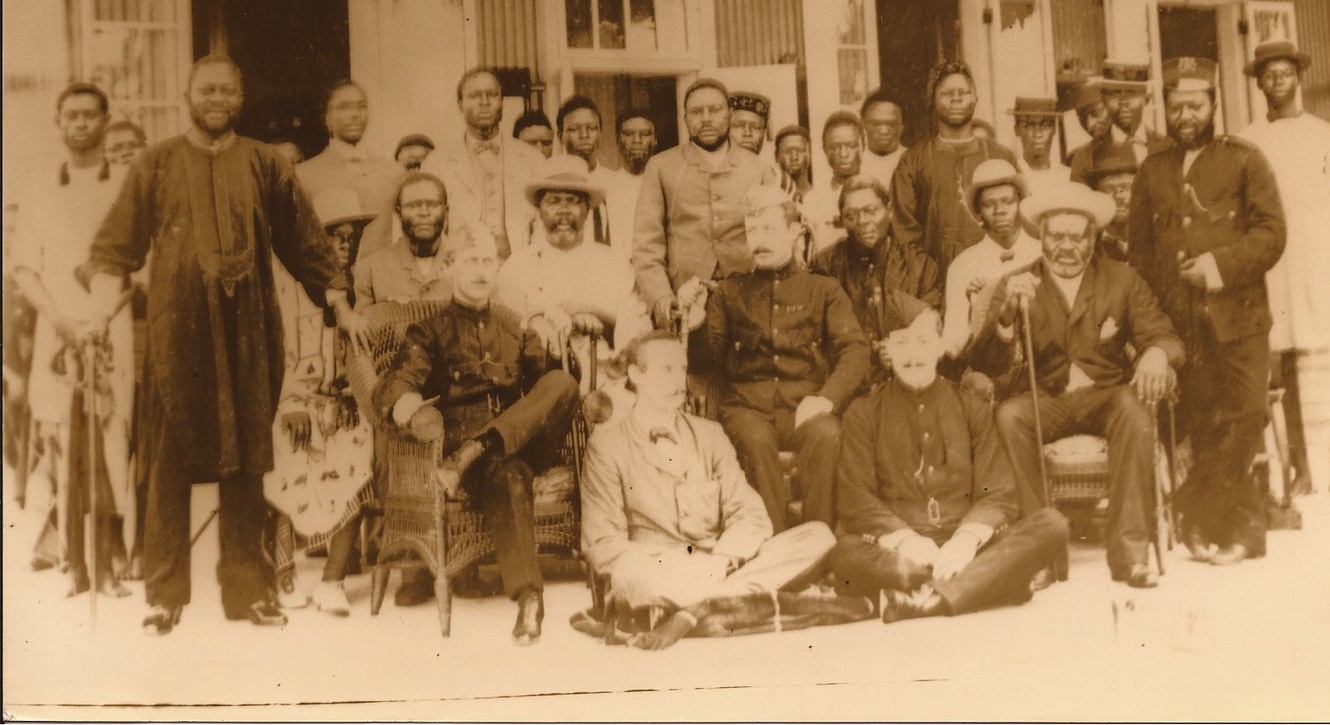
Things Fall Apart does not start with the arrival of missionaries or the establishment of colonial administration. It opens with Okonkwo throwing Amalinze the Cat in a wrestling match. The story begins inside a fully functioning, internally coherent world — its governance, its cosmology, its economy, its social obligations — before any colonial presence has appeared.
Age was respected among his people, but achievement was revered. As the elders said, if a child washed his hands he could eat with kings.
This temporal choice constitutes a deliberate literary argument. Readers of Things Fall Apart spend the majority of the novel inside a world that works before they see that world disrupted. By the time the missionaries appear, readers already understand what is being disrupted from the inside — not as outsider observers of an alien society, but as people who have been given access to a civilization's internal logic.
Chinua Achebe was explicit about why this mattered. He had grown up reading British novels about Africa — including Joyce Cary's Mister Johnson — in which Africa existed as backdrop for European narratives and Africans existed without interiority, without history, without fully realized culture. He had been taught, through colonial education, to identify with the white characters in those novels, not the African ones. Things Fall Apart was his correction: a novel in which an African civilization is the subject, not the setting, and in which that civilization's destruction is tragedy rather than progress.
The Yam Economy
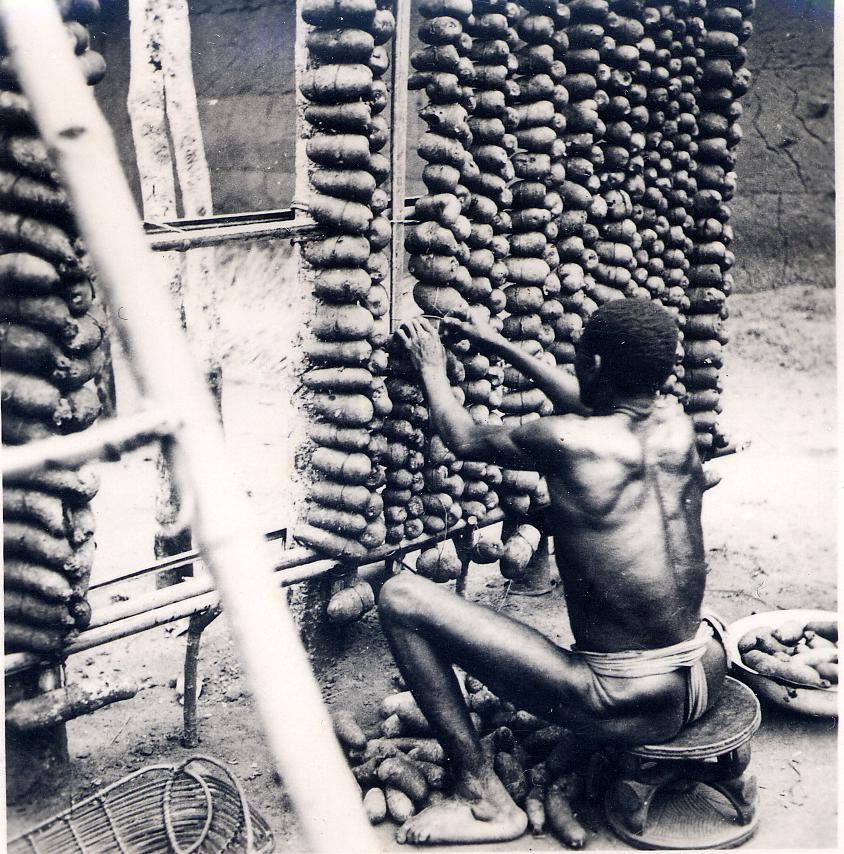
In Umuofia, the yam is not a crop — it is the organizing principle of social life. Yam farming defines masculine status, structures the relationship between wealth and labor, and ties a man's standing to the earth he works.
A man's barn was the measure of his standing — and most men began in another man's debt. Okonkwo starts the novel borrowing 800 seed yams from Nwakibie, on shares; season by season, a full barn is what marks "a great man."
Yam cultivation was men's work, and hard — clearing, mounding, planting, staking, weeding, harvesting across the year. A man's harvest was the direct index of his standing: "Yam stood for manliness," Achebe writes, "and he who could feed his family on yams from one harvest to another was a great man indeed."
The economy also ran on dependency. A young man without land borrowed seed yams from an established farmer, on shares — the arrangement Okonkwo has with Nwakibie at the novel's start. The obligations of that debt shape his character as much as his ambition does.
of all he has built
In Umuofia, a man's compound — his obi, his barns, his wives' huts, the space his family inhabits — is the physical expression of everything he has built. Okonkwo's compound is substantial: three wives, barns full of yams, a reputation established through wrestling, war, and consistent agricultural achievement.
A compound built in thatch and red earth. The obi — larger and more elaborately roofed than the rest — faces the gate across the courtyard, the head's watchpoint over all who come and go. Round mkpuke shelter each wife; the elevated ọba guards the yams; a standalone shrine holds the ancestors. Okonkwo's compound at the novel's start — three wives, full barns, a prominent obi — is a physical record of everything he has built.
Sacred Time
the season of rest
The harmattan is the wind of the dry season — the season of rest between harvests, of wrestling matches and storytelling, of the activities that fill the time when the fields lie fallow. It is the season in which the novel begins. The agricultural calendar marks time in Things Fall Apart as clearly as the clock marks time in a Western novel; knowing where the community is in its farming year tells the reader what kind of time it is.
Four market days make a week — izu. Seven weeks make a moon — ọnwa, twenty-eight days. Thirteen moons make a year — afọ — plus a single extra day at its close. The calendar is lunar: each month opens on a new moon. Below is one such week.
Igbo communities organized time on a four-day week — not the seven-day week of the Western calendar but a cycle of four market days, each named for a guardian spirit, each tied to one of the four directions, and each carrying its own associations: Eke, Orie, Afọ, and Nkwọ. Villages near each other held their markets on different days, so a trader could move between them across the week.
The Week of Peace is the most sacred period in the Igbo agricultural calendar — the seven days before planting during which the earth goddess Ala prohibits all conflict. No one in Umuofia is to speak harshly, let alone raise a hand. The earth must not be shown anger before it is asked to grow.
Okonkwo beats his wife Ojiugo during the Week of Peace — not because he does not know what the Week is, but because his furious, controlling temperament cannot contain itself when he discovers she has gone to braid her hair without preparing the afternoon meal. He is punished by the priest of Ala, Ezeani, who tells him: "You have committed a great evil." The punishment is not merely social; it is cosmological. Okonkwo has shown the earth goddess contempt at the moment she most demands reverence.
The Week of Peace episode is the novel's first demonstration of how Igbo sacred time works — and of how Okonkwo's defining flaw operates within it. He is not ignorant of the law. He simply cannot govern himself. This is the crack in the foundation that the novel will spend the rest of its pages widening.
The Infrastructure of Community Life
Sacred time in Igboland is not merely a religious concept; it is also an administrative one. The calendar structures when fields are cleared, when yams are planted, when the egwugwu emerge to administer justice, when marriages can be arranged, when wars can be fought. The Igbo week is the infrastructure of community life.
Achebe immerses the reader in this infrastructure before any outside force arrives, so that when that infrastructure is disrupted — when the colonial administration and the church impose their own calendar — the reader already intimately knows the world that is being replaced.