Introduction
The Renaissance represents one of the most dramatic shifts in the history of European art. Painters developed sophisticated techniques to make paintings look like windows onto the three-dimensional, physical world. This was not just a technical achievement but a philosophical revolution. To paint a measurable space with individual human beings standing in it was to declare that the physical world, and the individual’s experience of it, mattered.
This is the visual art of Hamlet’s intellectual world: the world of the soliloquies, of a mind that insists on examining itself and its surroundings with relentless rational attention. Where Medieval painting served the certainties of faith, Renaissance painting reflects the inquiries of humanism.
Figure & Space
How is the human figure placed within the pictorial space?
The great invention of the Renaissance was linear perspective — a mathematical system for creating the illusion of depth on a flat surface. Parallel lines converge at a vanishing point on the horizon, and figures diminish in size as they recede. For the first time, the viewer is positioned at a specific point in space, looking into the painting as if through a window. The human figure now stands on solid ground in a rational, navigable world, the visual equivalent of humanism. The individual now has a place, a body, a point of view.
Connection to Hamlet
Hamlet is ’s most Renaissance character, a Wittenberg student who insists on seeing for himself, testing claims against evidence, and locating himself precisely within the world he inhabits. The intense interiority of the soliloquies in which Hamlet examines his own thoughts and motives is the literary equivalent of perspective: a single consciousness positioned at a specific point, looking outward and trying to make sense of what it sees. But notice the tension: Hamlet inherits a medieval world of duty, honor, and ghostly commands, while possessing a Renaissance mind that questions everything. He is caught between the gold-ground certainty of his father’s world and the perspectival complexity of his own.
Light & Shadow
How does the painting use light — its source, quality, and emotional effect?
Renaissance light becomes naturalistic. It comes from a specific direction and casts real shadows. developed sfumato, a technique of softly blending tones to create an atmospheric haze that gives figures a mysterious, living quality. Light now reveals form: it curves around a cheek, catches an eye, models the folds of drapery. The world has become something that can be directly seen and measured, rather than something received on faith.
Connection to Hamlet
Renaissance light is the light of rational inquiry — it illuminates by falling on objects from a particular angle, revealing their three-dimensional reality. Hamlet, too, seeks to illuminate: “I know not ‘seems,’” he insists, demanding that appearances yield to truth. Yet in the play, the things most worth seeing — Claudius’s guilt, Gertrude’s complicity, Hamlet’s own motives — remain stubbornly resistant to clear illumination. The play is full of scenes of watching and being watched (the play-within-the-play, the eavesdropping scenes), as if the Renaissance confidence that light reveals truth is being tested and found insufficient.
Brushwork & Surface
What is the physical character of the paint itself?
Renaissance painters developed oil painting, which allowed far greater subtlety than tempera. Oils could be blended smoothly, layered in translucent glazes, and worked over long periods. The brushwork is controlled and largely invisible, seeking to create a seamless illusion. A great painting should look like the world, not like paint applied to a flat surface.
Holbein’s The Ambassadors is the supreme demonstration of Northern Renaissance oil technique. Two French diplomats stand in a space packed with objects — globes, instruments, a lute, an open hymnal — rendered with such microscopic precision that the surfaces of silk, fur, wood, and metal are individually convincing. The painting also quietly presents a contradiction of everything it seems to represent at first glance. Stretched diagonally across the lower foreground is a large anamorphic skull — visible as a skull only if the painting is viewed from an extreme angle — which can only be seen correctly when you step aside from the painting’s own rational vantage point. The technique that renders the world perfectly legible also allows an oblique reminder that legibility has limits, delivered by an image that pointedly references the medieval memento mori.
Connection to Hamlet
The smooth, invisible surface of Renaissance painting — the surface that asks the viewer to forget it is a surface and look through it to the world beyond — connects to one of the play’s central preoccupations: the relationship between surface and depth, appearance and reality. Hamlet distrusts surfaces (“Seems, madam? Nay, it is. I know not ‘seems’”), yet the play itself is a brilliantly crafted surface of language through which we apprehend a complex psychological world. The Renaissance painter’s ambition to make a perfectly transparent window onto reality mirrors the dramatist’s ambition to make speech sound like thought.
Looking Back
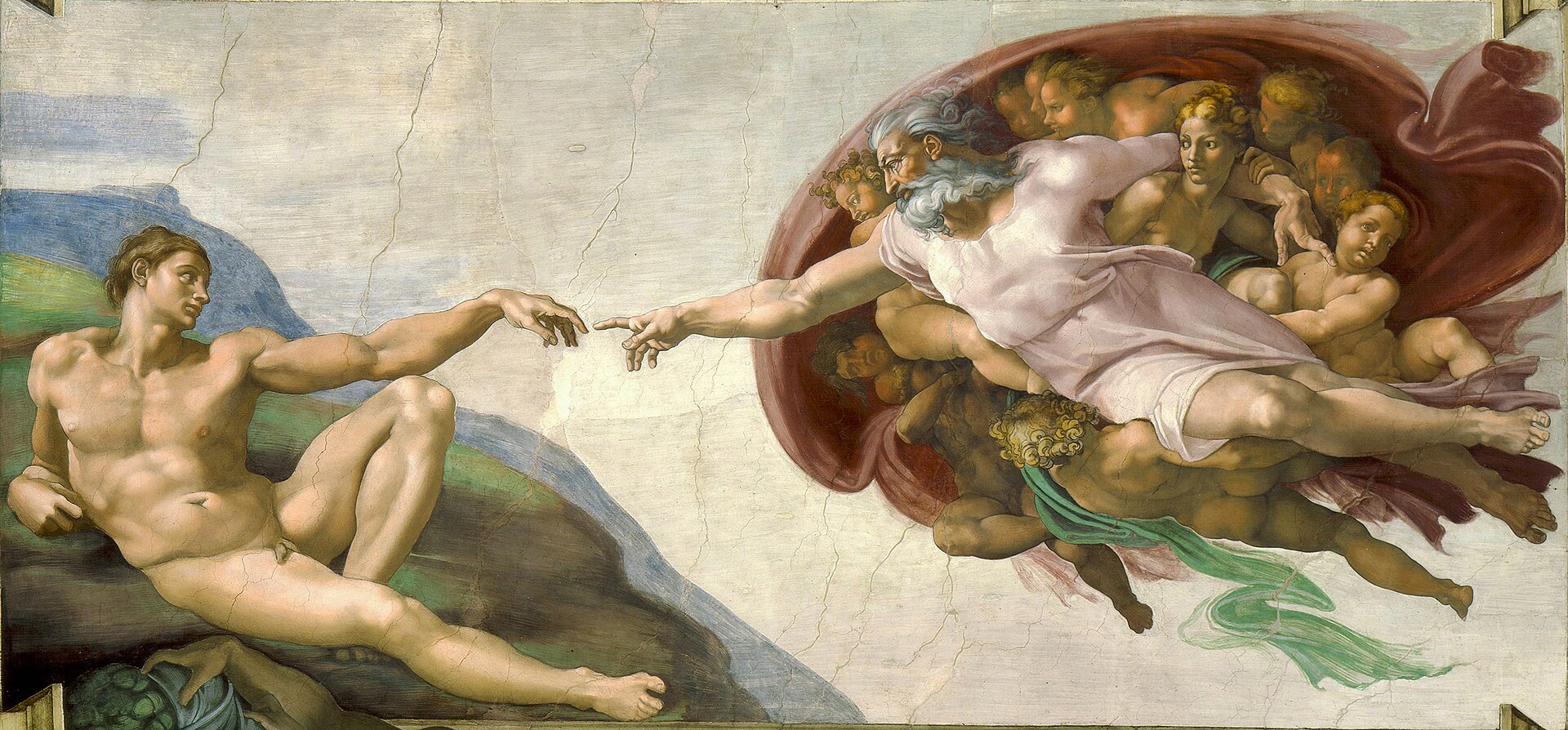
Compare the Creation of Adam to ’s Annunciation and the revolution is visible instantly. The gold ground is gone, replaced by sky and earth. The figures are no longer floating symbols arranged by spiritual rank; they are anatomically real bodies with muscles, weight, and physical presence. Light falls from a specific direction.
Looking Forward
The Baroque will take Renaissance rationality and shatter its calm. Where the Renaissance placed figures in balanced, harmonious spaces bathed in even light, Baroque painters will plunge their canvases into dramatic darkness pierced by violent shafts of illumination. Where Renaissance composition is stable and centered, Baroque composition will be dynamic, diagonal, and emotionally turbulent. The confidence that the rational mind can comprehend and reproduce reality will give way to a sense that the world is a theater of forces larger than any individual — the world of ’s Paradise Lost.
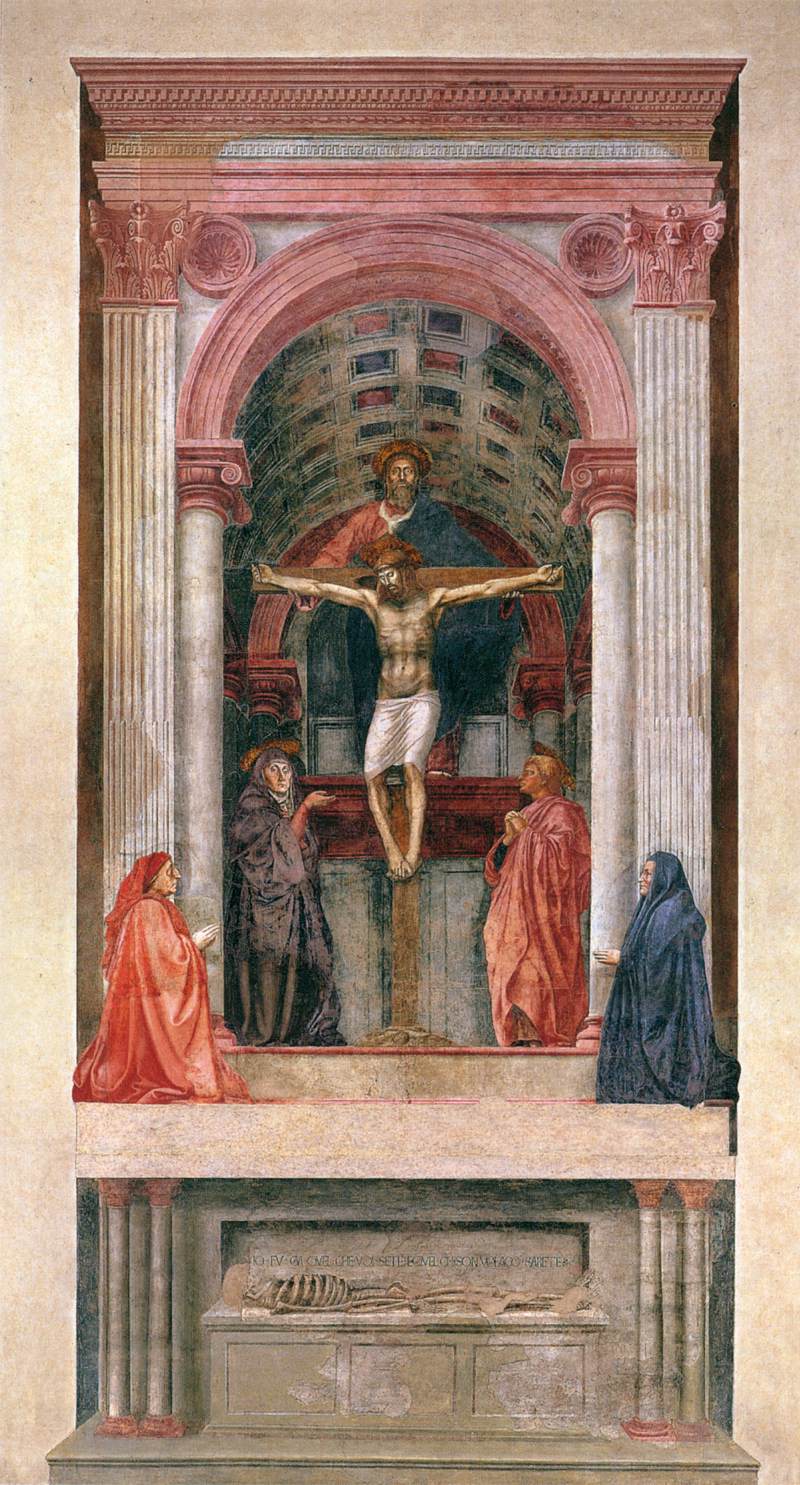
A barrel-vaulted chapel appears to open into a flat wall of Santa Maria Novella — coffered ceiling receding in measured steps, architecture that could be built. The whole illusion is organised around a single vanishing point set low, at the eye level of someone standing on the church floor. Below the painted chapel lies a tomb with a skeleton; above it, God supports the cross of his son. The perspective does not decorate the theology. It delivers it, as a measured space rising from a corpse to God with the viewer standing at the bottom of it.
Find the vanishing point, then notice where it puts you — on the floor of the church, looking up into a chapel that isn't there.
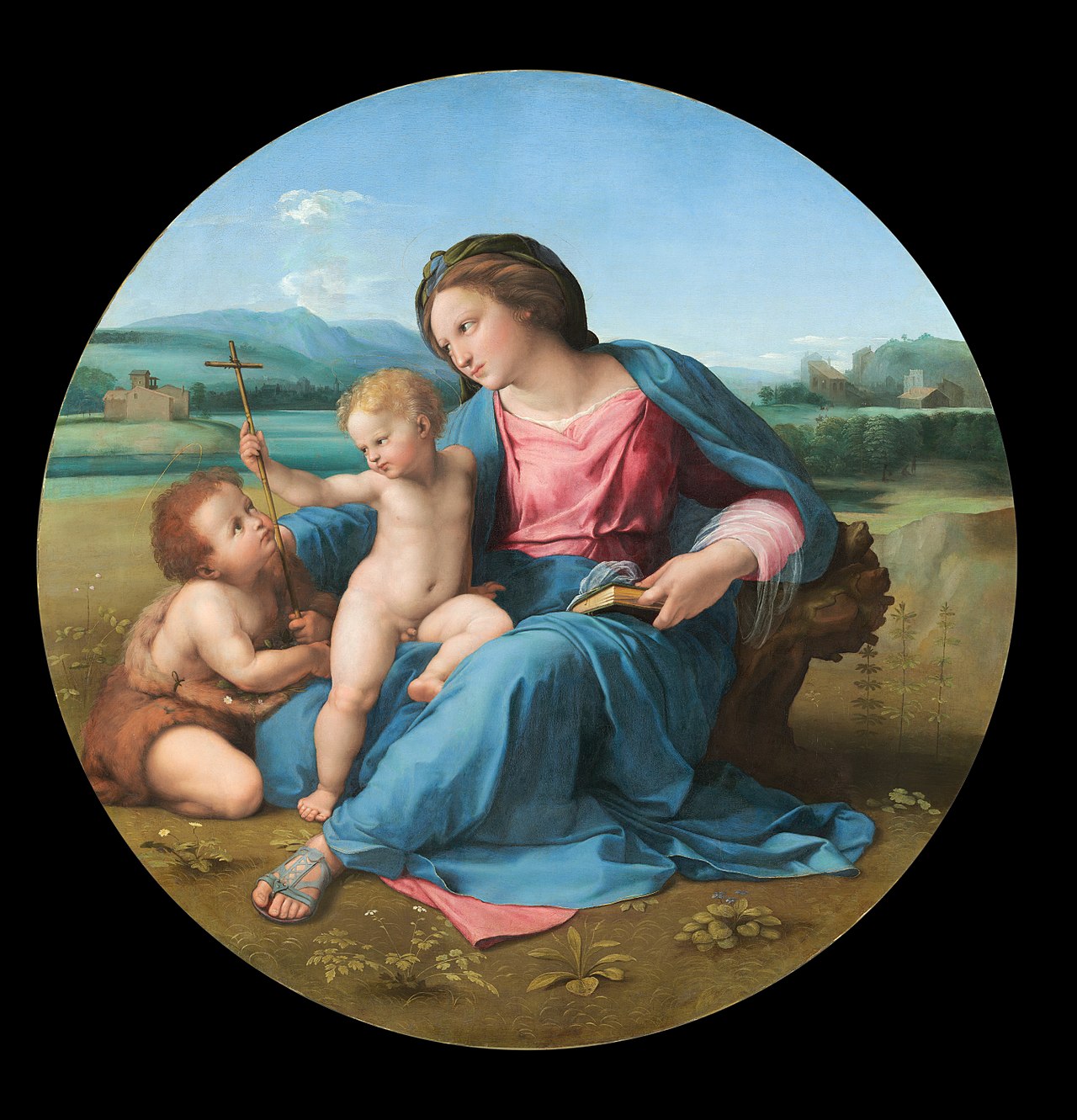
Raphael resolves the difficult circular (tondo) format through a stable pyramidal composition: the Virgin's body forms a broad triangle whose apex is her head, anchoring the three figures in serene equilibrium. She sits directly on the ground in a real landscape with a distant horizon — no gold, no hierarchy of scale, only weighted bodies in measurable space. Harmony here is not decoration; it is the Renaissance conviction that the world is intelligible.
Notice how the round frame never feels awkward — the figures are engineered to fill it.
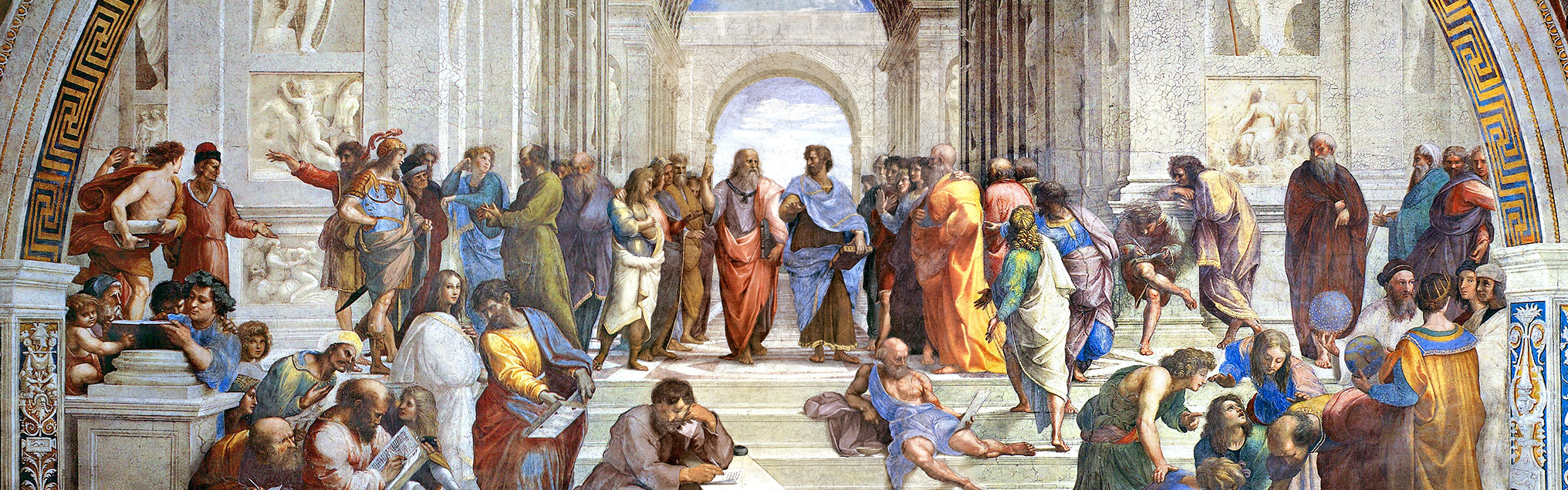
Find the vanishing point at the dead center of the composition, between Plato and Aristotle. Every architectural line — the coffered vaults, the floor tiles, the receding arches — converges on that single point, pulling your eye into a deep, rationally organized space. The philosophers of antiquity stand on a solid, measurable floor, gathered in an ideal humanist architecture where reason itself is given a stage.
Trace the ceiling arches with your finger — they all aim at the same spot. That spot is *you*, the positioned viewer.
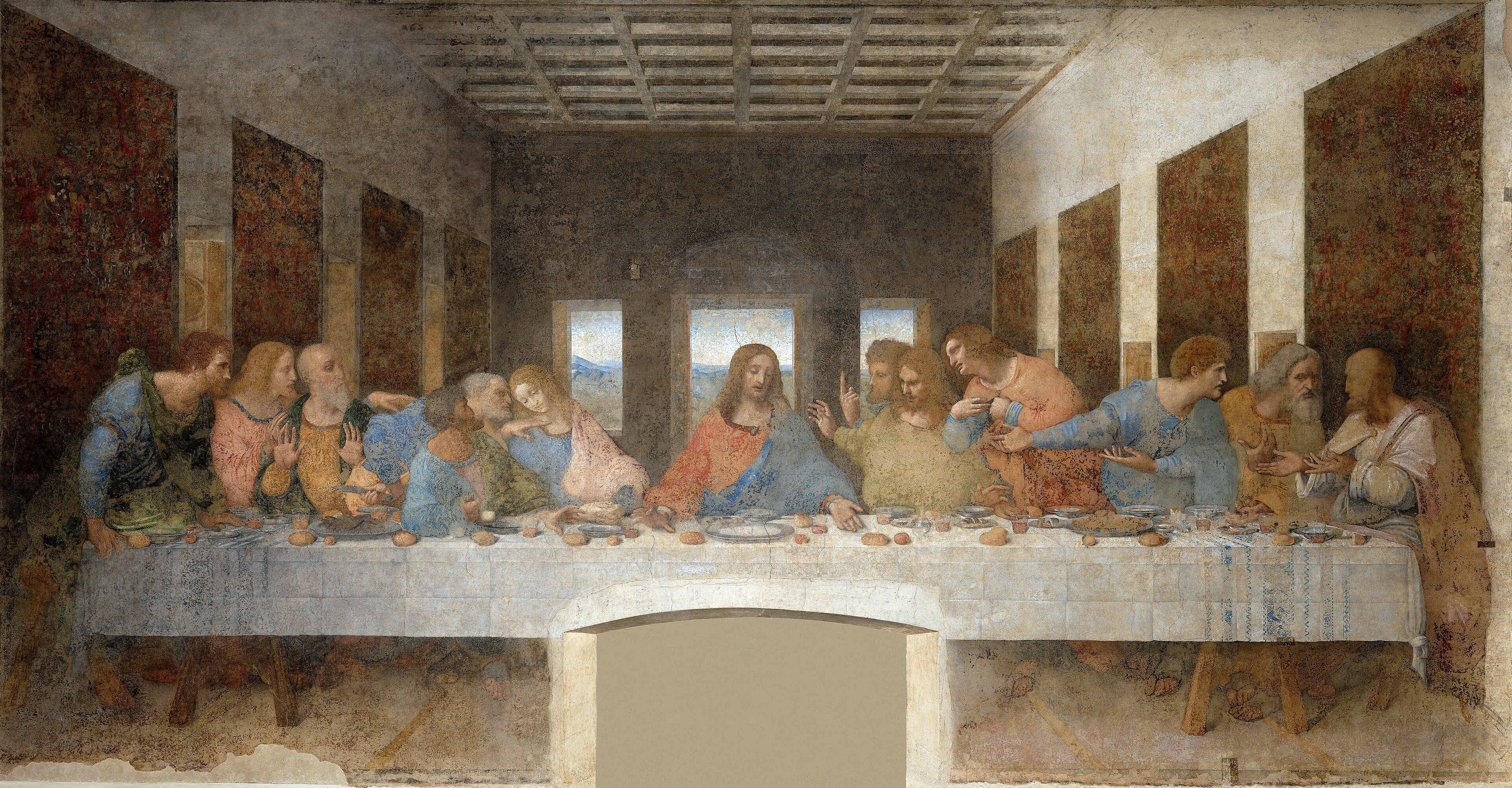
Light falls consistently from the left, matching the real windows of the refectory it was painted for, so that the painted room seems to extend the actual one. Those shadows confirm the solidity of every surface — table, wall, drapery, hands. Leonardo binds this naturalistic light to one-point perspective centered on Christ's head, making the calm at the center of a sudden emotional storm both a geometric and a luminous fact.
Follow the shadows: they all agree on where the light is. Nothing floats.
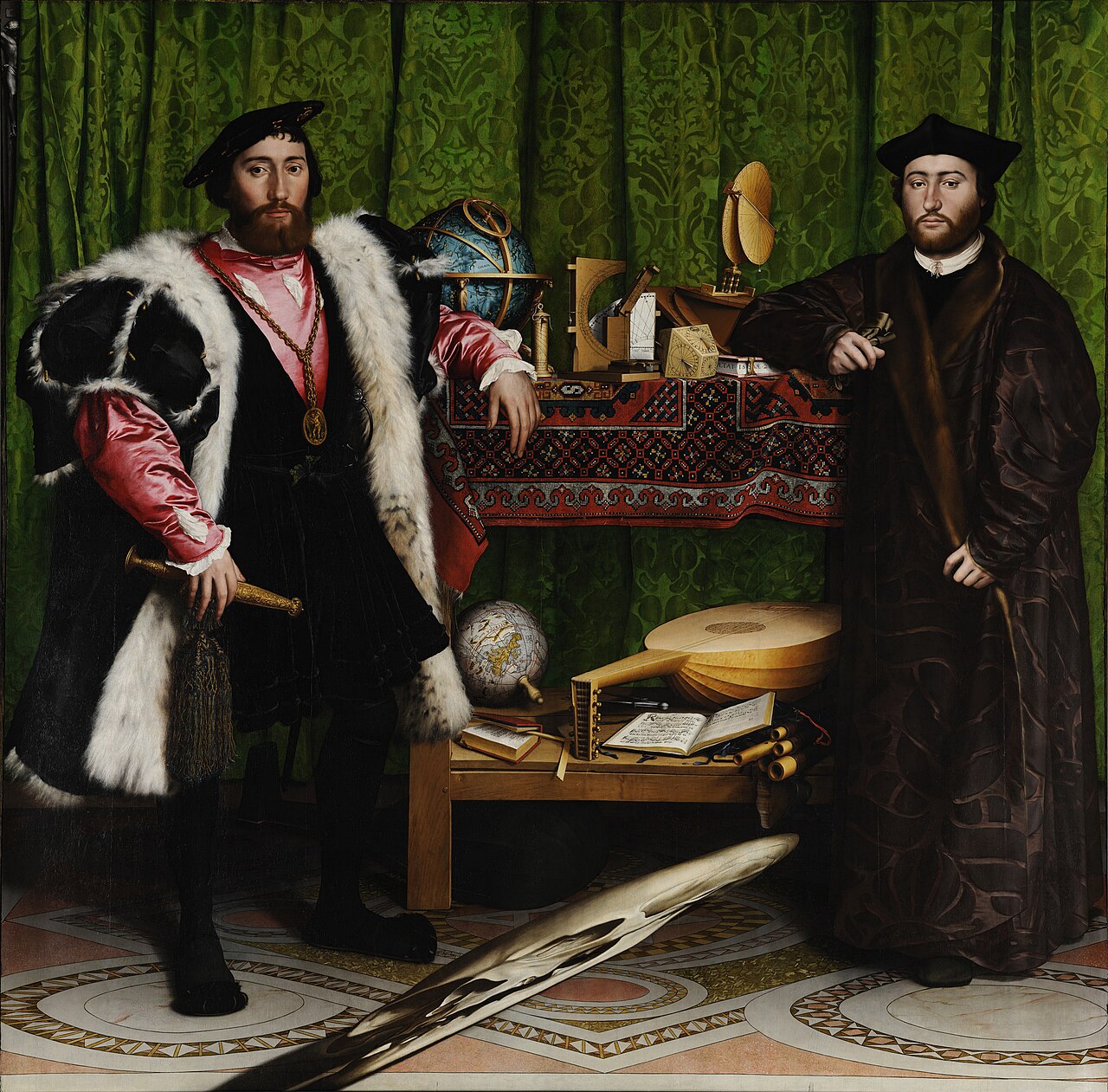
Take inventory of the objects on the lower shelf before looking at the figures — instruments of navigation, measurement, and music, the tools of the rational humanist world, each surface (silk, fur, wood, metal) rendered so precisely the brushwork vanishes. Then find the grey shape stretched across the foreground and try to resolve it. The perspective that organizes everything else cannot organize this shape; you have to abandon your own vantage point, step to the side, and only then does the skull snap into focus.
The flawless surface that renders the world also hides a death's-head in plain sight. Legibility has a limit.