Introduction
Medieval sculpture served architecture. Figures filled the portals of cathedrals, populated the capitals of columns, and illustrated biblical narratives on tympanums, but they did so as part of a larger program, subordinated to the building’s theological and structural purposes. The Renaissance reclaims sculpture as an independent art form capable of making its own claims about the world. The freestanding human figure returns for the first time since antiquity, and with it comes a new set of questions: What can a body say? How much can marble feel? What does it mean to sign your name to a work of stone?
These questions produce some of the most powerful objects in Western art. They resonate directly with Hamlet, a play that continually interrogates what it means to be a human being in possession of a body, a name, and a will.
Body & Volume
How does the sculpture render the human body in three dimensions — idealized, naturalistic, fragmented, abstracted?
The recovery of the classical body is the Renaissance’s foundational sculptural act. ’s David (c. 1440s) is the first freestanding nude figure in European sculpture since antiquity — a startling, almost uncanny object in its moment. It is not the body of a warrior but of an adolescent: slight, relaxed, one hip dropped in contrapposto, Goliath’s head already under his foot. The victory is over. The boy stands in the aftermath, self-possessed in a way that feels almost indifferent, his gaze downward, the drama resolved before we arrived.
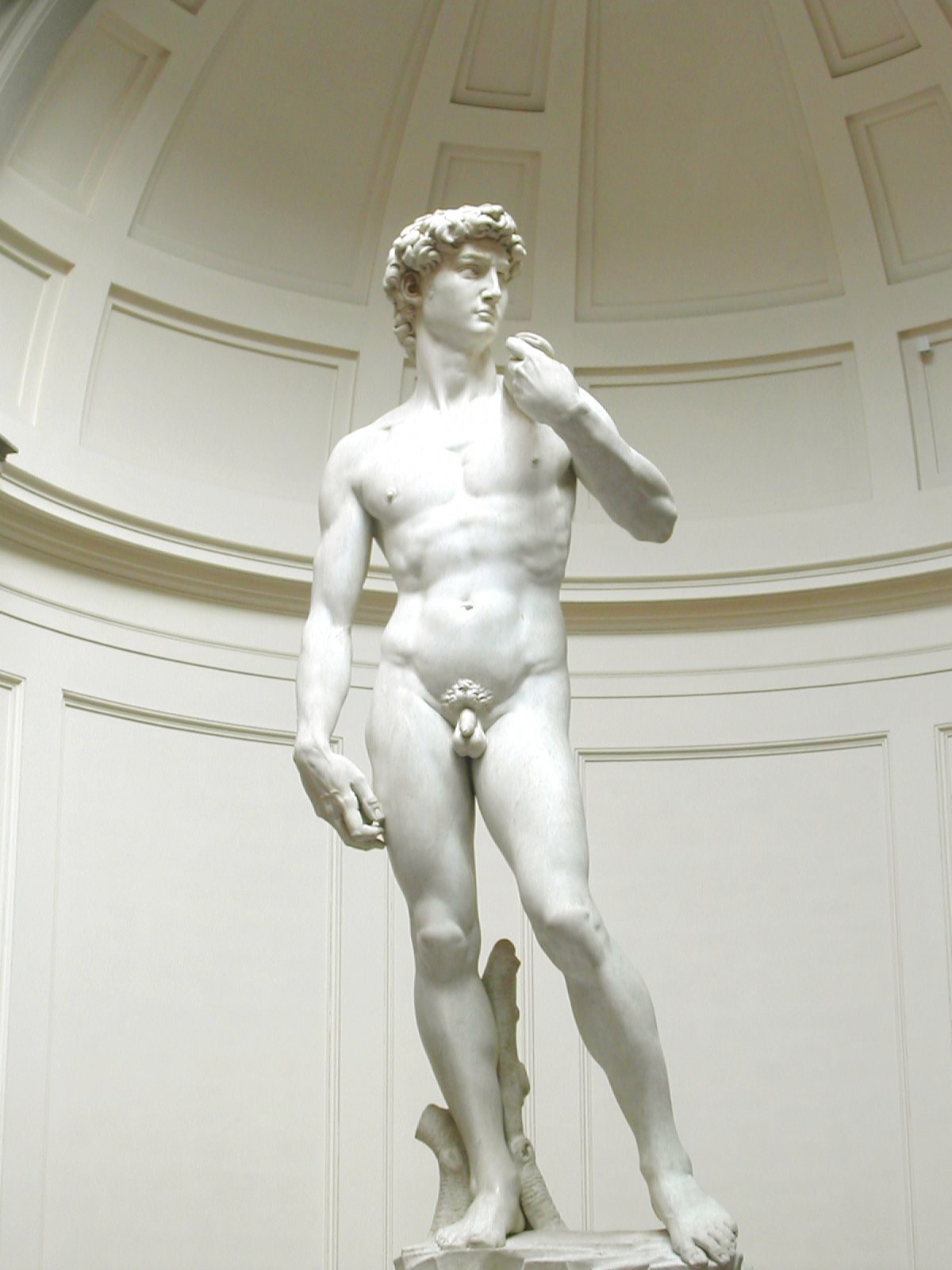
Michelangelo’s David (1504) makes a radically different temporal choice. Here the figure is depicted pre-action: colossal, taut, the gaze fixed on a point just off to the left where Goliath presumably stands. Every muscle is articulated with anatomical precision — the veins in the hand, the tension across the shoulders, the weight shifted onto the right leg. Yet the body is not yet moving. This David holds the instant of decision, the moment when the will is fully committed but the act has not yet begun. It is the most concentrated image of human agency produced by the Renaissance.
Connection to Hamlet
Hamlet’s famous meditation — “What a piece of work is a man, how noble in reason, how infinite in faculties, in form and moving how express and admirable” — is the verbal equivalent of Michelangelo’s insistence on the human body’s extraordinary dignity and capability. Hamlet in his soliloquy immediately undercuts himself: “and yet, to me, what is this quintessence of dust?” The Pietà gives that undercutting a physical form. Christ’s body, draped across Mary’s lap, conveys the specific weight and reality of corporeal death, a body magnificent and beautiful enough to inspire universal mourning.
Material & Making
What does the choice of material say about the work’s ambitions and its culture?
The Renaissance sculptor works primarily in two materials: marble and bronze. Each carries its own set of ambitions. Marble is the material of antiquity, the classical tradition the Renaissance is consciously recovering — but it is also significantly harder than the limestone medieval cathedral sculptors worked in, and far less forgiving. A mistake that might be corrected in limestone can shatter marble. Working it demands individual mastery in a way that large-scale workshop carving of softer stone does not. famously claimed that he simply removed the excess marble to reveal the figure already inside — a statement that captures the period’s conviction that artistic genius is a form of perception, not merely of craft. The hardness of the material is part of what makes that claim meaningful: only an exceptional individual hand could do this.
Bronze is technically more forgiving but culturally more assertive: it is the material of ancient civic monuments, of the equestrian statues of Roman emperors. To cast a freestanding figure in bronze is to assert that this subject deserves the same dignity as a Caesar. That Donatello makes this claim for a slight adolescent boy rather than a general or a saint is itself a statement about where the Renaissance locates human dignity.
The period also introduces another significant innovation: the named maker. Medieval sculptors were largely anonymous, their identities subsumed into the workshop and the cathedral program. Michelangelo’s signature runs across the strap of the Virgin’s robe in the Pietà — a young sculptor from Florence asserting, in the heart of Rome, that the work is his, and his alone. This is not vanity but a new cultural claim: the individual artist’s vision is the work’s meaning.
Connection to Hamlet
Shakespeare’s play is full of questions about authorship and attribution — who wrote the play-within-the-play, who authored the current situation at Elsinore, whose interpretation of events is authoritative. Hamlet himself is obsessed with authenticity. Michelangelo signing the Pietà and Hamlet demanding that his grief be recognized as real (“I know not ‘seems’”) are gestures from the same cultural moment.
Space & Setting
Where does the sculpture live, and how does placement shape meaning?
Both of Michelangelo’s major works in this gallery were made for specific public contexts that shaped their meaning. The David was commissioned for the Florence Cathedral but ultimately placed in the Piazza della Signoria — the civic heart of the republic — where it stood as a symbol of Florentine defiance, the small city facing down the colossal powers arrayed against it. The figure’s size (seventeen feet) was calculated to be read from below and at a distance, in the open air of a public square rather than the intimate scale of a gallery.
The Pietà was made for a very different setting: a cardinal’s funeral chapel in St. Peter’s Basilica. Where the David dominates civic space, the Pietà occupies a sacred space. The intimacy of the group (the Virgin’s lap cradling the full-grown body of her son) creates a scale that feels private, almost unbearably close, even when viewed in a vast basilica. The human figure belongs equally to the piazza and the chapel, to public life and to grief.
Connection to Hamlet
Hamlet is a play acutely aware of settings and the meanings they impose. The court is a theater of surveillance; the graveyard is the one space where the play’s pretenses fall away; the stage on which the players perform is a trap for a king. The Pietà’s placement in a funeral chapel resonates with the play’s graveyard scene, where Hamlet holds Yorick’s skull and confronts the body stripped of everything — name, performance, significance — that made it human. Both Michelangelo and Shakespeare represent the body in death as a site of irreducible meaning.
Looking Back
Medieval sculpture, for all its expressive power, subordinates the individual body to a larger program. The figures on the Chartres portal are not quite people; they are presences arranged in a theological hierarchy, their bodies elongated and stylized to convey spiritual meaning rather than physical reality. The Renaissance refuses this subordination. The David insists on bodily specificity — this particular body, these particular muscles, this particular moment — as the primary vehicle of meaning. What the medieval sculptor hid in symbol and hierarchy, Michelangelo exposes in anatomy.
Looking Forward
The Baroque will take the Renaissance body and subject it to forces it cannot contain. Where Michelangelo’s David holds its energy in perfect suspension, Bernini’s David releases it — the body in mid-action, the sling already moving, the face set in fierce concentration. Where the Pietà holds grief in a composition of almost impossible balance and stillness, Baroque sculpture will make grief writhe and transform. The Renaissance has established what the human body can do and be in marble; the Baroque will explore what that body looks like when its possibilities are pushed to their limit.
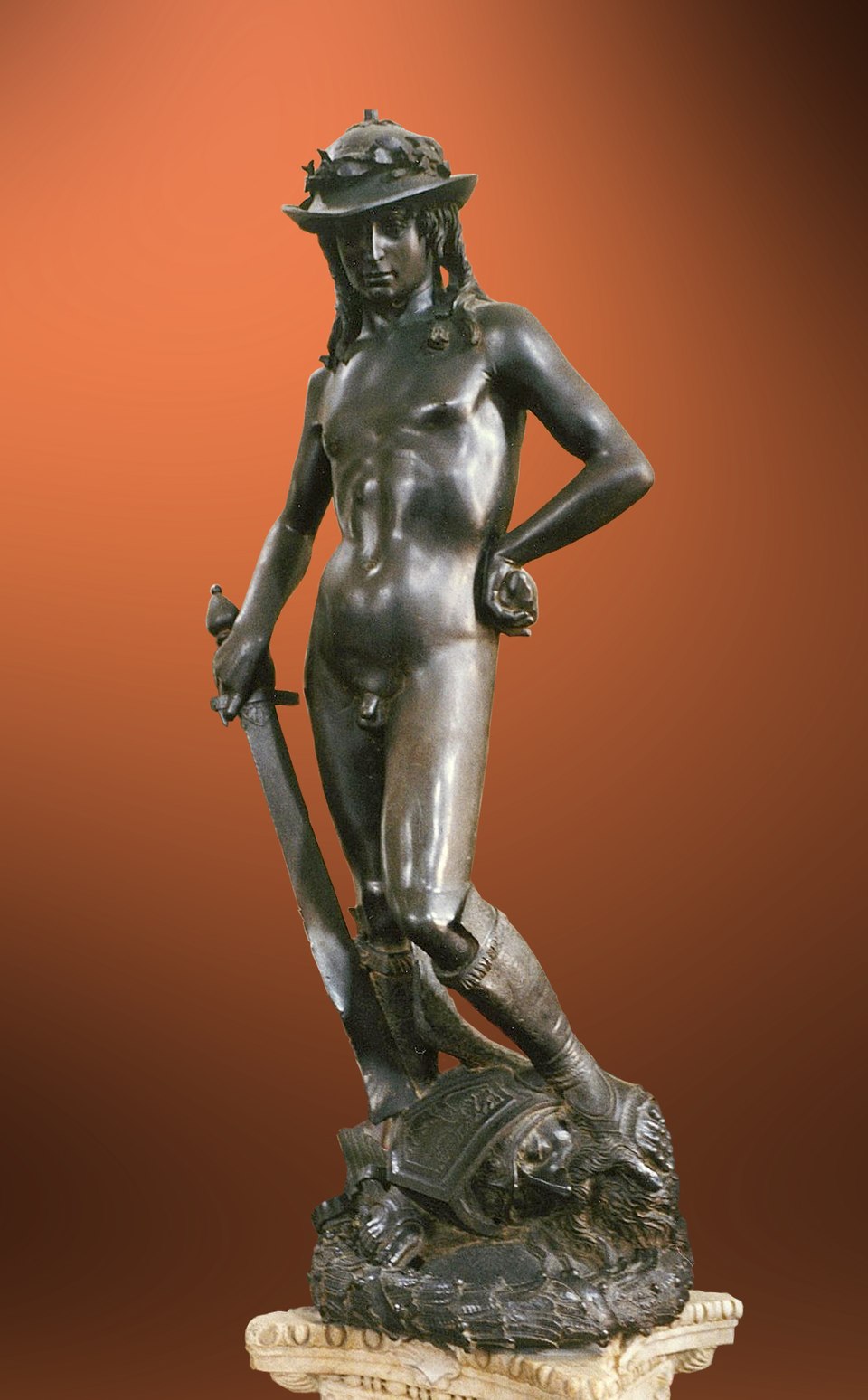
Notice the absence of effort, heroism, or drama. The boy simply stands, the giant's head beneath his heel, an expression of mild unconcern on his face. Cast in bronze — the material of ancient civic monuments and imperial statues — this claim of imperial dignity is made not for a general or a saint but for a slight, nude adolescent. It is a strange and disquieting image of power, and the first freestanding nude since antiquity.
The victory is already over. Donatello sculpts the eerie calm of the aftermath, not the heroics of the fight.
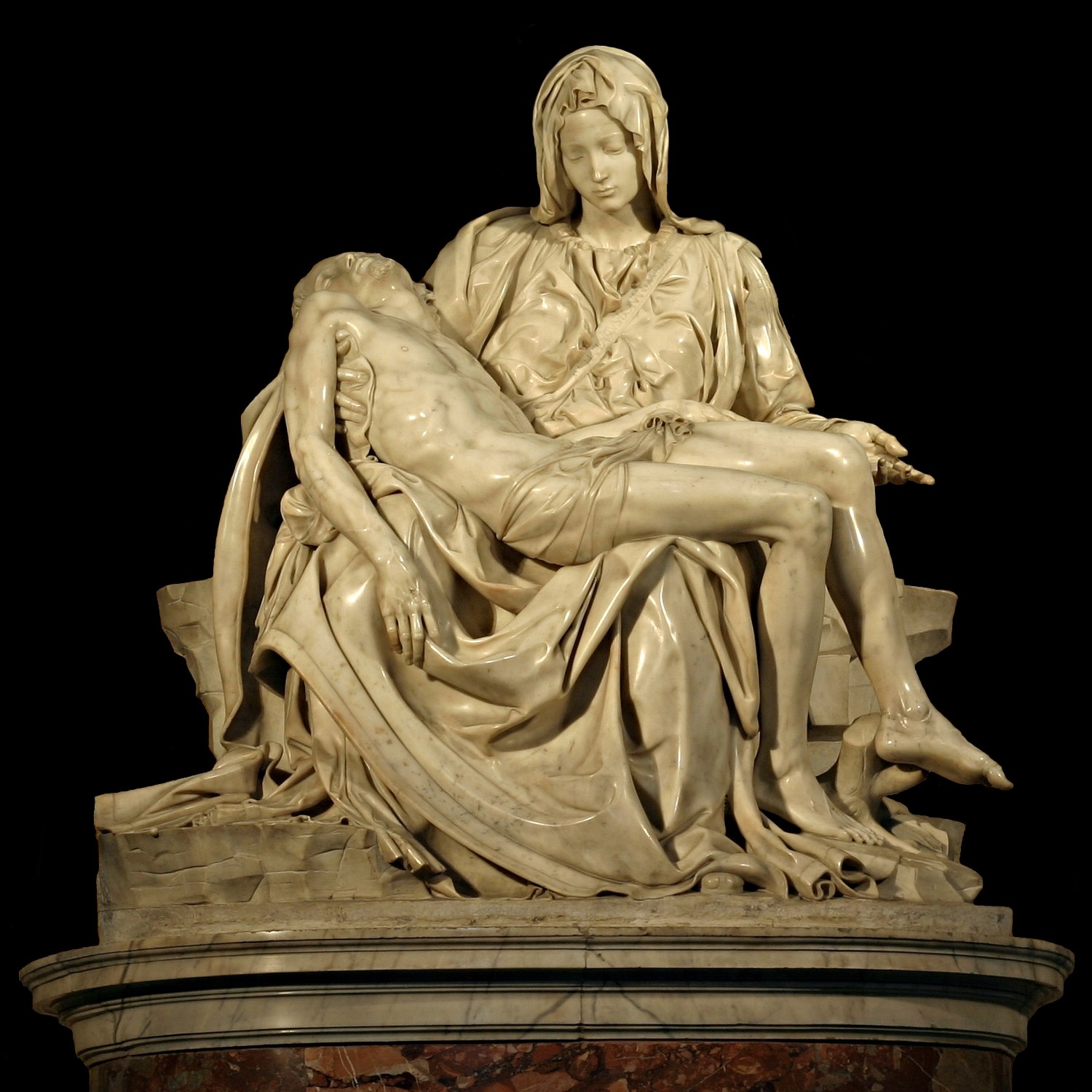
Look at the Virgin's face — serenely, impossibly young (Michelangelo said purity does not age) — then at her lap, engineered wider than anatomy allows to hold the full weight of the adult body draped across it. Now find the strap crossing her robe: it carries Michelangelo's signature, the only work he ever signed. Christ's body conveys the specific weight of corporeal death with a tenderness that makes the marble seem warm.
The one sculpture Michelangelo ever signed — carved into the Virgin's sash, a genius asserting authorship in the heart of Rome.